
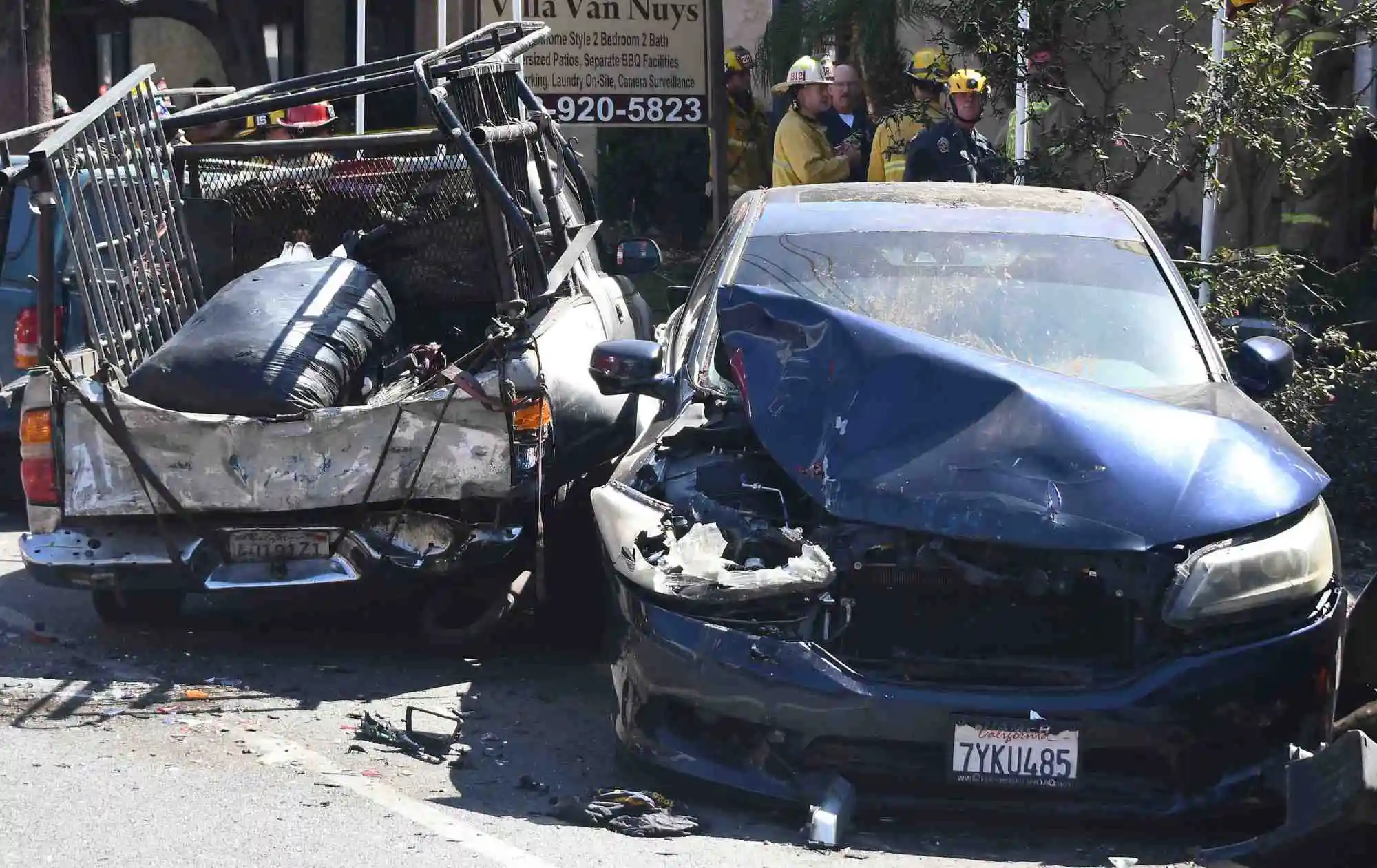
Playing it safe
According to the National Highway Traffic Safety Administration, the U.S. driving season typically peaks in July and August.
Read more Corky: When life hands you a broken board, you use a lot of resin to make it yours
The National Highway Traffic Safety Administration has been involved in vehicle safety improvements for decades. NHTSA sets and enforces safety standards, and it develops innovative approaches to vehicle safety — such as the New Car Assessment Program. NCAP, expanded in 1993 to include the 5-Star Safety Ratings system, marked 40 years in 2019. Here’s some NHTSA information that looks at some overall vehicle safety improvements that have made cars safer over a century.

The history of crash test dummies began in the 1940s, when they were developed for the U.S. Air Force to use in the testing of aircraft ejection seats.
In 1968, Samuel Alderson’s research company debuted the first crash test dummy designed specifically for automotive testing. It was known as the VIP, short for “vehicular impact personnel.”
Alderson went into the National Inventor’s Hall of Fame in 2013. He died in 2005 at age 90 in Marina del Rey.
“You can learn a lot from a dummy,” is the famous tagline of a popular NHTSA safety campaign that began in 1985 urging people to wear their seat belts. Vince and Larry, the crash test dummies, encouraged seat belt use through TV, print and radio ads. Vince and Larry have been inducted into the Smithsonian Institution’s Museum of American History as part of an exhibit on the evolution of automobile safety – along with authentic crash test dummies.
Air bag recall
In 2014, tens of millions of vehicles with Takata air bags were recalled. Long-term exposure to high heat and humidity can cause these air bags to explode when deployed. Such explosions have caused injuries and deaths.
In 2024, Carfax data showed that more than 6 million vehicles still had unfixed recalls to replace those inflators. In 2026, data shows roughly 4.8 million vehicles still needing to be fixed.
Recall search
Search vehicles, car seats, tires and other equipment for safety recalls, investigations, complaints and manufacturer communication on the NHTSA site, search words: check for recalls
You can reach the site here.
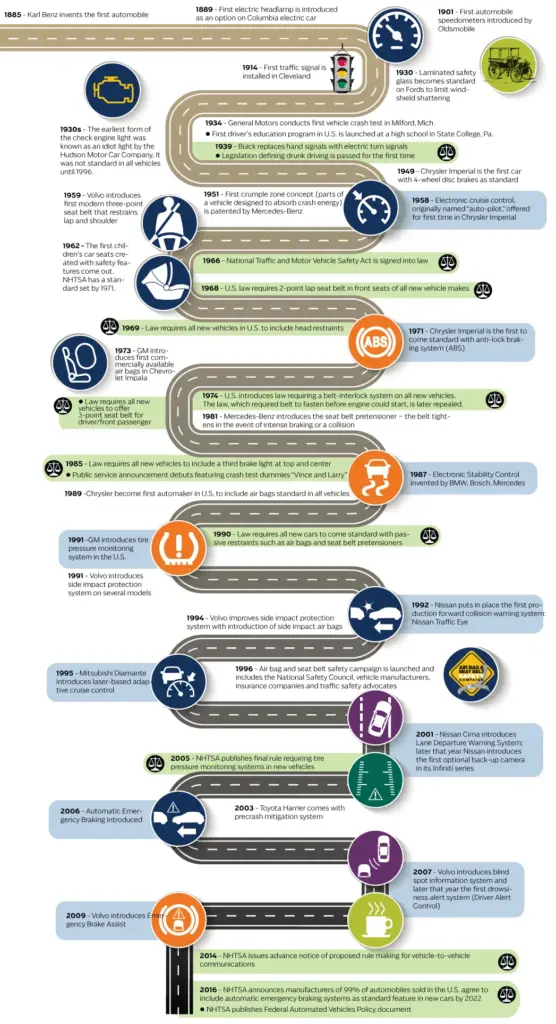
Car safety history
1885 – Karl Benz invents the first automobile
1889 – First electric headlamp is introduced as an option on Columbia electric car
1901 – First automobile speedometers introduced by Oldsmobile
1914 – First traffic signal is installed in Cleveland
1930 – Laminated safety glass becomes standard on Fords to limit windshield shattering
1930s – The earliest form of the check engine light was known as an idiot light by the Hudson Motor Car Company. It was not standard in all vehicles until 1996.
1934 – General Motors conducts first vehicle crash test in Milford, Mich. | First driver’s education program in U.S. is launched at a high school in State College, Pa.
1939 – Buick replaces hand signals with electric turn signals | Legislation defining drunk driving is passed for the first time
1949 – Chrysler Imperial is the first car with 4-wheel disc brakes as standard
1951 – First crumple zone concept (parts of a vehicle designed to absorb crash energy) is patented by Mercedes-Benz
1958 – Electronic cruise control, originally named “auto-pilot,” offered for first time in Chrysler Imperial
1959 – Volvo introduces first modern three-point seat belt that restrains lap and shoulder
1962 – The first children’s car seats created with safety features come out. NHTSA has a standard set by 1971.
1966 – National Traffic and Motor Vehicle Safety Act is signed into law
1968 – U.S. law requires 2-point lap seat belt in front seats of all new vehicle makes
1969 – Law requires all new vehicles in U.S. to include head restraints
1971 – Chrysler Imperial is the first to come standard with anti-lock braking system (ABS)
Read more LAZ Parking laying off 247 workers as LAX moves to People Mover
1973 – GM introduces first commercially available air bags in Chevrolet Impala
1974 – U.S. introduces law requiring a belt-interlock system on all new vehicles. The law, which required belt to fasten before engine could start, is later repealed.
1981 – Mercedes-Benz introduces the seat belt pretensioner − the belt tightens in the event of intense braking or a collision
1985 – Law requires all new vehicles to include a third brake light at top and center | Public service announcement debuts featuring crash test dummies “Vince and Larry”
1987 – Electronic Stability Control invented by BMW, Bosch, Mercedes
1989 – Chrysler become first automaker in U.S. to include air bags standard in all vehicles
1990 – Law requires all new cars to come standard with passive restraints such as air bags and seat belt pretensioners
1991 -GM introduces tire pressure monitoring system in the U.S.
1991 – Volvo introduces side impact protection system on several models
1992 – Nissan puts in place the first production forward collision warning system: Nissan Traffic Eye
1994 – Volvo improves side impact protection system with introduction of side impact air bags
1995 – Mitsubishi Diamante introduces laser-based adaptive cruise control
1996 – Air bag and seat belt safety campaign is launched and includes the National Safety Council, vehicle manufacturers, insurance companies and traffic safety advocates
2001 – Nissan Cima introduces Lane Departure Warning System; later that year Nissan introduces the first optional back-up camera in its Infiniti series
2003 – Toyota Harrier comes with precrash mitigation system
2005 – NHTSA publishes final rule requiring tire pressure monitoring systems in new vehicles
2006 – Automatic Emergency Braking introduced
2007 – Volvo introduces blind spot information system and later that year the first drowsiness alert system (Driver Alert Control)
2009 – Volvo introduces Emergency Brake Assist
2014 – NHTSA issues advance notice of proposed rule making for vehicle-to-vehicle communications
2016 – NHTSA announces manufacturers of 99% of automobiles sold in the U.S. agree to include automatic emergency braking systems as standard feature in new cars by 2022 | NHTSA publishes Federal Automated Vehicles Policy document
2018 – Backup cameras became a standard feature in vehicles. Cameras have also evolved to have backup sensors
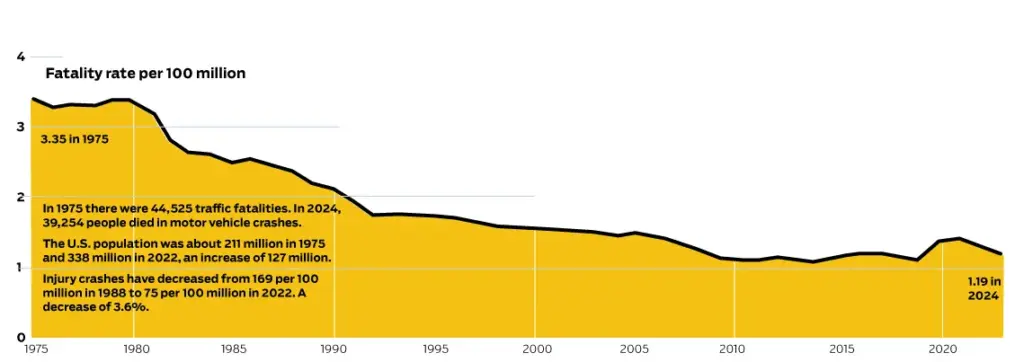
Fatality rate per 100 million
3.35 in 1975
1.19 in 2024
In 1975 there were 44,525 traffic fatalities. In 2024, 39,254 people died in motor vehicle crashes.
The U.S. population was about 211 million in 1975 and 338 million in 2022, an increase of 127 million.
Injury crashes have decreased from 169 per 100 million in 1988 to 75 per 100 million in 2022. A decrease of 3.6%.
Sources: National Highway Traffic Safety Administration, U.S. Department of Transportation, University of Iowa, National Safety Council
Read more Homicides dropped 18.1% in 2025 to the lowest rate since 1956, FBI says