
Lithium-ion battery fires can continue generating heat and reignite even after flames and smoke have disappeared.
Read more Lakers transition from ‘LeBron Era’ to a Luka Doncic-led squad
So while temperatures inside two fire-damaged lithium-ion battery storage units at a Metropolitan Water District facility had stabilized by Thursday afternoon, hundreds of nearby residents remained under evacuation orders as crews worked to make the batteries safe.
Firefighters must cool the batteries enough to keep heat from triggering additional cells while determining when the systems are stable enough to safely approach, de-energize and eventually dismantle and remove them.
A lithium-ion cell can enter thermal runaway, a self-sustaining reaction that rapidly releases heat and energy, said Jon M. Williams, CEO of Viridi, a battery energy storage company.
The larger problem occurs when the heat triggers surrounding cells, a process known as propagation.
“The one cell is the size of a double-A battery sometimes, but it’s the 5,000, 10,000, 15,000 cells next to it that it chain-reacts into,” Williams said. “So there’s thermal runaway, which is an individual cell, and then there’s propagation.”
At the La Verne facility, firefighters have repeatedly poured water onto the damaged battery systems, then stopped the streams and monitored temperatures to determine whether the units could remain stable without continuous cooling.
On Wednesday, temperatures rose again after crews stopped the water. One section of the unit that initially caught fire Tuesday climbed to about 300 degrees, while the adjacent unit also experienced a temperature increase, prompting firefighters to resume cooling.
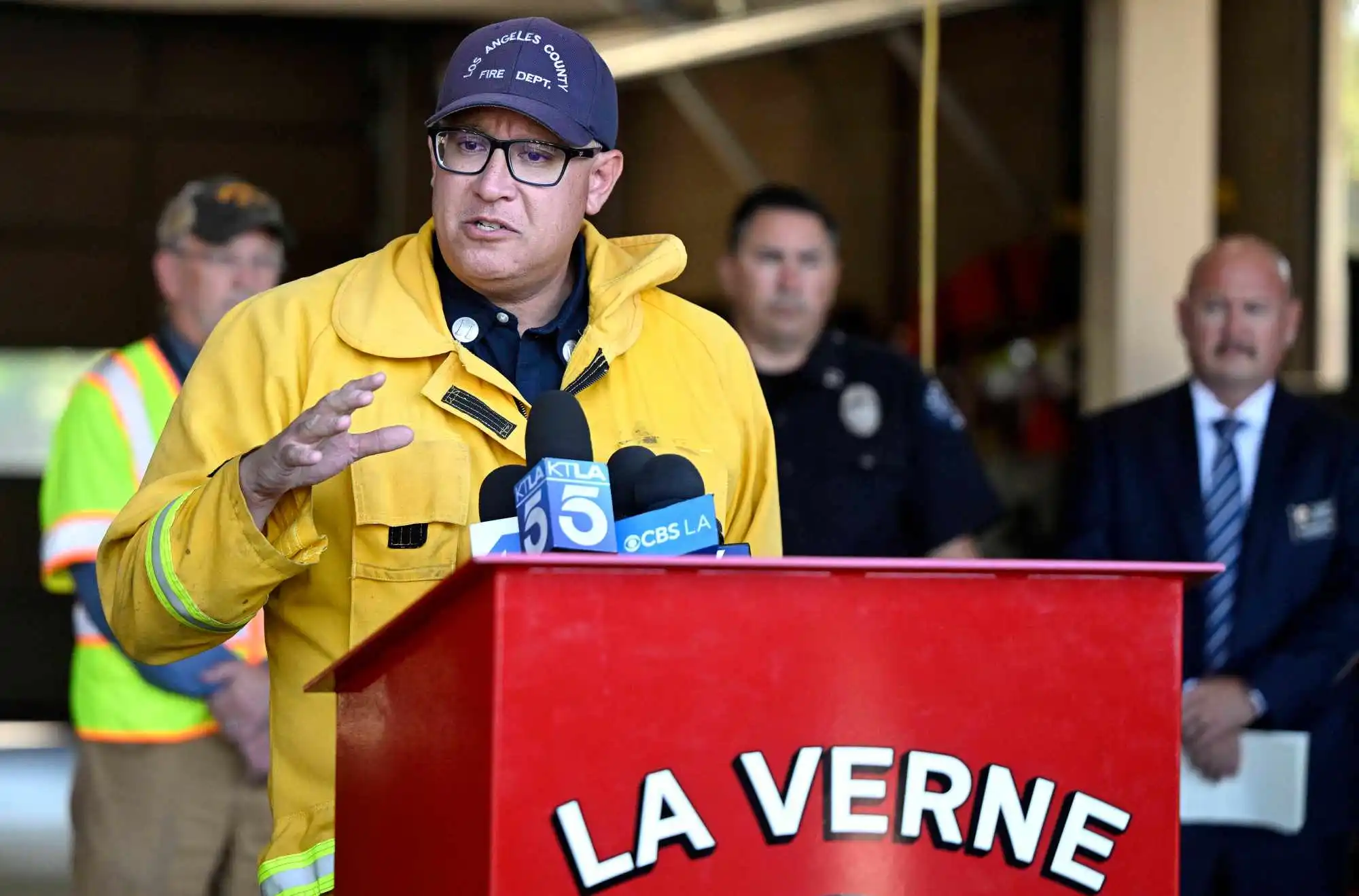
By Thursday afternoon, crews had stopped the water for about three hours. The temperature in the second unit rose to about 150 degrees but stabilized, allowing specialists to approach the batteries and begin the process of de-energizing them, La Verne Fire Chief Brandon Coatney said.
Water is particularly effective on lithium-ion battery fires because its role extends beyond extinguishing visible flames, Williams said.
“It’s really not the water putting the fire out,” he said. “It’s the water absorbing the heat and transferring that heat away from the fire.”
The challenge is removing enough heat from the entire battery system, including cells firefighters cannot immediately reach.
“You really have to get enough water around it that it almost acts like a radiator,” Williams said. “It continues to pull the heat away until you get it to a stable point.”
Judy Jeevarajan, vice president and distinguished scientific advisor at UL Research Institutes, has worked in battery safety for more than 25 years and previously led battery safety and advanced technology work at NASA’s Johnson Space Center.
Jeevarajan said firefighters need to cool the cells themselves, rather than simply the exterior of the system. If cells remain hot, that heat can continue spreading and trigger additional thermal runaway.
Read more Man who was shot during 2024 Trump campaign rally in Butler, Pennsylvania, has died
“The heat can linger and reignite days, even weeks later,” Jeevarajan said. “All cells must be brought to room temperature.”
Lithium-ion cells and larger battery systems typically incorporate safeguards, including electronic monitoring and vents designed to release built-up gases, Williams said.
At the cell level, systems can be designed to interrupt electrical faults and vent gases if a cell begins overheating. Larger battery arrays also can include ventilation and other measures intended to manage a failure.
But once a cell enters thermal runaway, the rapid release of heat and energy can overwhelm those safeguards, Williams said.
“The challenge is simply that there is a tremendous amount of energy in those arrays,” he said.
That stored energy is one reason firefighters cannot necessarily treat the incident like a conventional structure fire once the visible flames are gone.
In a remote location, allowing a lithium-ion battery to burn and consume its remaining energy can sometimes be an option, Coatney said. He said Wednesday that firefighters could take that approach if the La Verne batteries were “in the middle of nowhere.”
But the Metropolitan facility is surrounded by neighborhoods, and officials have said an uncontrolled fire could produce smoke and hazardous vapors that could travel into surrounding areas.
Instead, firefighters have worked to control the heat while monitoring the systems until specialists can safely approach them.
Coatney said the first unit was largely consumed by the original fire, leaving melted components behind, but officials believe some energy could still be stored in the system.
Once the batteries are de-energized and no longer producing concerning levels of heat or hazardous vapors, officials have said they can be dismantled and transported to a hazardous waste facility for disposal.
The cause of Tuesday’s fire remains under investigation.
The two battery storage systems were installed within the past 18 months and placed into service in June, Metropolitan officials said.
Williams said battery safety technology increasingly focuses not only on detecting a failing cell and shutting down a system but also on preventing heat from a failing cell from spreading to neighboring cells.
“We should be able to have batteries, and we should be able to have safe batteries,” Williams said.
Read more LA lawmakers hopeful that a federal film tax incentive could become law by year’s end