
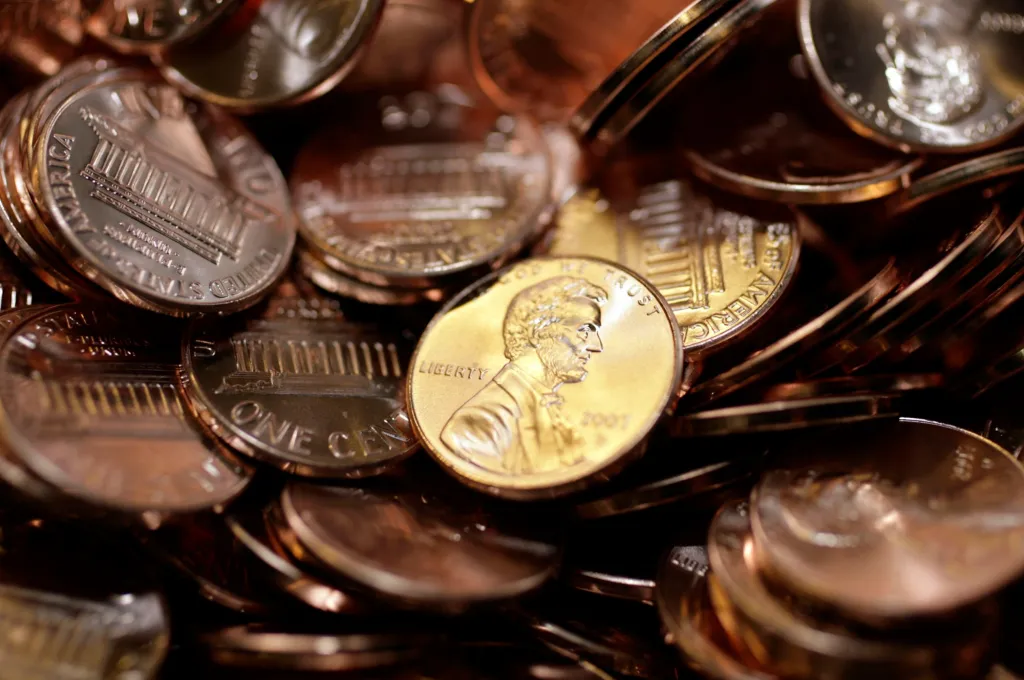
A penny for your thoughts? Those could soon cost a nickel — if you’re paying cash.
Read more USC’s Space Engineering Research Center open house’s mission: Connect with local industry
The U.S. House on Tuesday, July 14, by a unanimous voice vote, passed a bill from Reps. Robert Garcia, D-Long Beach, and Lisa McClain, R-Michigan, that legally ends the production of the penny and sets a federal standard allowing businesses to round prices to the nearest nickel for cash transactions.
Related: Killing the penny shortchanges the poor, UC Irvine professor says
The U.S. Mint already stopped penny production late last year, through a determination made by Treasury Secretary Scott Bessent. But the bipartisan “Common Cents Act” formally ceases the penny production.
With the focus on government waste being so large in recent years, Garcia said, it’s “common sense that we should stop making a coin that costs nearly four times more than it’s worth to produce.”
“At a time when we should be focused on improving government efficiency, ending penny production is an obvious place to start,” Garcia said in a statement.
McClain said the federal government’s spending problems show up “in places big and small.”
“If the federal government is spending more to make a penny than the penny is worth, something is broken. House Republicans are proving that common sense still has a place in government by cutting waste and protecting taxpayer dollars,” she said.
When the U.S. Mint halted production of the penny late last year, it cost 3.69 cents to produce the zinc and copper coins. That’s up from a production cost of 1.3 cents per penny a decade ago, according to the Treasury Department.
The Mint projected an “immediate annual savings” of $56 million when production ceased.
When it was announced that penny production would stop, many businesses already began rounding cash transactions to the nearest nickel.
Read more Ex-captain pleads guilty to drugging and raping a US Merchant Marine Academy cadet on a cargo ship
Garcia and McClain’s bill, if passed by the Senate and signed by President Donald Trump, would establish the five-cent rounding practice as a federal standard.
There were roughly 114 billion pennies in existence as of December, but how long they remain in circulation “depends largely on consumer behavior,” the Treasury Department said. The Federal Reserve will continue to recirculate them for as long as possible
Garcia and McClain’s legislation would also allow the Treasury Department “the option to test a redesigned, lower-cost nickel that must ensure it saves money while continuing to work in vending machines,” according to Garcia’s press release.
Minting of the penny began in 1793. And though production has stopped, numismatic versions of the coin — those made for collectors — will continue to be made, the Mint said.
The Mint auctioned in November 232 three-coin sets of the last pennies minted. Sets contained a circulating penny from each of the Mint’s production facilities in Denver and Philadelphia, as well as a 24-karat gold uncirculated penny, also minted in Philadelphia.
The number of sets made was emblematic of how many years the penny was produced. According to ABC News, each set sold for an average value of over $72,000. The final set, no. 232, sold for about $800,000, according to the news outlet.
Some, however, say there will be unintended consequences to ceasing the penny’s production.
Bill Maurer, dean of the School of Social Sciences at UC Irvine, said last year that removing the penny would harm those who don’t use bank cards or digital payment options.
A key concern, Maurer said, is that when retailers round up charges to the nearest nickel, it doesn’t hurt those who have money. But over time, that change hurts poor, unbanked and underbanked customers, said Maurer, the director of UCI’s Institute for Money, Technology and Financial Inclusion.
Read more Ducks sign 1st-round pick Marcus Nordmark to 3-year deal
Pat Maio contributed to this report.