
Forget blue and red. Blue and pink might better describe the gap among California’s Latina and Latino voters, according to a new report.
Read more No. 14 USC football’s freshmen shine as Trojans blow by Louisiana
Released this month, the study by the UCLA Latino Policy & Politics Institute found that the Golden State’s Latina voters are likelier to embrace progressive politics and an anti-Donald Trump ethos than Latinos.
“These findings show why California’s Latino registered voters cannot be understood as a single political constituency,” G. Cristina Mora, a study co-author, sociology professor and co-director of UC Berkeley’s Institute of Governmental Studies, said in a news release.
Patterns revealed by the study deserve national attention, Nicholas Vargas, another study co-author, said in the release.
Parties competing for Latino voters “should not assume that Latinas and Latino men — or voters of the same age and educational background — are responding to the political environment in the same way,” said Vargas, an associate professor of Chicanx/Latinx studies at UC Berkeley.
One of the nation’s fastest-growing ethnic groups, Latinos are a crucial voting bloc in California and nationwide.
Traditionally, Latinos lean Democratic. That changed in 2024, when Trump won a substantial share of the Latino vote to take back the White House.
Polls show that Latinos, angry about inflation and the economy, are souring on Trump and favoring Democratic candidates ahead of the Nov. 3 midterm elections. That could influence races in Southern California and especially the Inland Empire, where a slight majority of residents are Latino.
Using data from a May poll of 1,912 voters in California, the study found that the gender gap in political attitudes among U.S. male and female voters extends to Latinos and Latinas.
California has a plurality of voters who are registered Democrats. California Latinas are registered as Democrats at higher rates than California Latinos, the study found.
Sixty-nine percent of Latina voters said protecting immigrant communities is very important, according to the study. Just 52% of Latinos said the same.
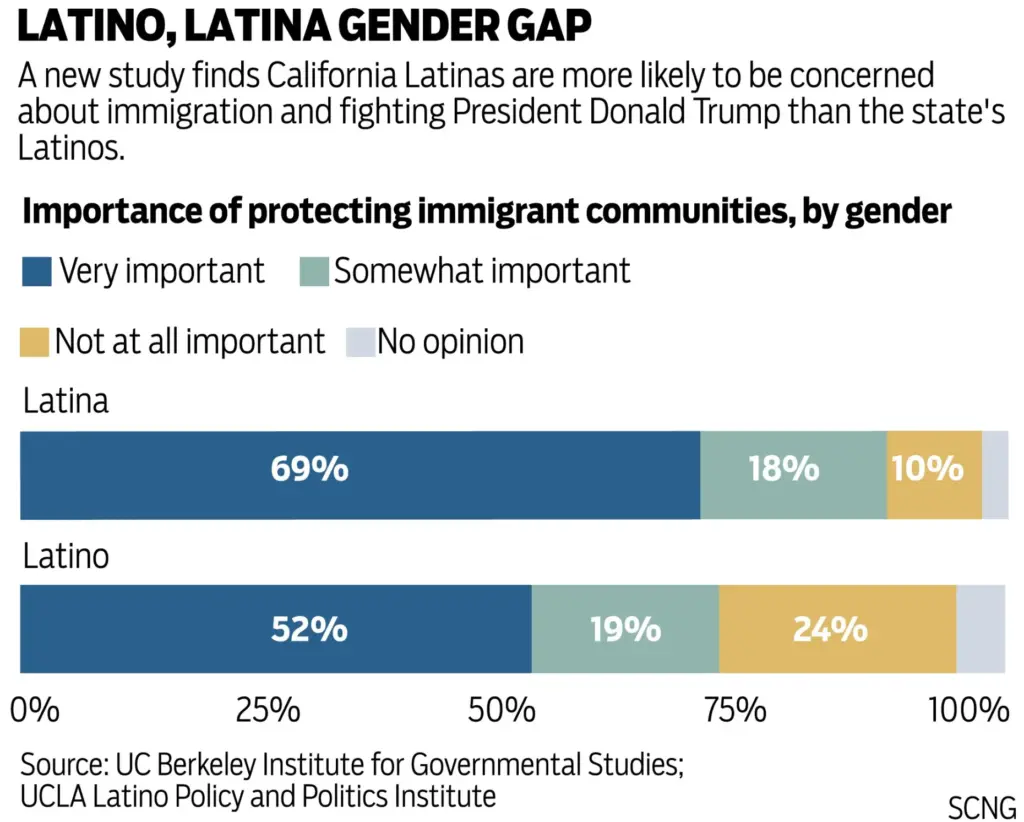
Latinas also are more likely to oppose Trump’s agenda. Almost seven out of 10 Latinas surveyed said fighting the White House is very important, compared to 51% of Latinos, the study found.
Majorities of both genders — 77% of Latinos and 87% of Latinas — said protecting democracy and voting rights is very important, the study read.
Read more Ryan Garcia stops Conor Benn in 2nd round to retain WBC welterweight title
The study also found differences based on age and education.
“Younger Latinas consistently express more progressive views than younger Latino men,” the study read. “In many cases, the differences between young Latinas and Latinos are substantially larger than those observed among older voters.”
Younger, non-college educated Latinas also might work in fields “that place them in contact with immigrant communities, such as child care, social services, or service work, inspiring their views on Trump and democracy,” the study states.
“It may also be that younger Latino men get their news and information from sources that differ dramatically from those of younger Latinas, or that their education and labor market experiences place them in positions where they are less likely to form progressive views.”
The gender gap narrows for Latinas and Latinos with four-year college degrees, the study found.
“In several cases, Latina and Latino college graduates express nearly identical levels of concern” about immigrants, Trump and protecting democracy and voting rights.
The study’s findings “have been evident for a decade,” Mike Madrid, a political strategist and expert on Latino voting behavior, said via email.”Latinos have the largest gender gap among all racial groups because we have the largest education gap among all groups.”
He added: “This trend line was first noticeable in 2016 at the time we also started to see a dramatic rise in the U.S. born population rising among adult Latinos. Latino adults, and thus voters, began growing as a larger share of the Latino electorate.”
As a result, there was “a commensurate rise in the number of Latinos attending and graduating from college and Latinos started to reflect the trends of the overall population,” Madrid said. “That meant the education divide that started to become characteristic of the American electorate was also defining Latinos.”
Madrid noted that college-educated voters “lean much more Democratic” while those without a college degree “lean much more Republican.”
“Latinas are more likely to attend and graduate from college than Latinos,” he said. “That gender gap is greater among Latinos than any other racial or ethnic group.”
Latino population changes “are manifesting themselves in Latino voting behavior and explain recent voting changes,” Madrid said. “Latinos are much more U.S. born. Latinas are going to college at rates bigger than men and voting more Democratic as a result.”
The gender gap also influences who gets elected, Madrid added.
“Latinos elect women to office at higher rates than any other ethnic group,” he said. “There are more female Latina legislators in Sacramento than Latinos.”
Read more Galaxy settle for draw with Sounders in playoff push