
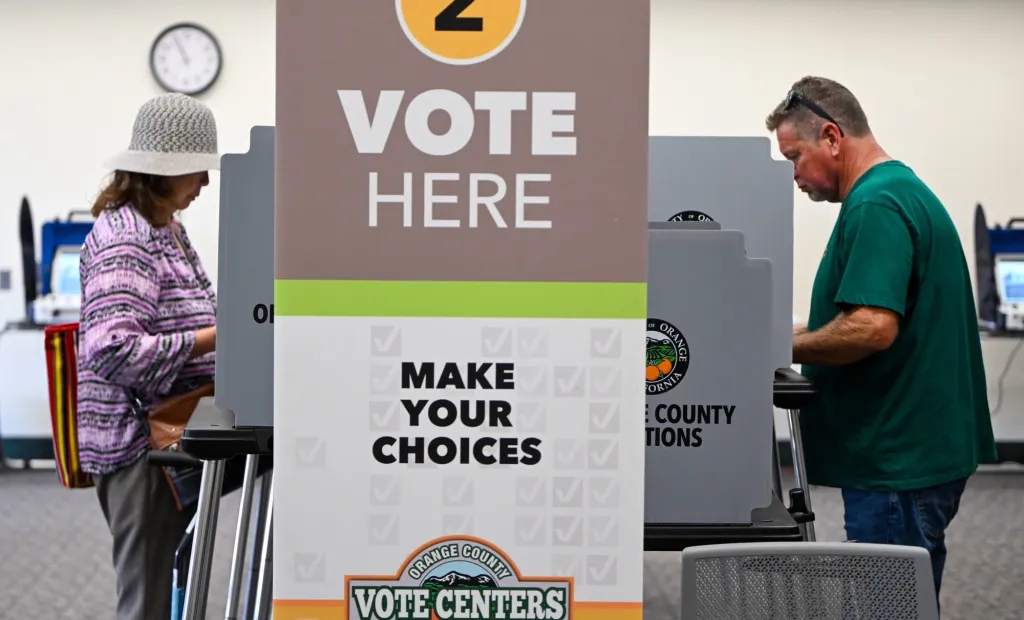
Huntington Beach is objecting to a recent court order that it adopt ranked-choice voting for City Council elections.
Read more You can cross those single, solid white lines on the freeway
Orange County Superior Court Judge Craig Griffin tentatively ruled last month that the city must implement the new voting method for the November midterms — making Huntington Beach potentially the first Orange County city to integrate a ranked-choice election.
In a July 10 filing, the city cited a letter from OC Registrar of Voters Bob Page that the county does not have a “state-certified voting system” to implement ranked-choice voting for November. Page also said the city would need to pay for software upgrades to the county’s existing voting system so that “the election can be conducted lawfully and accurately.”
The city also noted that ranked choice can be burdensome for voters.
“Ranked choice voting can also be confusing for voters, particularly those unfamiliar with ranking candidates,” the city argued in its filing. “This complexity may lead to voter errors and/or discourage participation.”
The June 26 court order stemmed from a long-running legal battle over Huntington Beach’s at-large system, in which voters cast ballots picking winners for all open council seats. A 2024 lawsuit brought by the nonprofit Southwest Voter Registration Education Project and Victor Valladares, a Huntington Beach resident, argued that at-large elections have diluted the voting power of Latino residents, who make up 20% of the population in the city of about 200,000 residents.
In his ruling last month, Griffin said ranked-choice voting is a “less drastic remedy” than a by-district method that the plaintiffs had pushed for.
In a ranked-choice election, voters rank all the candidates in order of preference instead of having to lock in on one. The candidates with the fewest votes are then eliminated, round by round, until the candidate who receives the majority of the votes is declared the winner. In district elections, the city is divided into geographic districts and voters choose a candidate from their part of the city for the council.
Read more Maine shooting and officer’s background raise new questions about ICE’s rapid hiring
The city is also questioning the legality of the lawsuit because it violates the Supreme Court’s April ruling in Louisiana v. Callais, which limited the use of race as a factor in drawing election districts.
“The only reason why the city is being ordered to adopt ranked-choice voting is because this lawsuit was filed based on race and any remedy imposed on the city based on race violates Callais,” the city said in its argument back to the court, adding that ranked-choice voting “was based solely on a naked preference for electing a ‘Hispanic candidate of choice.’”
In a separate motion, the city has requested that the court schedule a jury trial for deciding the lawsuit, which it argues is appropriate given that taxpayers will be on the hook for “significant monetary costs” of implementing ranked-choice voting.
In addition to ranked-choice voting, Huntington Beach also objected to the judge’s order that the City Council’s staggered terms be consolidated so that all seven seats are on the ballot every four years. The ruling meant that councilmembers elected in 2024 — Chad Williams, Butch Twining and Don Kennedy — would serve only two-year terms before facing reelection in November.
The city argued that forcing some councilmembers to serve shorter terms is a violation of its charter.
Read more Andy Burnham is declared leader of Britain’s Labour Party, will become prime minister on Monday