
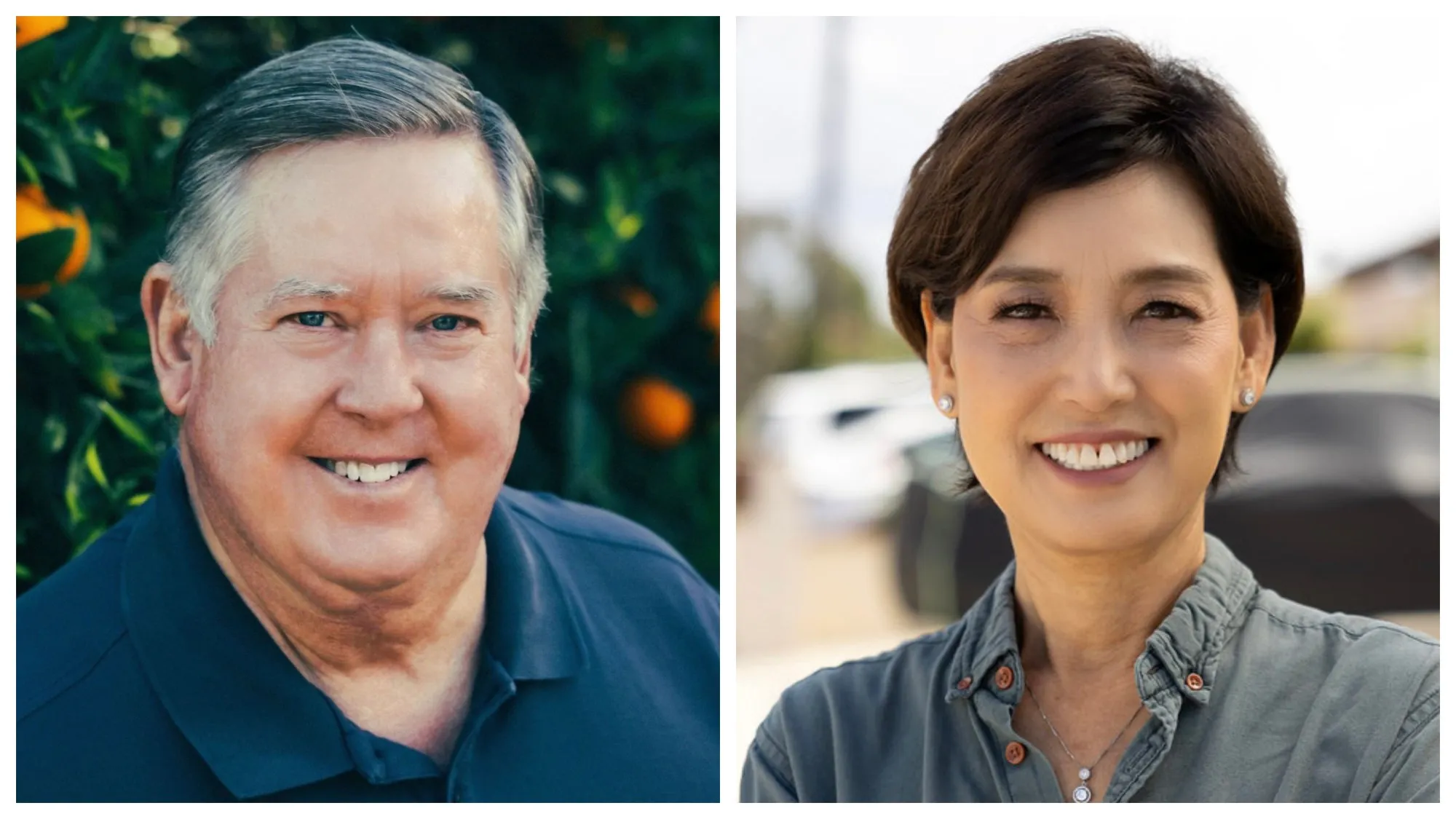
Although it’s been a volatile and expensive battle between Republicans Ken Calvert and Young Kim as they compete for California’s 40th Congressional District, they tend to agree, at least somewhat, on several issues they see facing their district.
Read more OC Sheriff’s deputies take pumpkin assignment taken seriously
California’s midcycle redistricting redrew the geographic boundary lines of the district, which spans Orange and Riverside counties, and ultimately pitted the two Republicans against one another. Calvert, R-Corona, is a longtime lawmaker who has served in Congress for over three decades, while Kim, R-Anaheim, has served three terms in the House.
Calvert, 73, and Kim, 63, through their respective campaigns and with outside groups and independent expenditures, aggressively hammered one another with personal ads. Both Calvert and Kim issued advertising and public statements to tell primary voters that they, not their opponent, were most loyal to President Donald Trump. Both accused each other of being secretly liberal or not MAGA enough.
Then over the summer, the message changed. Supporters of Kim began touting her bipartisanship, while Calvert’s campaign stopped running ads implying that Trump backed him over his opponent.
Messaging, advertising and vitriol aside, the top issue residents face in the 40th Congressional District is one that Calvert and Kim see as needing immediate attention: affordability.
But how the two sitting members of Congress say they’ve worked to address that in recent years — and how they intend to continue addressing the rising affordability concerns — shows how they differ, despite being on the same side of the aisle.
“People are working hard, but their paycheck is being stretched thinner by the rising cost of housing, groceries, gas and electricity,” Calvert said in response to a questionnaire from the Southern California New Group.
Calvert pointed to his support of the Big Beautiful Bill, which passed last year, as a way he is delivering relief to “families, seniors and small businesses across our district.” The federal tax, spending and reconciliation package extended individual income tax cuts.
Kim said the issue itself is two-fold: Not only are Californians struggling with rising costs, but “too many in Washington are looking out for themselves instead of addressing it.”
Kim touted her work on increasing the SALT cap, the limit on the amount of state and local taxes (SALT) that taxpayers can deduct when filing their federal taxes. The idea is to offset some of the money taxpayers have already contributed to local and state taxes when figuring out how much to pay the federal government. Prior to 2017, there was no limit to SALT deductions, which generally benefited taxpayers in high-tax states — including California, New Jersey and New York — and wealthier people.
And as for addressing self-serving politicians in Congress, Kim pointed to her bill that would ban members of Congress from trading individual stocks and prevent them “from lining our pockets at our expense.”
As for rising housing costs, Calvert said he would work to increase the housing supply by “cutting unnecessary regulations, speeding up permitting and creating tax incentives that encourage more housing construction.”
But regulation isn’t the only driver of rising housing affordability issues, Calvert said: Immigration is another.
“For years, the federal government failed to secure our southern border while California was already struggling with a severe housing shortage. Unchecked illegal immigration adds even more demand to an already strained housing market,” he said. “I would measure success when we turn around the net migration numbers from California and see that our state has once again become a desirable place to live and work.”
Kim said she sees homeownership as “a cornerstone of the American Dream.” The issue of regulation and policy is usually alleviated by meaningful policy enacted by state and local governments, she said, but Congress has used that reality “as an excuse to kick the can down the road,” she said.
Kim touted her co-sponsoring of the 21st Century ROAD to Housing Act, a massive bipartisan housing bill that was made into law earlier this year, as an example of her work on this front. Calvert, too, voted for the bill.
“This bipartisan package cuts red tape to build more homes, lowers barriers to homeownership and includes my Community Investment and Prosperity Act, which unlocks more funding for housing to get shovels in the ground,” she said. “The true test of success is whether hardworking Californians can once again see homeownership as a realistic, attainable goal.
“One bill won’t solve the housing crisis, but after decades of inaction, it’s a meaningful start that we must keep building on,” Kim said.
The two candidates for the 40th Congressional District see similar solutions to other issues as well, from surveillance technology to immigration.
Read more Hundreds of Orange County workers go on strike
Surveillance technology
Concerns about the use of surveillance technology have intensified recently, often relating to license plate readers made by Flock Safety.
Proponents of the technology tout its ability to improve the operations of law enforcement. But opponents say these tools create mass surveillance systems that infringe on an individual’s right to privacy.
Kim said in meetings she’s had with local law enforcement and community leaders in Orange and Riverside counties, she’s learned that the ability this technology has to improve their abilities to “drastically reduce crime” is clear. But those groups also know the public’s concern is real, she said.
To prevent potential abuse of these tools, Kim said, Congress must establish “clear parameters” for where the cameras can and cannot operate, as well as how long the data they record can be stored.
“There should also be frequent audits and oversight to prevent abuse and close any loopholes that could leave Americans’ privacy vulnerable,” she said. “Strong guardrails coupled with public awareness can protect Americans’ privacy while giving law enforcement the tools they need to keep our communities safe.”
Calvert said this technology is an important part of any law enforcement agency’s toolbelt, but using it shouldn’t force citizens “to surrender their constitutional rights in the process,” either.
Congress can find the right balance between public safety and individual privacy, Calvert said.
“Congress should establish clear rules governing how sensitive data collected by surveillance technologies can be accessed, retained and shared. That means setting reasonable limits on how long data can be stored and requiring law enforcement to get a warrant,” he said. “Law enforcement should be able to use these tools for legitimate public safety purposes but not infringe upon the constitutional rights our citizens are entitled to.”
Immigration
Calvert hopes that in five years, the U.S. “can look back and say we finally turned the tide” on immigration numbers.
But that only happens if the U.S.-Mexico border is secure, “illegal crossings are dramatically reduced if not eliminated entirely, criminal illegal immigrants are deported, and our immigration laws are being enforced again,” he said.
Once that happens, Congress can begin considering reforming immigration policy, Calvert said.
“I do not support a blanket amnesty that rewards people who knowingly broke our laws by coming here illegally with U.S. citizenship,” he said. “America should remain a nation that welcomes legal immigrants who follow the rules. But we also must be a nation that enforces its laws and puts the safety and economic interests of American citizens first.”
Kim, an immigrant herself, said she knows the U.S. immigration system firsthand, “both its value and shortcomings.”
Like Calvert, Kim says the past few years have made it clear that reforming the U.S. immigration system cannot happen until “a strong and secure border” is established.
“People risk everything for the safety, security and opportunity of America. For that promise to mean anything, we must maintain a secure border and uphold the rule of law,” she said. “We have seen border security increase, but we must take steps to ensure the border doesn’t descend into chaos in the future … our immigration system must focus on rewarding those who follow the rules while preserving the unique American Dream that draws people here in the first place.”
In the 40th Congressional District, registered Republicans make up 39.68% of the voters (207,520), according to the latest . Registered Democrats account for 31.2% of the voters (163,150), and another 21.24% (111,071) are no party preference.
For more about these candidates’ — and others’ — views on data centers, immigration, surveillance technology and more, view their questionnaires on our voter guide.
Ballots have already been sent to every registered voter in California, and voting is underway. Election Day is Nov. 3.
Read more Trump says he cares for Americans. They think he’s more focused on his wealth, poll finds