
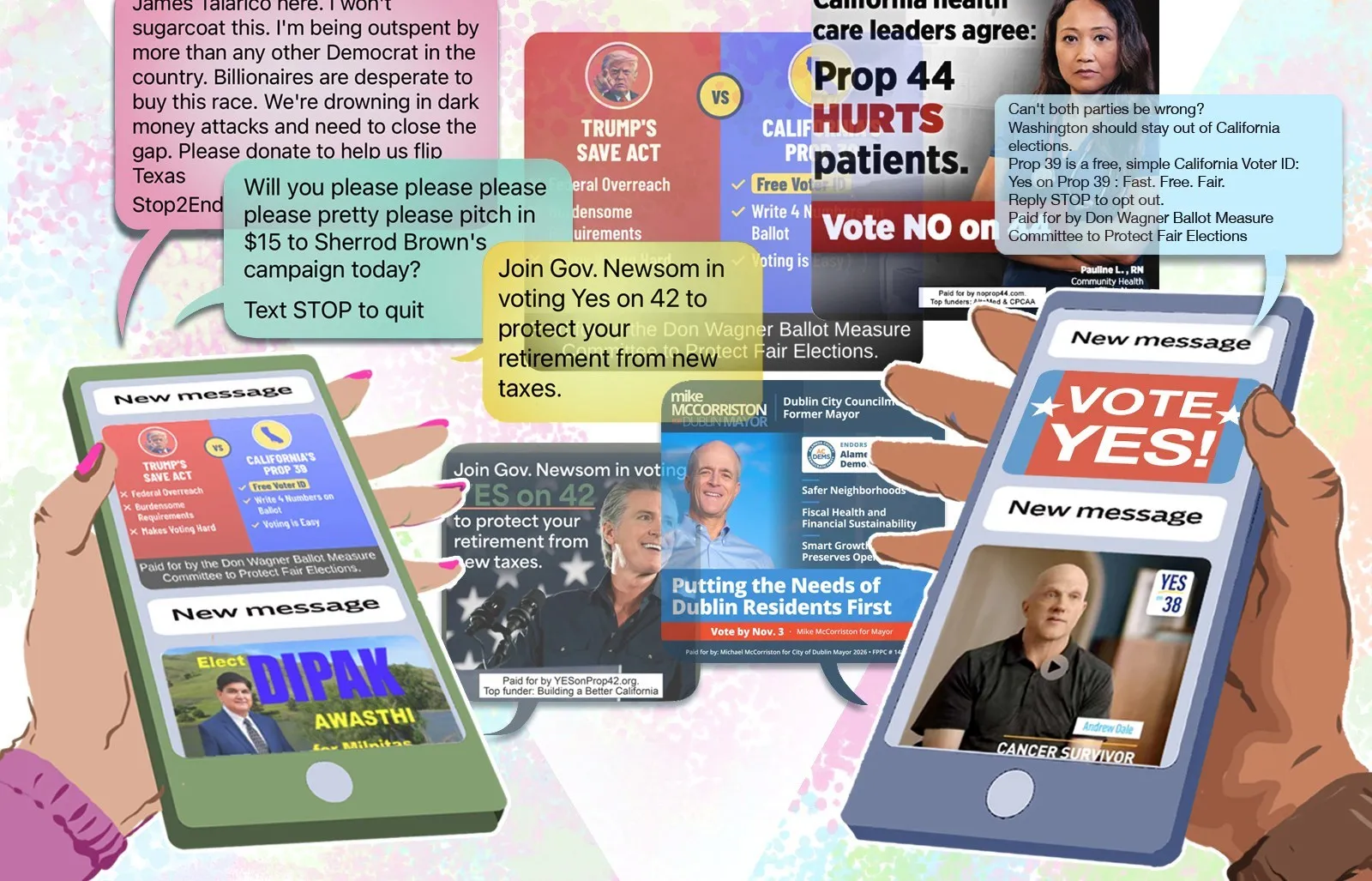
Your cell phone loudly buzzes on your desk and an unknown number flashes across the screen.
Read more 2026 Election: Meet the candidates vying for 3 seats on the Capistrano Unified school board
You quickly open the text to see who it is — maybe it’s a long lost friend or an urgent message about a loved one who was in an accident.
“It’s Steve Hilton” the first line reads. “I’m humbly asking you to pitch in $10. Not $500. Not $50. Just $10 to stop the Democrats.”
It’s the Republican candidate for governor once again making a fundraising pitch.
With less than three weeks until Election Day, our phones are being bombarded by a seemingly never-ending stream of political text messages asking us to donate money to a candidate or vote a certain way.
Some paint an urgent picture.
“James Talarico here. I won’t sugarcoat this. I’m being outspent by more than any other Democrat in the country,” a recent text from the Texas Senate candidate read.
Others take a more polite approach.
“Will you please please please please pretty please pitch in $15 to Sherrod Brown’s campaign today?” a text from the Ohio Senate candidate said.
Text messages have become an increasingly popular tool for political campaigns to reach voters — Robokiller, an app that blocks spam calls and texts, estimated that in 2022, Americans received 15 billion political texts.
But for many voters who are on the receiving end, they’ve become an intrusive and unwelcome part of an election year. So why do campaigns send so many?
“Text messages are a great deal because they’re very cheap and they work,” Melissa Michelson, a political science professor at Menlo College said. “We all think that they’re annoying, but folks look at their phones all the time.”
With only a few weeks to go until Election Day and the text messages ramping up, we’ve compiled a list of frequently asked questions about political texts.
Q: How did they get my cell phone number?
A: If you provided your phone number when you registered to vote, campaigns can obtain it by purchasing voter registration information from a county or the state. Campaigns also collect your number and other personal information like email addresses from other campaigns, political action committees or data brokers.
Q: Are they really allowed to send me texts if I didn’t opt-in?
A: Yes. Michelson said that there are “fewer restrictions on unwanted text messages if it’s for political speech.” Political texts are exempt from the Do Not Call Registry that prevents you from getting an onslaught of telemarketing calls.
Read more Study: Psilocybin may ease suicidal thoughts
A further empowered campaigns to send texts en masse after it sided with Facebook in a case that examined an unsolicited message with a security code from the social media platform to one of its users. The court ruled that texts didn’t violate federal restrictions around robocalls.
Q: Why am I getting texts from only one party or from candidates out of state?
A: Everything these days seems to be microtargeted to appeal to our interests, and political text messages are no exception. Campaigns purchasing voter registration databases know your political party, what elections you voted in and whether you voted in person or via mail. Political donations are also public record, so if you’ve donated to a candidate in another state, Michelson said you might be more likely to get fundraising texts from other out-of-state candidates.
“They’ve fed (information) into their databases so that they can figure out what message will work on you and what kinds of appeals are going to get you to click,” she said.
Q: Is AI being used to send texts?
A: Marty Santalucia, a partner at Vector Political, a generative-AI texting company, said campaigns are starting to harness artificial intelligence to connect with voters and potential donors this election cycle. Santalucia said that his firm, which launched in June, uses its AI-powered texting system to help campaigns decide who they should be contacting, conduct conversations over text and then use the data they gather in “every aspect of the campaign.”
“Campaigns have been all about talking to people at a larger scale and a louder volume,” he said. “And for the first time we have the capacity for campaigns to actually listen to their voters, listen to the people that they’re trying to engage with and to do something meaningful with what they hear.”
Q: Will I know if I’m conversing with an AI agent from a political campaign?
A: Yes. California requires campaigns to disclose the use of AI.
Santalucia said that they recently ran a study with 40,000 voters across the country and split them into two groups: one that disclosed the usage of generative-AI and one that didn’t. The voluntary disclosure, he said, drove higher response rates.
“People want to be listened to, and when they feel like there’s a viable path to that, they’re going to respond positively to it,” he said.
Q: How do I know it’s not a scam?
A: Most political texts in California will have a “paid for by” disclosure at the bottom of the text that will tell you what committee or candidate it’s coming from. However, scammers may try to obtain your information by posing as a political campaign.
“I would delete and ignore them all,” Michelson advised. “If you want to support a campaign or a candidate, go to their website and contribute on your own. Don’t use the text message to do it.”
Q: How do I get them to stop?
A: While there’s no one way to prevent all unsolicited political texts from coming to your phone, you can reply “STOP” to opt-out of future texts from that particular campaign or update your phone settings to filter out texts from unknown numbers. You can also report it as spam by forwarding the text to 7726 (or “SPAM”). If you believe a text is violating Federal Communications Commission rules, you can file a complaint online at consumercomplaints.fcc.gov or by phone at 1-888-CALL-FCC.
Voting early can also dissuade campaigns from contacting you as they update their voter registration data to see who has yet to vote.
“We are all going to keep getting these messages until everyone starts ignoring them,” Michelson said. “If we make it so that they’re not worth the investment, campaigns will stop doing it. But so far, it’s still working out really well for them.”
Read more Fundraising to protect oceans, forests and other key nature sites falling short ahead of UN summit