
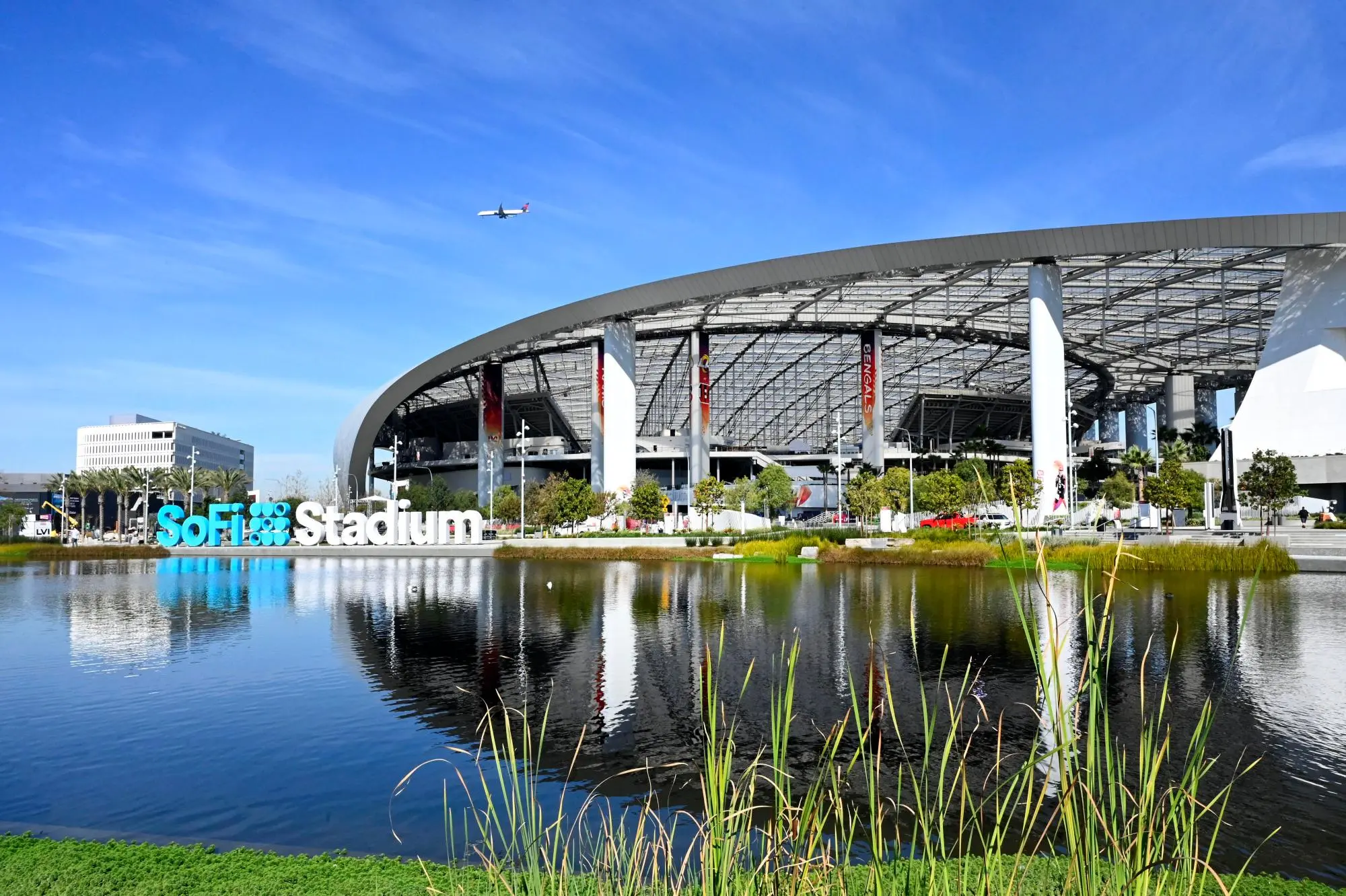
The agreement that authorized and served as the backbone for construction of the $5 billion SoFi Stadium in Inglewood has been declared invalid by a Los Angeles Superior Court judge.
Read more Brian Ortega off UFC 331 card due to injury
As such, Inglewood no longer needs to pay back the more than $400 million the stadium’s owners say they spent on public infrastructure improvements and services so far.
“This decision has huge repercussions for the 300-acre SoFi Stadium/Hollywood Park development,” said Skip Miller, the attorney representing Inglewood, in a statement. “It means that without a valid development agreement, Hollywood Park/SoFi Stadium no longer has vested rights and that the City has no further obligations under the 2015 Development Agreement.”
The two sides will now need to renegotiate. The legal victory, if it holds, will give City Hall tremendous leverage in those negotiations and allow it to push for much more favorable terms.
Miller stated the city and Hollywood Park already have “agreed to engage in talks aimed toward a resolution so the project can move forward.”
In a statement, Hollywood Park indicated it is “reviewing the decision and evaluating all legal options, including a potential appeal.”
“Hollywood Park has fulfilled every one of its commitments under an agreement that the City unanimously adopted, described as ‘the best (stadium deal) ever,’ and benefited from for more than a decade,” the statement reads. “We remain hopeful that the City and its leadership will reverse course from their unilateral decision to abandon their commitments under the agreement and will honor their part of the deal.”
The company said it is committed to “supporting Inglewood and its continued growth as this legal process continues.”
As part of the stadium’s construction, Hollywood Park claims it paid $376 million toward public improvements — sidewalks, roads, utility upgrades — and $52 million toward public services on the promise that Inglewood would pay back the developer over time.
The previous agreement required Inglewood to begin making reimbursement payments once tax revenues from the stadium exceeded $25 million. Hollywood Park alleges the revenues passed that threshold in 2022.
Hollywood Park and several affiliated companies sued for breach of contract in December after Inglewood notified the company that the development agreement approved in 2015 was unknowingly voided by a legal precedent three years later and that it would need to return a $20 million payment made by the city.
In 2018, a California appellate court, in a case out of Moreno Valley, determined that the law governing development agreements prohibited a city from adopting one through an initiative process and instead required “negotiation between a local government and a developer.”
The stadium projected in Inglewood similarly started with a voter-sponsored initiative, but the City Council adopted the initiative outright rather than sending it to the ballot.
Read more Dodgers reliever Edwin Diaz’s postseason status in doubt after poor rehab results
In his ruling, Superior Court Judge David Reinert agreed that the precedent from the Moreno Valley case applied.
“Therefore, here too, the Development Agreement must be set aside,” he said.
The decade-long alliance between the stadium’s developers and Inglewood soured last year over a dispute about billboards.
The City Council in April 2025 approved an up to 40-year lease agreement allowing WOW Media to place dozens of digital billboards and signs on public property near the Hollywood Park project, where SoFi Stadium is located, and the Intuit Dome, the Clippers’ multibillion-dollar arena across the street.
The venues, fearing the lease would hurt their own advertising revenues, sued to try to undo it, arguing it was not properly approved and went against their own deals with the city. Advertising rights in the area are estimated to be worth hundreds of millions of dollars.
A judge in that case rejected the challenges in June.
Inglewood Mayor James T. Butts Jr., in a letter sent to Rams owner Stan Kroenke shortly after the billboard lawsuit was filed, expressed disappointment that Kroenke hadn’t reached out to him, according to court filings.
“We started our relationship face to face and together set the foundation for you and the Rams to gain the support of your colleagues and the NFL for the Rams to move back to the LA market in Inglewood,” Butts wrote. “I would have expected a call from you personally and not just a lawyer’s letter and a lawsuit.”
The city, upon receiving the lawsuit over the WOW Media lease, discovered a legal precedent out of Moreno Valley that appeared to void the stadium’s development agreement entirely, the mayor wrote.
“I’m writing to invite a dialogue about how to address and hopefully resolve these issues,” Butts wrote. “I think we should handle the situation, as we have in the past, by working together in a productive manner as partners — not by way of lawsuits.”
In a previous interview, Butts said the decision in the Moreno Valley case — involving the World Logistics Center project in 2015 — requires “a true and meaningful negotiation” of the development agreement, and the city will follow that standard if the courts rule in its favor.
The dispute has sparked several other proxy battles. The companies on the two sides of the fight — WOW Media and Hollywood Park — each are backing ballot initiatives that, if successful, could financially damage the other.
One, backed by Hollywood Park, would prohibit advertising kiosks and billboards on public space from displaying “commercially sponsored advertisements.” Others, backed by WOW, would limit parking fees within 2 miles of the venues and remove a $15 million annual cap on the ticket tax paid to the city by the stadium.
SoFi Stadium is set to host the Super Bowl again next year and will co-host the opening ceremonies for the Summer Olympics in 2028.
Read more A Vermont man is on trial for shooting 3 Palestinian students. He claimed the CIA told him to do it