
An anti-pesticide movement inspired by the emergence of rare cancer cases in Ladera Ranch is beginning to spread throughout Orange County and beyond — and already enjoying some success.
Read more Eswatini receives 2 more US deportees under a controversial third-country deal
Activist movements have formed in Dana Point, Rancho Mission Viejo and San Juan Capistrano, and some in Aliso Viejo are using the current momentum to revive a campaign they’d fought in 2024. On Instagram, a series of new accounts have popped up: Regenerate OC, San Clemente Goes Organic, Toxic Free Newport Beach, RMV (Rancho Mission Viejo) Spray Notices and Toxin Free Temecula, as well as several from Ladera Ranch, including Ladera Health Watch and Ladera Goes Organic.
Carolyn McCuan, who founded the group Toxic-Free OC in 2022, said she’s seen a spike in local interest since the Ladera Ranch cancer cases emerged. “We have been really busy,” she said. She’s heard from concerned community members in Mission Viejo, Dana Point and Aliso Viejo, among others.
Some cities are taking action. On Tuesday, Aug. 25, Newport Beach city councilmembers unanimously voted to discontinue synthetic herbicide use on city athletic fields, and San Clemente officials have taken steps to tighten the city’s pesticide policy.
Dana Point mom Lily Eichert said what’s happening in Ladera Ranch “got people thinking.” Eichert’s 10-year-old son spends a lot of time outside, and, after they moved to the beach community four years ago, he developed a chronic cough. His pediatrician diagnosed him with asthma and blamed environmental exposure.
“When the Ladera thing happened, I was like, well, let me just see what’s going on at the park near our house,” Eichert said. She requested pesticide spray records for nearby Pines Park, but was told that the private landscaping company — not the city — maintains those records.
Eichert isn’t the only one troubled by potential pesticide spray in Dana Point. There’s “a group of ragtag mothers who are concerned for their children and their health,” she said. “Everyone’s just like, whatever we have to do.”
Activists are mobilizing in Aliso Viejo as well. McCuan founded Toxic-Free OC after she said she experienced herbicide poisoning in Aliso Viejo. After moving to the city in 2020, she said her energy levels dipped, rashes broke out on her face and arms, and she experienced severe brain fog.
One morning in June 2023, she couldn’t speak or “even muster up the energy to walk to the bathroom,” she said.
An environmental toxins test showed that she’d had high exposure to herbicides. Around that time, she learned that the weed killer Cheetah Pro was being sprayed at nearby Canyon View Park. McCuan pushed for pesticide reform in Aliso Viejo, but when she didn’t see significant change, she moved her family to San Juan Capistrano.
But since news broke about the Ladera Ranch cases, the movement in Aliso Viejo has been revived, McCuan said.
“We’ve been at this for about two-and-a-half years,” said Melissa Christian, an Aliso Viejo resident who’s campaigned for pesticide reform with Toxic-Free OC. “The Ladera issue has really reignited what we’ve been doing.”
At an Aug. 10 meeting of the Aliso Viejo Community Association, which is the HOA for most of Aliso Viejo, about 10 residents asked the association to adopt an organic policy, and some referenced the cancer cases in Ladera Ranch, according to an attendee.
In an email, AVCA General Manager Josh Hodosh said AVCA “is continually evaluating and refining” its pest management program and “serves as a true model for Orange County in responsible landscape management.” AVCA’s maintenance program focuses on “drastic reduction and preventing weeds from germinating,” and the association this summer achieved a full year without the use of “post-emergent pesticides,” Hodosh said.
“It’s a terrible thing that’s happened to those families,” Christian said, referencing the rare cases of Ewing sarcoma diagnosed in young people in Ladera Ranch. “But I’m really glad that everybody is thinking about this more deeply than maybe they were before.”
Creek Team OC expands
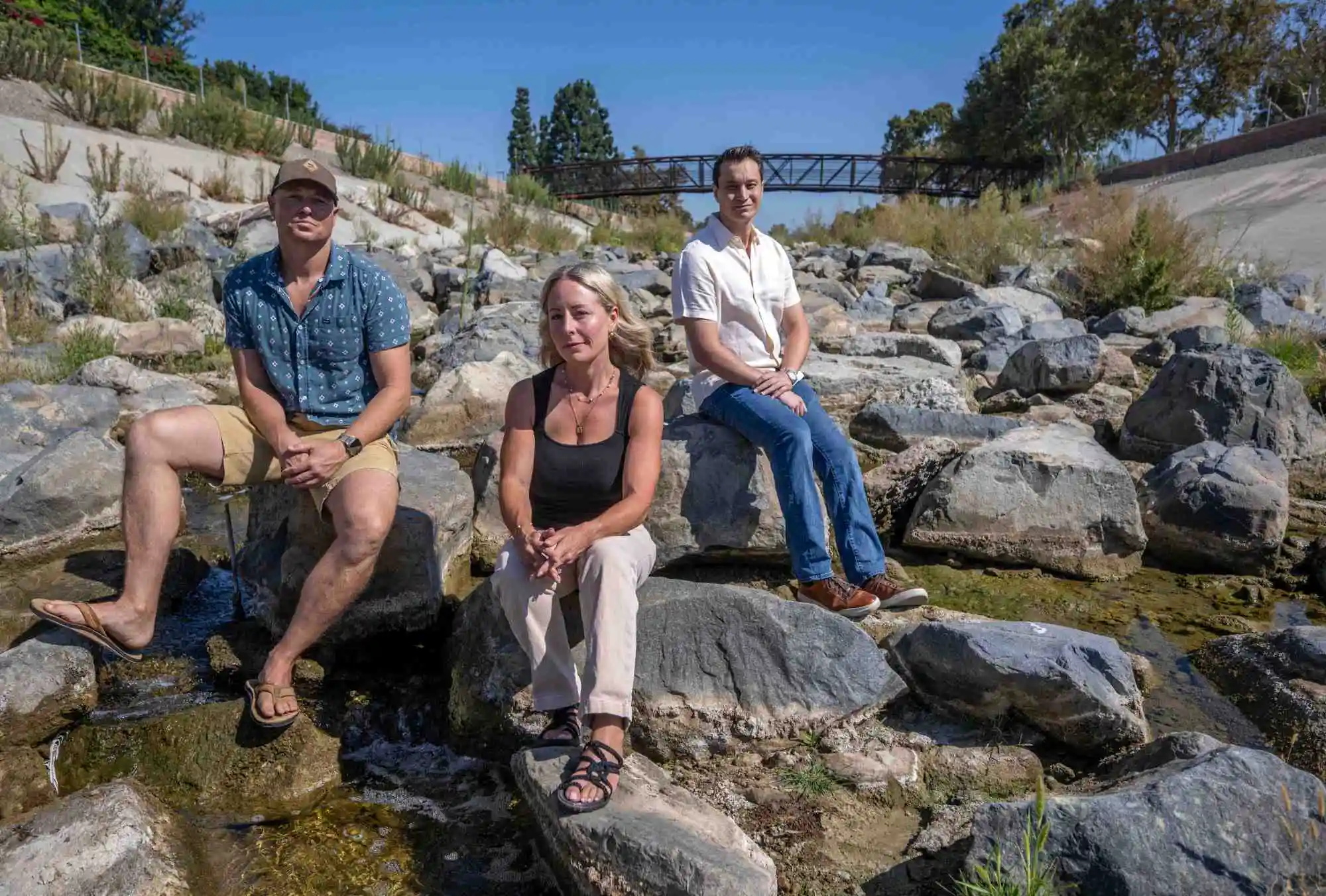
Creek Team OC, a grassroots environmental activist group dedicated to protecting Orange County waterways from herbicide spraying, also has seen growing interest in its cause because of what’s happening in Ladera Ranch.
Creek Team emerged in February after its founder, Brent Linas, noticed there was no foliage along his running path around San Juan Creek. He met with representatives from the Orange County Public Works department to inquire about pesticide spraying in the creek, but said he was met with hostility.
In response, he launched a campaign pushing for an end to pesticide spraying in the creek. The group’s Instagram page “took off like wildfire,” Linas said. It now has more than 27,000 followers.
Soon, he and two other advocates, Bethany Nelms and Robert Beard, began advocating for reduced pesticide spraying throughout Orange County. Recently, Linas traveled to Sacramento to attend a California Assembly hearing on the state’s pesticide program.
The Ladera Ranch cancer cases have added fuel to that fire, Nelms said.
Her next big project is starting Creek Teens, a group geared toward teenagers interested in learning more about and advocating for the health of local waterways. The group also will help coach young people on how to make their voices heard, such as speaking at city council meetings. She’s hosting the Creek Teens’ first meet-up soon for about a dozen kids ages 12 to 15.
“If the kids want to get more involved, we want to show them how to do that,” Nelms said.
Broken promises
But advocates say they face an uphill battle. Even in communities that already have established organics-first policies, some are not keeping their promises.
McCuan and her family moved to San Juan Capistrano largely because of the city’s organics-first policy, which prioritizes mechanical foliage removal before treatment. If that fails, organic products can be applied. And if that fails, synthetic pesticides can be used as a last resort.
Read more Trump used to say he saw a quick end to his Iran war, but 6 months later he claims he’s in no hurry
But soon after she moved, she said a public records request revealed that San Juan Capistrano parks were being sprayed with Roundup, a weed-control product that contains glyphosate, a chemical linked to cancer as recently as September 2025.
When she found out about the spraying, “I was speechless,” McCuan said. She said she contacted the Public Works Department, and within months, it stopped its contractors from using Roundup.
In a letter sent to a local community group inquiring about the city’s use of pesticides, City Manager Benjamin Siegel acknowledged that although San Juan Capistrano’s pest management program does not prohibit pesticide use, recordkeeping has been “inconsistent,” and a review found that the program “has not been applied consistently at City-maintained areas.”
In June 2025, Siegel said, the City Council awarded a new landscape maintenance contract that incorporated the city’s pest management program.
“Since the contract was approved, City staff has worked with the contractor to significantly limit pesticide use,” Siegel wrote. “The City’s review highlighted the need for improved communication and coordination.” He said the City Manager’s Office and the Public Works Department would work together to “develop improved internal systems for consistent documentation and reporting.”
Irvine, which is credited with implementing the county’s first organic policy in 2016, also has recently increased its nonorganic pesticide use. In 2024, the city of Irvine reported using approximately 3 ounces of Roundup in city parks and open spaces, but in 2025 more than 1,500 ounces were sprayed.
In an email, public information officer Linda Fontes said that while Irvine “continues to take an organics-first approach for City facilities and parks,” the city’s pest management program was updated in March 2024 “to offer some exceptions for open space areas.” This modification allowed for the use of glyphosate to eliminate “hard-to-eradicate species” such as the invasive artichoke thistle in Quail Hill and to prepare sites for habitat restoration, “which ultimately aids in our wildfire mitigation,” Fontes said.
While the amounts are small, residents who believe Irvine is all-organic are being misled, McCuan said. Irvine has been held up as an example for what to do in other communities, including Ladera Ranch.
“Most people are still under the impression that Irvine is completely organic,” McCuan said. “What we see is a slippery slope where you reintroduce it, and then over the years, it just becomes more and more used because it’s easier.”
Pesticide regulation is increasingly being left to citizens, Linas said.
“No one’s coming to the rescue,” he said. “We’re going to have to deal with this ourselves.”
A patchwork of policies
Part of the struggle to fight pesticides is the patchwork of agencies responsible for applying pesticides — HOAs, school districts, cities and counties may have jurisdiction over different areas within a specific region.
In Ladera Ranch, it’s an HOA. The Ladera Ranch Maintenance Corp., or LARMAC, has come under scrutiny for its pesticide spraying. Since news about the cancer cases has emerged, Nelms said, people have been asking Creek Team how they can convince their HOAs to stop spraying pesticides.
“We’ve had, gosh, I mean, dozens upon dozens of people reach out to us and say, ‘Who do I talk to?’ ” Nelms said. “This thing has just really taken off in such an unbelievable way.”
But the battle is just beginning, she said. In Orange County, there are nearly 5,000 HOAs. “That’s 5,000 individual campaigns and asks to move away from synthetic herbicide,” Nelms said.
But even when cities eschew pesticide use, other entities within them might embrace nonorganic methods.
Though San Juan Capistrano adopted an organics-first policy in 2017, records show that on Capistrano Unified School District campuses, landscapers were spraying the herbicide Cheetah Pro, which contains glufosinate-ammonium, during the previous school year.
Gulfosinate-ammonium is the same chemical present in Lifeline, which raised alarm in Ladera Ranch and sparked a Change.org petition calling for a ban that racked up nearly 5,000 signatures.
In an email to families, CUSD Chief Communications and Public Engagement Officer Ryan Burris said the district would implement a 60-day pause on maintenance products and weed spray applications in response to community members who raised “thoughtful questions about the landscape maintenance products used within our neighborhoods and shared spaces.”
During the pause, the district will “evaluate whether newer or lower-risk alternatives are available” to “reduce unnecessary chemical exposure,” Burris wrote. District staff will recommend to the Board of Trustees which products should remain, which should be replaced, whether chemical use can be otherwise reduced, and how to improve the district’s pest management policy.
At its Aug. 13 meeting, community members requested that the temporary pause be made permanent. The Board of Trustees said the pause may continue beyond 60 days and established that there would be an annual review of approved pesticides and herbicides.
Jackie French, a Ladera Ranch advocate behind the group Ladera Health Watch, said CUSD’s response was “refreshing.”
“I feel like we’re all on the same page and we all want the children to be safe,” she said.
Read more US, South Korea and Japan to hold trilateral drill as North Korea ramps up pressure on US