
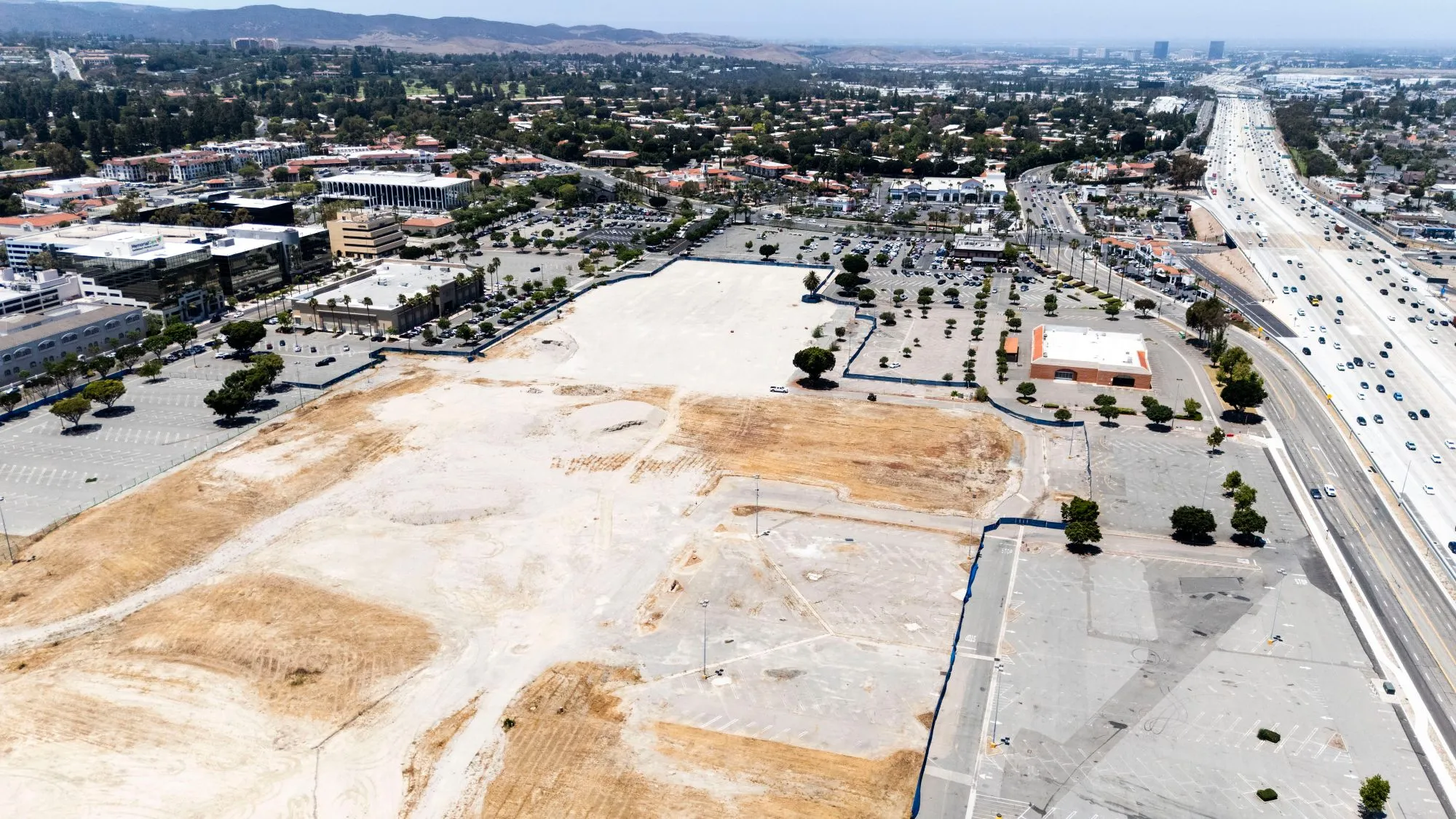
Eight years since the Laguna Hills Mall was shuttered, redevelopment of the now vacant property is taking a new direction, with a revised plan that reduces retail space in favor of more housing, an additional hotel and an expanded public park.
Read more Next stop, Trump Station? Administration wants to rename New York’s Penn Station
“We’re trying to re-envision Laguna Hills,” Mayor Don Caskey said, “68 acres gives us the opportunity to make a really big, positive point on that.”
The City Council recently approved a series of amendments to the Village at Laguna Hills project that significantly reshape the mixed-use development plan first approved in 2022. Councilmembers Erica Pezold and Dave Wheeler wanted more time to review the proposed changes and new documents, but a council majority voted the project on.
This latest update — which scraps plans for office space, a gym and a movie theater — will bring the highly anticipated development project one step closer to fruition, Caskey said. The developer, Merlone Geier Partners, first purchased the property in 2013, and the mall was razed in 2023.
While progress toward redevelopment has been largely delayed due to developer concerns about economic feasibility, Caskey said the city’s approval of the new plan marks an important step toward a financially successful outcome. Over the last four years, city leaders have been working closely with the developer, he said, to design an “urban village” that comprises a variety of affordable housing options, shopping, restaurants and community gathering spaces.
The revised proposal preserves that vision but alters how the site will be divided between the categories. The new village plan features 1,457 residential units, at least 200 of which will be affordable housing options for senior citizens.
Though several community members at the July 14 meeting voiced their desire for expanded affordable housing options to accommodate a more diverse population — specifically for members of Laguna Hills’ working community — Caskey assured them that the city will advocate to make housing more accessible for a broader community at the Village in the future. However, the target audience for affordable housing will ultimately be determined by the developer, he added.
The remaining units will be split between apartment buildings, townhomes, duplexes and single-family detached homes, creating a broader range of ownership opportunities.
“We are very proud of the mix of housing in this development, and we think it’s going a long way to making it better for residents and future residents,” Councilmember Jared Mathis said. “We want the kids that go to school in Laguna Hills and the people that work in Laguna Hills — whether they’re teachers or firefighters — to be able to live here.”
Additionally, instead of the one five-story hotel previously planned, two four-story hotels will be built, offering a combined 239 rooms.
Read more FACT FOCUS: Posts falsely claim Obama urged noncitizens to vote in 2016
To make room for these adjustments, retail space will be scaled back, dropping from 250,000 square feet to about 163,000 square feet, and the project will no longer include the previously approved 465,000 square feet of office space, according to a report to councilmembers from city staffers. They cited economic feasibility as the primary reason for cutting the gym and theater.
Despite the loss of retail space, city officials said they are confident that the modified plan will generate significant revenue — an anticipated annual general fund surplus of $2 million, along with almost $29 million in fee payments from the developer — which will fund other benefits to the city, including more than $20 million toward funding parks and recreation facilities.
“It’s a home run for Laguna Hills,” Mathis said. “The revenue that’s going to come to the city off of this project is not only more than the previous version proposed, but more than the mall — even adjusted for inflation — in its heyday.”
Instead of a larger commercial district, the village will prioritize neighborhood-oriented retail, restaurants and pedestrian pathways centered around an enhanced 3-acre community park. The natural space will allow the center to host community gatherings, while also enabling easy access to any of the surrounding businesses, Caskey said.
“This is about bringing people together,” Caskey said. “It’s a ‘happening’ place.”
Several existing restaurants, including BJ’s Restaurant & Brewhouse, King’s Fish House and In-N-Out Burger, are expected to remain, officials said.
Caskey and Mathis, who both served on the ad hoc committee responsible for overseeing the city’s involvement in the project, are optimistic that the redevelopment plan will invigorate the south Orange County property, which is visible from the 5 Freeway. The developer expects the plan, which has tentatively been split into three phases, to be complete over the next decade, Caskey said.
While they don’t yet have any specific plans for adjacent development projects, city officials said they hope the projected success of the new village center will generate motivation for other redevelopment endeavors.
“Rising tides lift all boats,” Mathis said. “That’s what we hope for this project.”
Read more Trump imposes double-digit tariffs on dozens of countries as his 10% levies are set to expire Friday