
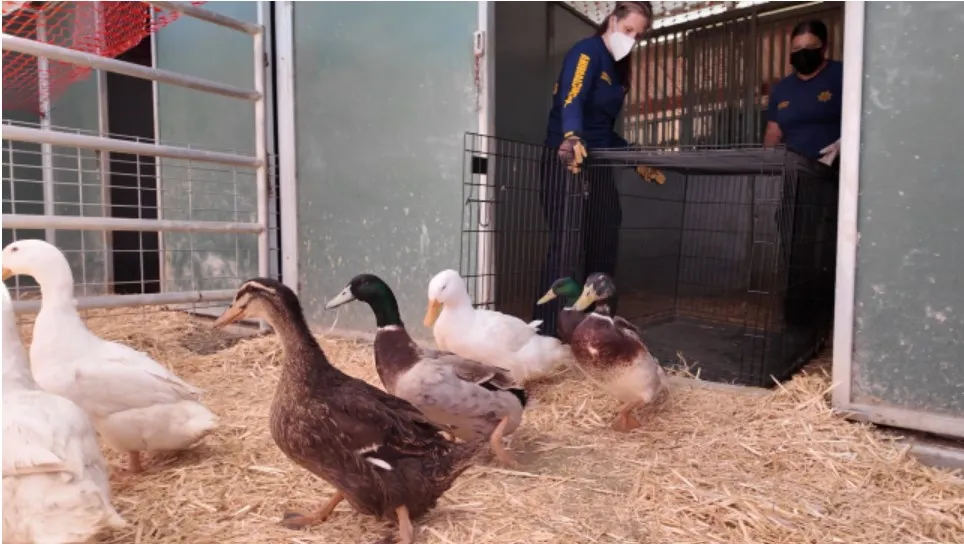
The Riverside County Department of Animal Services is under fire from animal activists for its handling of nearly 500 ducks surrendered last week by an animal rescue in Anza.
Read more Riverside County duck sanctuary founder charged with animal cruelty
As sanctuaries were lining up to adopt the ducks, activists say, the agency instead decided to make them available for adoption the following day, April 15, on a “first-come, first-served basis” at the agency’s San Jacinto Valley shelter. Adoption fees were waived.
Activists who were willing to take the ducks were irate at the hastily arranged adoption event. More than half the 480 animals were immediately turned over to a livestock business in Norco that began selling them on Facebook, ostensibly to some people who planned to eat them.
Howard Berkowitz, owner of the Duck Sanctuary that surrendered the animals, also expressed his disappointment in Animal Services.
Berkowitz, who acknowledges that his sanctuary was “overwhelmed” with the ducks, said he agreed to surrender them only on the condition that they would go to a sanctuary.
“The only way that I would ever relinquish any ducks was that I knew that they were going to a safe place,” he said. “I’ve raised those ducks for years. I spent my entire life savings taking care of these ducks, and they all went for food.
“I hope that Riverside pays for what they did.”
Urgent adoptions necessary
The Department of Animal Services said its decision to move the ducks quickly after they were taken from Berkowitz’s Duck Sanctuary on April 14 was “in the best interest of the animals,” given that the surrender was “the largest single intake for the department in over a decade,” according to public information officer Veronica Perez.
A week prior to the surrender, amid a lengthy investigation of conditions at the Duck Sanctuary, Perez said the department’s rescue team contacted partners and known animal rescue groups.
“Given our inability to provide long-term care for that many animals, we urgently acted to secure placement through rescue and adoption, leaning on the public to give the animals a different outcome than the overcrowded conditions they came from,” Perez said in an email. “Urgency was of the essence in order to not impact the planned large-scale intake or impede the ongoing investigation.”
Rescues caught flat-footed
That move caught one animal activist by surprise.
Darcy Smith, co-founder of the Funky Chicken Rescue, a farm animal sanctuary in Vacaville, said she had been notified before the ducks were surrendered that Riverside’s Department of Animal Services might soon be receiving an influx of animals.
Smith submitted a partnership agreement, saying she could take in 50 of the birds. And other rescues in Oregon and Washington were planning to step up as well, she said.
“They had places that they could go — sanctuaries that had vetted homes ready for them,” Smith said. “It’s like, really, you’re going to pull them out of a horrible situation and then put them in another one?”
Within hours of adoptions opening, a business named Matt’s Livestock had taken 270 birds and began selling them on Facebook for $15 each. A man who identified himself as Matt said he didn’t have information about who was buying his ducks.
“I do not do any screenings,” he said. “I run a livestock business.”
On April 16, Riverside County Animal Services announced on Facebook that all of the animals had been adopted. One Facebook user, whose profile contained numerous references to cockfighting, commented that he took 11 birds.
Perez said the department looked adopters up in its database to check for a history of documented animal welfare issues. “We follow a barrier-free adoption model that places trust in our community to act in the best interest of the animals leaving our shelters,” she said.
In the end, Smith said she managed to take in only eight birds. Other local animal advocates adopted them and held them for her until her husband could fly down to pick them up. Two needed veterinary attention — one had bill rot, or discoloration that can be caused by infection, and another had an eye infection, she said.
Read more In Anaheim, St. Louis fans find arch disappointment in 5-1 loss to Angels
Ashli Shore, a vet tech and co-founder of the Shore Sanctuary in Eucalyptus Hills, said she had been in touch with Animal Services Cmdr. Leslie Huennekens to coordinate bird rescues. Shore said Huennekens told her some of the ducks were sick with zoonotic diseases.
By allowing open adoptions, Shore said, Animal Services has “placed sick animals into the community without disclosing their medical needs.”
Though the ducks “showed signs consistent with prior inadequate care,” Perez said they tested a representative sample of the animals for zoonotic infectious diseases and all results were negative.
Ongoing investigation
Sascha Knopf, an animal advocate behind the Facebook page “The Duck Sanctuary Exposed,” says the situation at Berkowitz’s sanctuary involved more than just overcrowding. She called it hoarding, and said Animal Services knew about the problems with Berkowitz for years.
Indeed, the Department of Animal Services acknowledged in its press release that “recent investigations revealed the need for action to remove the animals from the property due to improper husbandry.”
Knopf shared photographs with the Southern California News Group that show mounds of feathers, feces and garbage at one of Berkowitz’s previous properties. Many animals were kept in pack ‘n plays, Knopf said, and the animals would sit in their own filth.
Berkowitz vehemently denied that his animals were in poor condition. “There wasn’t one single sick duck on my property,” he said. Animal Services has visited his property 14 times in the past year, he said. “Did they see any ducks laying in filth? No, because they would have taken them from me if they did.”
Over the years, Shore said, Duck Sanctuary volunteers brought a few sick or severely injured animals to her for examination. She coordinated veterinary care for one animal, a Silkie rooster, that she says had been “essentially suffocating in the mud and in (his) own feces,” according to photos volunteers shared with her.
The rooster was so weak it couldn’t move, and three different strains of E. coli were detected in his system. The rooster eventually died.
Perez said Animal Services inspected four of Berkowitz’s previous properties and “documented no animal cruelty or neglect.” But the department’s ongoing investigation of the Anza sanctuary revealed that as he “continued to increase the number of animals,” overcrowding became a problem.
Owner ‘shutting it down’
As for the Duck Sanctuary, Berkowitz said he’s done with the rescue world because his “haters” make it too difficult for him to operate.
“I’m shutting it down, I’m done,” he said. “Make me the criminal, make me the bad guy. I don’t care anymore.”
Berkowitz said he has put in an offer on a 160-acre property in Northern California, where he plans to take his remaining ducks and go back to selling classic cars.
Shore said she and other animal rescues are still willing to work with Animal Services going forward and would take in other ducks remaining in Berkowitz’s care.
“This could have been a really positive situation,” Shore said. “Unfortunately, it was just handled very poorly.”
Read more Auto safety agency exploring new car door rules after deaths in Teslas