
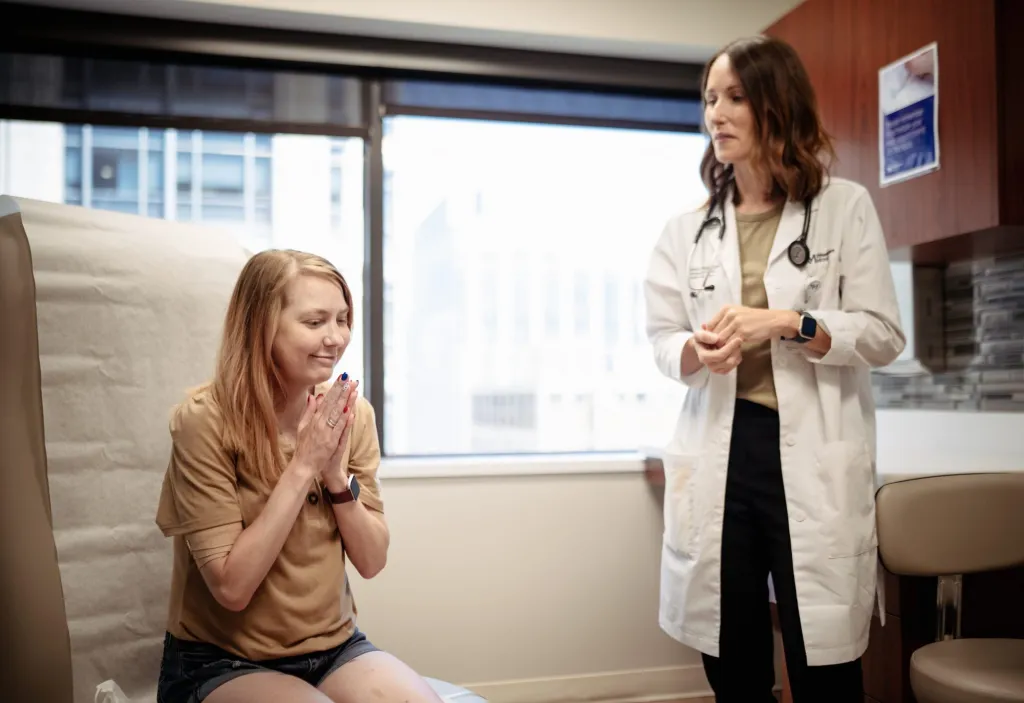
Before she went into surgery, Elizabeth Wehrle knew that doctors wanted to transplant four new organs into her body.
Read more E. Jean Carroll is paid $5.8M in Trump sex abuse and defamation case
She didn’t know, at the time, that the operation at Northwestern Memorial Hospital was potentially the first of its kind in the country — a quadruple-organ transplant performed on a person who had already had a previous lung transplant.
“I’m incredibly grateful that they decided to take this chance on me, but I’m also very glad that I didn’t know that I was the first,” Wehrle, 36 of Montezuma, Iowa, said with a laugh Monday.
Though seven quadruple-organ transplants have been performed in the U.S. in recent years, Wehrle is the first known person to get a liver, a kidney and a second set of donor lungs, after her body rejected lungs she received during an earlier transplant and after her liver and kidney were damaged by cystic fibrosis, according to Northwestern, citing information from the Scientific Registry of Transplant Recipients.
A quadruple-organ transplant is always a complex surgery, but Wehrle’s case was especially difficult given her previous lung transplant. A lung transplant can leave dense scars and distort a person’s natural anatomy, making a second lung transplant trickier than a first one, according to Northwestern doctors.
“This is a young woman who really had no options and she really had nowhere else to go, and we were able to apply the power of transplant to be able to save her life in a way that had not ever been done before,” said Dr. Satish Nadig, transplant surgeon and director of the Northwestern Medicine Comprehensive Transplant Center.
When she was 11 years old, Wehrle was diagnosed with cystic fibrosis, a genetic disease that can damage the lungs and other organs. Doctors were able to keep the illness mostly under control until late 2015. In 2017, she underwent a lung transplant in Iowa.
Following that transplant, Wehrle returned to her normal life — raising her then-toddler son and running a massage therapy studio.
Her health, however, took a dramatic turn in January of this year when she contracted pneumonia. She spent about three weeks in the hospital in Iowa before returning home. But she worsened during her time at home. She lost 30 pounds in just a few weeks, had difficulty breathing and needed help with daily tasks, such as dressing.
By February, she was back in the hospital. At one point, she said she became unresponsive, and was intubated and later put on a life-support machine called ECMO (extracorporeal membrane oxygenation).
During most of that time, she was unconscious. Her parents did, however, make the decision to have her awoken when it became clear that she needed another organ transplant, she said.
Having already gone through a lung transplant, she knew how difficult it would be. Previously, she had said that she wouldn’t want to go through it again. So her parents wanted her to make the decision about whether to move forward.
“It was so hard the first time mentally to go through all of this and then have to prepare yourself to go through it again with four organs instead of just the lungs,” Wehrle said. “But I have an 11-year-old son. … There was no way that I was going to voluntarily leave him this early.
“If I didn’t make it through the surgery then at least I tried to fight,” she said. “There was no decision for me.”
She was flown to Northwestern where doctors performed the surgery in two stages. Part of the challenge was that Wehrle had developed a particularly severe form of rejection that tends to make second lung transplants even more difficult, said Dr. Ankit Bharat, who is chief of thoracic surgery and executive director of Northwestern’s Canning Thoracic Institute.
Read more To promote more housing, cities and states target parking minimums
“It’s technically very, very difficult,” Bharat said of performing second lung transplants on patients with that type of severe rejection. “The patients are also very sick.”
During the first stage, surgeons freed up the rejected lungs from their surrounding structures to make it easier to remove them.
Wehrle was then kept under general anesthesia for several days and on the ECMO machine and a ventilator, with her chest open.
Surgeons then embarked on the second stage of the transplant, placing her new lungs into her body, followed by a liver and kidney — a surgery that took about eight hours altogether. The liver and kidney had been kept on perfusion machines to keep them viable during the lung transplant.
All the organs came from one donor, though Wehrle said she does not yet know any details about that person.
Wehrle’s memory of waking and learning that the surgery was complete is hazy. But once the fog of those initial moments lifted, Wehrle remembers feeling relieved.
“I’m here and I still get to raise my son and run my business,” Wehrle recalls thinking. “I get my life back.”
Wehrle spent several weeks at Northwestern following the transplant before moving to Shirley Ryan AbilityLab for rehabilitation for another couple of weeks.
She’s been in Chicago ever since, with help from her mom and dad, so as to be close to Northwestern for follow-up care and appointments. Her son visited for two weeks in June, a time during which they played tourists, seeing the Shedd Aquarium and riding the Centennial Wheel at Navy Pier. She’s now walking about three to four miles a day.
Wehrle is looking forward to heading home later this week, where she expects to enjoy a belated celebration of her birthday with her son and see her two cats for the first time in months.
“I’m just so incredibly grateful for the doctors and the team and Northwestern for taking that chance and for letting me fight my way back,” Wehrle said.
Northwestern doctors say they hope the surgery opens doors for more patients with similarly complex cases.
“The amount of coordination this takes beyond just the technical ability to do this, it’s really staggering,” Nadig said. “… It gives people hope in other places that this can be done.”
Read more An experimental Alzheimer’s drug shows promise targeting a different brain protein, new study shows