
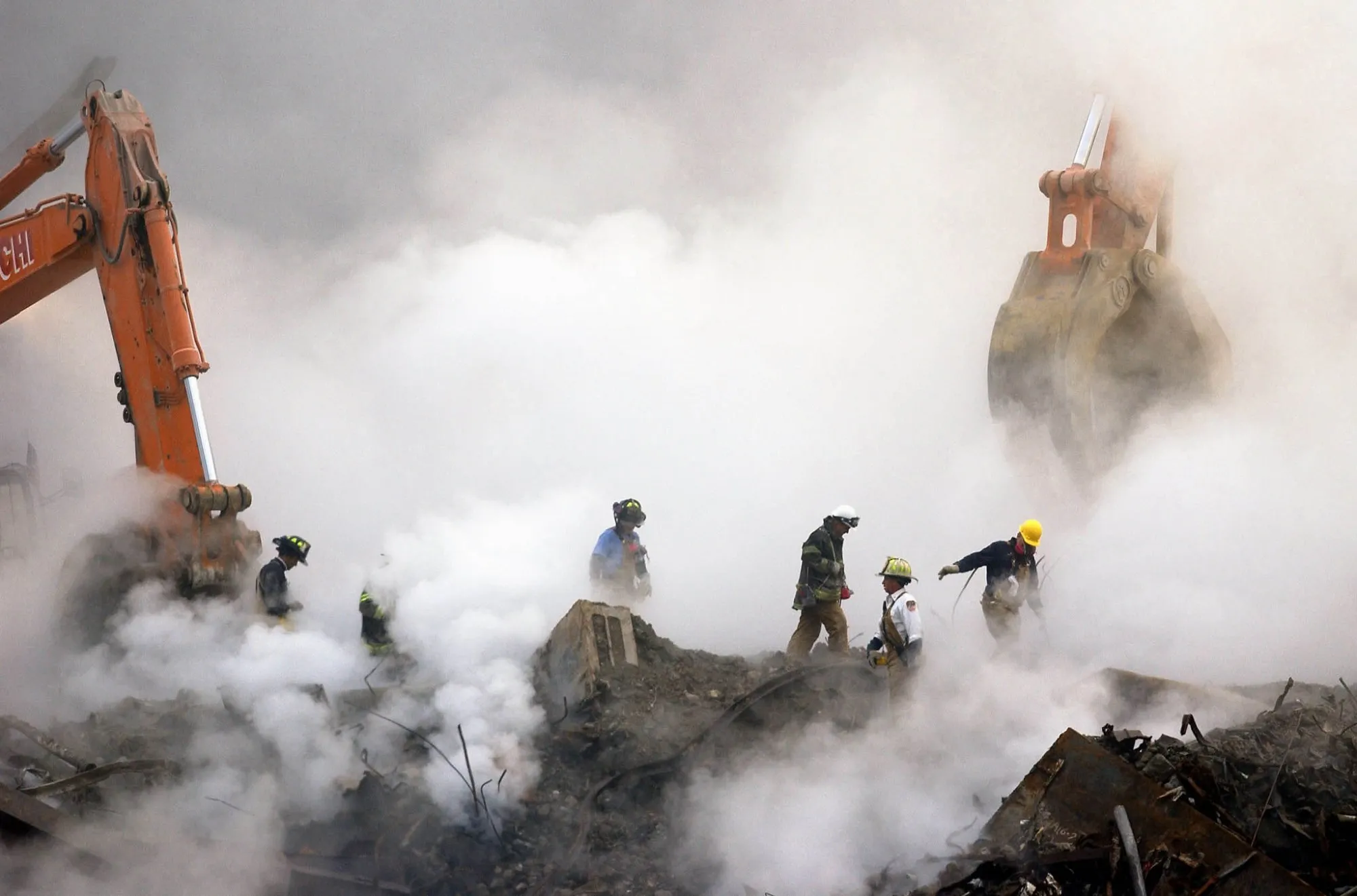
NEW YORK — In the days and weeks after 9/11, as those working the pile began coughing, City Hall denied knowing anything about the hazardous toxins that wafted above Ground Zero.
Read more Federal judge extends block on Trump executive order seeking to limit mail voting in the midterms
Then, as people began dying, City Hall still denied having any information.
And even as the number of dead from 9/11 illness climbed to 6,000 — double the number who died in the attack — City Hall denied knowing anything.
Along with the legacy of heroism and sacrifice New York City is remembered for, one mayoral administration after another has left behind a legacy of anger and shame amid accusations that City Hall has been covering up what it knew about the dangerous chemicals people around Ground Zero were breathing.
That pivotal information, advocates say, could have saved lives.
“This entire history shows the worst of government bureaucracy,” said attorney Andrew Carboy, who is in the middle of an ongoing fight to get 25-year-old documents about the toxins over Ground Zero released. “To keep this information suppressed and then deny it exists is the laziest, most disingenuous form of obstruction that I can think of.”
“This government misconduct insults and disrespects survivors, the men and women who served, and the families of the fallen,” he said. “They honored the city with their bravery and selflessness. And the city can’t even reveal quarter-century-old records to them?”
But the effort to uncover the truth may soon yield some results. As the city prepares to mark the 25th anniversary of the 9/11 attacks, Mayor Mamdani has said the city’s Law Department will create an online portal where the public can access city documents about air quality tests at Ground Zero following the terror attack.
Yet still, after all the hand-wringing over claims that the city had no 9/11 toxin documents to share from four mayoral administrations, advocates for 9/11 illness survivors are skeptical about what they are going to get once the digital floodgates open.
“We have no idea of what’s going to become of this,” Carboy said. “The city has shattered my worst expectations.”
Something foul in the air
It was no secret that something foul was in the air after the Twin Towers collapsed on the morning of Sept. 11. First responders and volunteers were worried about breathing in everything from asbestos and fiberglass to pulverized bone and human tissue as they sifted through the rubble, looking for bodies.
The burning smell lingered for months after the attacks, survivors said.
“It smelled like burning plastic the whole time,” Lori Ellis, a senior manager for Century 21 on Cortlandt St. in lower Manhattan, told the Daily News about the store’s reopening five months after the attack. “But when you’re there, you get used to it. It’s like when you work at a fish market and you get used to the smell of fish.”
Daily News columnist Juan Gonzalez was one of the first to report on air quality concerns at Ground Zero. His columns in the days and weeks after 9/11 were filled with lower Manhattan residents, along with unions for first responders worried about what everyone was breathing.
But two weeks after the collapse of the towers, both the feds and the Giuliani administration still defiantly said there was a “minimal risk from the fetid, dust-filled air and smoke that continued to envelop Ground Zero,” Gonzalez wrote.
Independent air quality studies taken by the Police Benevolent Association around Sept. 28, 2001 showed that asbestos fibers were found in 2% to 5% of the samples taken. Federal regulations require abatement procedures whenever asbestos was found in more than 1% of samples.
The city Department of Environmental Protection had air monitoring stations around Ground Zero, but the results they posted began on Sept. 22-24, some 11 days after the buildings collapsed, Gonzalez wrote.
Yet even those results seemed to vanish over time.
In the fall of 2001, Carboy was working for the law firm Sullivan Papain Block on 120 Broadway. At the time, one of their clients was the Uniformed Firefighters Association, whose members were beginning to suffer from what was known back then as the “World Trade Center cough.”
He and his fellow attorneys were busy putting together notices of claim against the city for firefighters “who believe that they were exposed to toxic contaminants or had symptoms.”
“By December 2001 it was all hands on deck,” Carboy remembered. “Our large conference room became the war room for about two years.”
As more and more people got sick from the toxins over Ground Zero, Congress passed the Zadroga Act in 2010, which created the World Trade Center Health Program. Still, City Hall refused to supply elected officials, including congresspeople and senators, with any air quality studies taken at Ground Zero.
Freedom of Information Law requests were stopped in their tracks as well, with city agencies claiming that no documents could be found after diligent searches.
The continuing denials were seen by some as being linked to the Harding Memo, a pivotal document that was sent to Deputy Mayor Robert Harding in October 2001 that summarized city attorneys’ findings that “there are approximately 35,000 potential plaintiffs as a result of the events of Sept. 11 and it is estimate that 10,000 would file a claim.”
The memo then listed the potential claims against the city, including lawsuits over “health advisories (that) caused individuals to either return to the area too soon (causing toxic exposure or emotional harm) or too late (causing economic hardship).”
The document was referenced in investigative Village Voice journalist Wayne Barrett’s 2007 book “Grand Illusion.” It quickly became a holy grail of sorts for 9/11 survivor advocates looking for any documents that could show the city’s reasoning for not sharing their air quality studies.
Benjamin Chevat, the executive director of 9/11 Health Watch, Carboy and attorney Matt McCauley got their hands on the memo in February, but not from the city. It was found at the Dolph Briscoe Center for American History at the University of Texas at Austin, where Barrett’s estate had bequeathed his personal papers and notes.
Read more Aaron Cooney is Ducks’ new play-by-play voice for audio network
Advocates for 9/11 survivors believe that the city purposefully denied the existence of these records to limit their liability for the flood of lawsuits they were worried about receiving.
“They lied to limit their liability and hid the records,” Andrew Ansbro, the president of the Uniformed Firefighters Association, said about prior administrations. “They made a conscious choice to keep these cancers hidden instead of studying them. And now 25 years of mayoral sins are dropping on Mayor Mamdani’s lap.”
The search heats up
For more than two decades, the city either refused to provide the documents or claimed they couldn’t find the documents, until the Adams administration, which made it clear that they didn’t plan to release any documents until it resolved a number of issues, including the likelihood the city would get sued.
“We are aware of requests to produce city documents on the aftermath of the attacks, which would require extensive legal review to identify privileged material and liability risk, and are exploring ways to determine the cost of such a review,” a mayoral spokeswoman said.
At the same time, Carboy, Chevat and McCauley were filing FOIL requests with the city’s Department of Environmental Protection and other agencies for any documents they had about the Ground Zero toxins.
The lack of action continued until last year when City Councilwoman Gale Brewer (D-Manhattan) pushed through legislation ordering the city’s Department of Investigation to launch a probe over what and when the city knew about the toxins.
“The [Harding] memo is very clear that there’s [additional] material to be had,” Brewer said earlier this year. “I don’t know why we had to wait more than 20 years for this to come out.”
A Daily News story published last year as the city marked the 24th anniversary of the terror attacks disclosed that only eight weeks into the DOI review, the response for documents put out to other city agencies was so overwhelming the agency was looking at the possibility of getting outside help to parse through all the data.
Then, after telling Carboy that they had no documents to share — and even petitioning the court to dismiss the attorney’s FOIL requests, calling the search nothing more than a “fishing expedition” — the DEP late last year suddenly produced 68 boxes of materials for attorneys to sort through, some of which the agency said it discovered while replacing the carpets in one of their offices.
“We’re witnessing pure alchemy, creating documents from absolutely nothing! It’s a fantastic feat, pure magic,” Carboy said last year, stunned by the sudden turnaround.
The city was nonplussed over the sudden discovery.
“The city’s FOIL response reflected what was true and accurate at the time: DEP couldn’t locate hard copy documents,” Law Department spokesman Nicholas Paolucci said at the time. “That has since changed and we have a schedule in place to produce documents.”
What comes now?
Most of those documents are expected to be released publicly by the 25th anniversary, Mayor Mamdani vowed as he added $34 million to the city’s budget so the law department — which has continued to try and block Chevet and Carboy’s legal attempts to get the documents — could create an online portal for people to access documents about post-9/11 air quality and health risks.
“For too long, New Yorkers who have become sick have had to fight for information that should have been theirs from the very beginning,” Mamdani said in July. “We will provide the transparency that New Yorkers living with post-9/11 health concerns deserve.”
An additional $4 million was earmarked for the DOI probe, which should be completed next year.
But for thousands, the damage has already been done.
Upwards of 6,000 people have died of 9/11 illness from breathing in the air at Ground Zero, according to best estimates, twice the number who died the day of the attack.
Out of that number, 610 active FDNY members and agency retirees who volunteered their time to work on the pile have died of a 9/11 cancer or illness. So have 432 NYPD members — far outpacing the 366 cops and firefighters who died in the World Trade Center collapse.
More than 145,000 people have enrolled in the World Trade Center Health Program. Out of that number, about 81,000 have a certified medical condition linked to the toxins that hung above Ground Zero.
And the number keeps growing: by the end of June, 4,276 people have enrolled in the program this year, officials said.
Once they are released, the new documents won’t likely cause a flurry of lawsuits since first responders and survivors who are receiving help from the WTC Health Program and the 9/11 Victim Compensation Fund have already signed waivers agreeing not to sue over their illnesses. More than 100,000 people have signed these waivers, officials said.
But the air quality studies conducted by the city more than 20 years ago could be imperative to learning more about the cancers that survivors are facing, advocates said.
“We could find a smoldering gun,” Chevat said. “It’s about finding out the truth. The city should have been more careful when they brought people back into lower Manhattan.”
“There should be a reckoning on what they did know and when they knew it,” he said.
Read more Trump and Kennedy’s health industry deals haven’t been enforced and are at risk of vanishing