
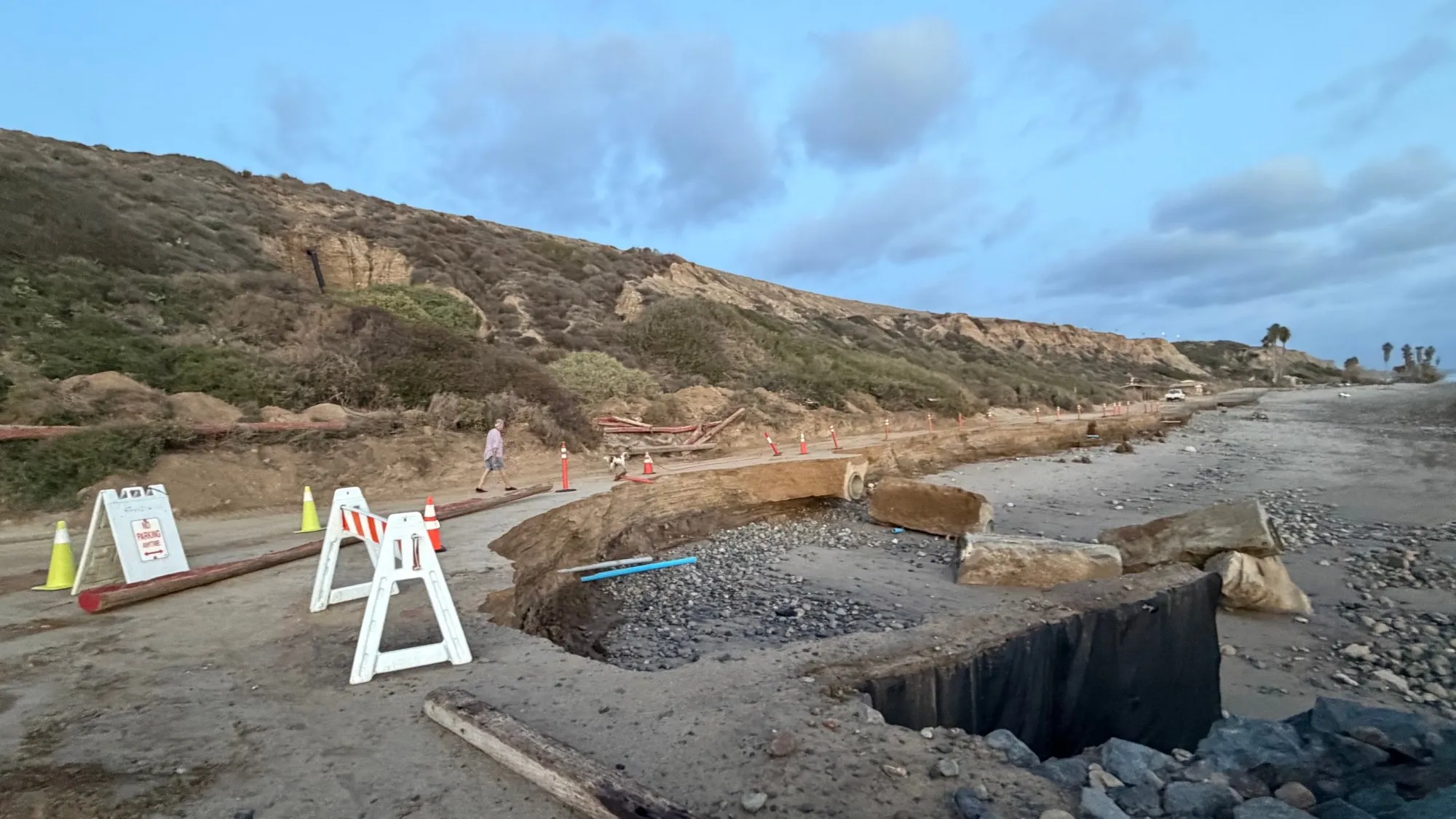
A pilot program for a cobblestone barrier where the ocean is eating away at an eroded stretch of sand at San Onofre Surf Beach is in the works, with hopes that new rocks similar to the natural landscape will be put down by December.
Read more Fryer: Finish first? Hit the road. Finish last? Start the CIF-SS playoffs at home
The idea is for the nature-based solution to serve as a model for long-term erosion protection in coming years.
State Parks officials are also considering creating a trail from an upper bluff so people can get to the beloved beach, which would allow a loop road that served as a line where visitors often wait sometimes for hours for a car to exit before being allowed entry to be turned into a parking area that could hold 88 vehicles.
The updates were given at a recent community forum hosted by the Surfrider Foundation, the San Onofre Parks Foundation and State Parks, drawing a full crowd awaiting word on when the dirt road and lower lot parking area would reopen.
“I think, as we can all very well attest to, the conditions at Surf Beach are getting much more dire every day,” said Alex Ferron Mignogna, coastal adaptation manager with Surfrider. “So this is definitely timely.”
The discussion comes as relentless high tides and swells for months have battered San Onofre Surf Beach so beyond repair that officials recently said the dirt road leading to the shore will be closed to cars through at least spring, with upcoming El Niño conditions potentially doing even more damage.
The tucked-away surf destination, wedged between San Clemente and San Diego, was closed on Oct. 7 following a hurricane swell that clawed out a section of the road near the entrance. A series of mega high tides worsened erosion at the already vulnerable pinch point just south of a seawall.
Parking for now is limited to a small upper concrete parking lot, and the area is still open to pedestrians and bicyclists.
The latest discussion is the third in a series of community meetings, using a $1 million grant awarded in 2024 by the California State Coastal Conservancy, to figure out the best way to approach maintaining the natural landscape long term and providing the public continued access in years to come.
Concerns about the access road began about a decade ago, when El Niño conditions in 2015 and 2016 eroded a large section of the beach. The damage was so bad, State Parks filled in about 900 feet of rock revetment to stabilize that portion of the parking lot in 2017.
Beachfront parking went from 330 spots to 160, and to even fewer in recent months.
The current grant gets planners to about 30% of design, with more funding needed to move to final design and implementation. Surfrider is waiting to hear about another grant that may be available by the end of the year, officials said.
Part of the community discussion was to find out what solutions people prefer, one of them being a natural cobble berm to disperse the wave surge and protect the road. Patches of cobble already exist naturally, but the idea would be to haul in more to be placed at a heavily eroded section just south of the rock revetment where the road is nearly impassable.
“There’s a lot of native cobble on that beach, and the idea of using cobble to protect that beach was an attractive option for folks,” Mignogna said.
Read more Fryer: JSerra vs. Newport Harbor again in a CIF-SS boys water polo final
The other popular idea from surveying the public was allowing erosion to occur and letting the beach turn to a more natural state, she said. “I personally wasn’t expecting that.”
Mignogna pointed to Surfers’ Point in Ventura, an area battered by erosion and the sea until it became inaccessible, but with long-term planning is now a healthy, resilient stretch of beach.
State Parks environmental scientist Riley Pratt showed the gathered audience photos of some of the recent damage, including a wall that supports the back of the riprap leading into the beach that buckled and collapsed.
“The latest storms really did a number on the north end of this revetment,” Pratt said.
A steep drop-off of 6 feet, even 8 feet in places, now exists where the road has been eroded away. Big pipes have broken into several pieces.
While the current El Niño-fueled tide levels are expected to drop back to normal following the climate event, the sea levels the coast are experiencing now are what people can expect in the future, in about 20-to-25 years, up about 12-to-20 inches, he said.
“We’re sort of getting a glimpse into the future,” Pratt said. “The beach is essentially migrating landward.”
James Jackson, civil engineer and hydrologist with Environmental Science Associates, said his team has been tasked with coming up with a resiliency plan for Surf Beach.
The project goal is to develop a nature-based shoreline concept for Surf Beach that reduces wave overtopping, and eases damage to the parking lot, road, and facilities, he said.
“We have a small cobble berm along the whole length of Surf Beach, and cobble berms can be found along many beaches in Southern California. It just happens to be buried a lot of the time,” Jackson said of the highest-ranking option being looked at.
“Cobble berms naturally accumulate where there’s space, dissipating wave energy, and serving as a buffer to what’s behind them for wave runup and erosion,” he said. “And so the natural morphology of a cobble berm fits with the site here, and it’s the most compact, natural solution that we could fit at the site.”
Cobble moves dynamically and adjusts with storms, meaning it is able to adapt under high water during El Niño season or storms, he said. “Cobble is able to adapt and adjust with those waves to help reduce that impact and limit some of the other negative effects that traditional mechanisms and means of erosion protection lead to, like revetments and seawalls.”
“It is definitely harder to walk down a cobble berm than a sandy shoreline,” he added, “but it’s much more feasible than crawling down a revetment.”
Read more Sofia Dajnowiec leads Corona del Mar girls volleyball to CIF-SS championship