
Add a Pac-12 executive, the Mountain West commissioner and a U.S. senator to the list of voices that have, directly or indirectly, addressed Pac-12 expansion in recent weeks.
Read more LA County directs attorneys to weigh in on 12 states’ lawsuit to block Paramount-Warner merger
Taken collectively, their words (and actions) suggest the conference is unlikely to add a ninth football school, at least in the near term.
Should we believe them? After all, circumstances change rapidly in realignment.
The layers of intrigue are both deep and wide, stretching from Pac-12 campuses to the U.S. Senate.
But to accurately read the e-leaves provided by Pac-12 deputy commissioner Rick Hart, Mountain West commissioner Gloria Nevarez and Sen. Maria Cantwell (D-Washington), context is required.
In April, Colorado State athletic director John Weber and two Washington State officials, president Elizabeth Cantwell and athletic director Jon Haarlow, addressed the Pac-12’s expansion calculation. In totality, their public comments indicated the conference is standing down.
“We are building a new brand, which is both unique and very powerful,” said Cantwell, who is not related to the Washington senator. “Any additional schools would have to be ready for that brand. We operate really tightly … You don’t see that really anywhere else. It’s a huge value for us at the moment, and we wouldn’t want to mess that up.”
There’s a cost to competing with just eight football schools, however. The conference opted to play a seven-game schedule and include an unprecedented flex weekend at the end of the season. Each team will play one of the others, but the Nov. 28 games won’t count in the standings.
Ideally, the Pac-12 would have nine football schools, eight conference games in a pure round-robin format and no need for the flex weekend arrangement. But Hart, the deputy commissioner, placed the challenge in perspective during a Q&A session with the media at Fresno State last month.
Referencing expansion, Hart said: “That’s another way to solve the operational problem with football: add a team. But (conference executives) have been very thoughtful and deliberate about, ‘You don’t solve operational problems through membership.’
“We talk about (expansion) at every membership meeting. It’s certainly something that’s top-of-mind that we continue to evaluate. But until or unless someone adds value to our existing members, we’re going to embrace the teams we have.”
The school cited most often in expansion chatter is UNLV, which rejected a Pac-12 invitation in the fall of 2024 when Boise State, Colorado State, Fresno State, San Diego State and Utah State made the move from the Mountain West.
Could the Rebels be next? Nevarez addressed the stability issue during her podium session at Mountain West football media days last week.
“I do believe the Mountain West is as stable as we can be at the moment, largely based on the fact that our current members all have committed to the grant-of-rights,” she said.
Nevarez added that the conference would meet the financial obligations to the schools in the grant-of-rights agreement and noted that any speculation to the contrary, in the wake of the lawsuit settlement with the Pac-12, was inaccurate.
That wouldn’t necessarily prevent UNLV from eventually leaving for the Pac-12. But to this point, there is no evidence the Rebels want to change conferences.
Their goal is membership in the Power Four — in the Big 12, specifically — and the Mountain West could be viewed as the more strategic launch point. Why? In theory, the weaker competition offers UNLV an easier path into the College Football Playoff.
Read more Wreckage found of Pan Am plane crash that helped lead to today’s safety briefings on every flight
However, the future of realignment at all levels is playing out on Capitol Hill this month, where a Senate Commerce Committee bill could have sweeping implications for schools in both the Pac-12 and Mountain West.
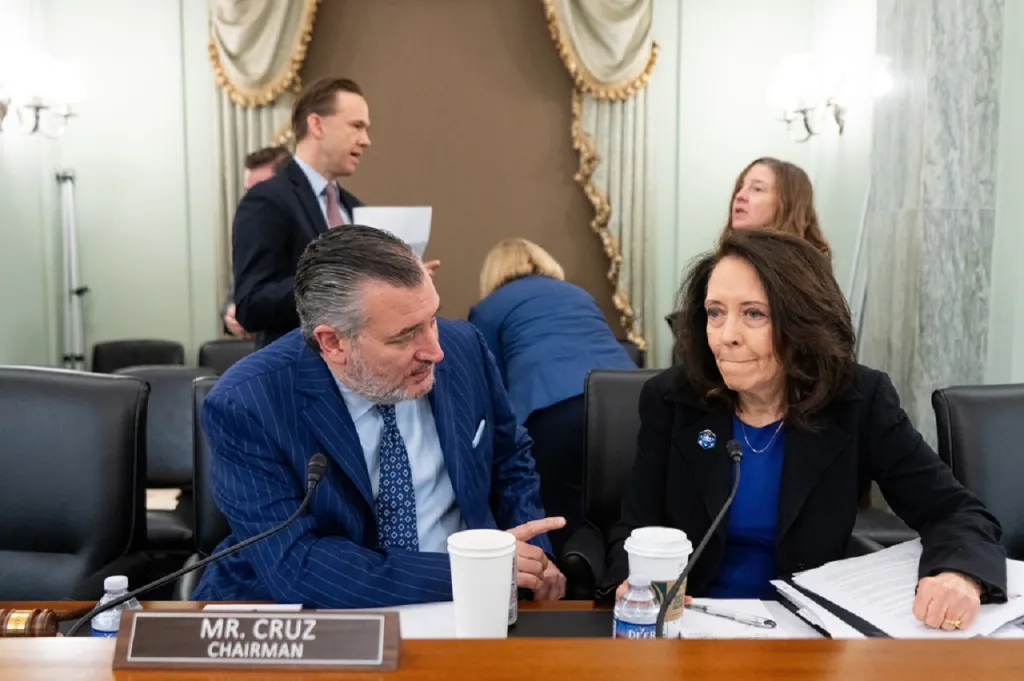
The Protect College Sports Act, which counts Maria Cantwell as a co-sponsor, offers college sports help with issues ranging from agent regulation to NIL compensation and eligibility standards. It also features a controversial provision targeting conference expansion.
The original version prohibited any conference generating at least $1 billion in annual revenue from expanding. Only two clear that threshold, the SEC and Big Ten. They were not pleased and made their objections known to Cantwell, co-sponsor Ted Cruz (R-Texas) and their staffs.
But the next iteration of the PCSA was, in some regards, much worse: It effectively froze conference membership throughout the Football Bowl Subdivision.
Instantly, frustration soared within the Group of Six, which is stocked with schools hoping to eventually move into the power conferences. Every member of the rebuilt Pac-12, for example, is eyeing an invitation to the next version of the Big 12 or ACC. Same with schools in the Mountain West.
Yet another round of changes to the PCSA’s so-called anti-expansion provision is underway, with Sen. Cantwell telling Yahoo: “I want teams to be able to move where they want to like Washington State. We’ll get an adjustment to that language.”
But the details are critical, and it’s unclear whether Cantwell and Cruz recognize the interconnected nature of realignment.
For schools hoping to ascend the conference hierarchy, merely tweaking the language to allow Group of Six members to move up isn’t nearly enough. Congress also must loosen restrictions at the Power Four level.
If the SEC and Big Ten cannot add teams from the ACC and Big 12, then the ACC and Big 12 won’t experience the attrition that could prompt backfilling from schools (emphasis on the plural) from the Group of Six.
No member of the Group of Six currently claims the competitive success or media value needed to gain entry into the Power Four as a singular entity.
Put another way: The Big 12 is unlikely to take just one.
Rather, the most favorable ascent seemingly requires the Big 12 or ACC to lose several schools to realignment and turn to the Group of Six for replacements. In numbers, there is strength, stability and value.
Unless Cantwell and Cruz lift the anti-expansion restrictions on the SEC and Big Ten the realignment pipeline could remain clogged.
That, in turn, would impact the likelihood of Pac-12 expansion.
If the eight football schools don’t have anywhere to go, the need to add schools to enhance the conference’s competitive and financial value could wane.
Fortunately, clarity should come sooner than later.
If the PCSA doesn’t reach the Senate floor for a vote before the August recess in two weeks, it could die in committee … and keep the realignment pipeline flowing.
Read more Man tossed by Yellowstone bison says hitting the ground was the worst part