
By PHILIP MARCELO
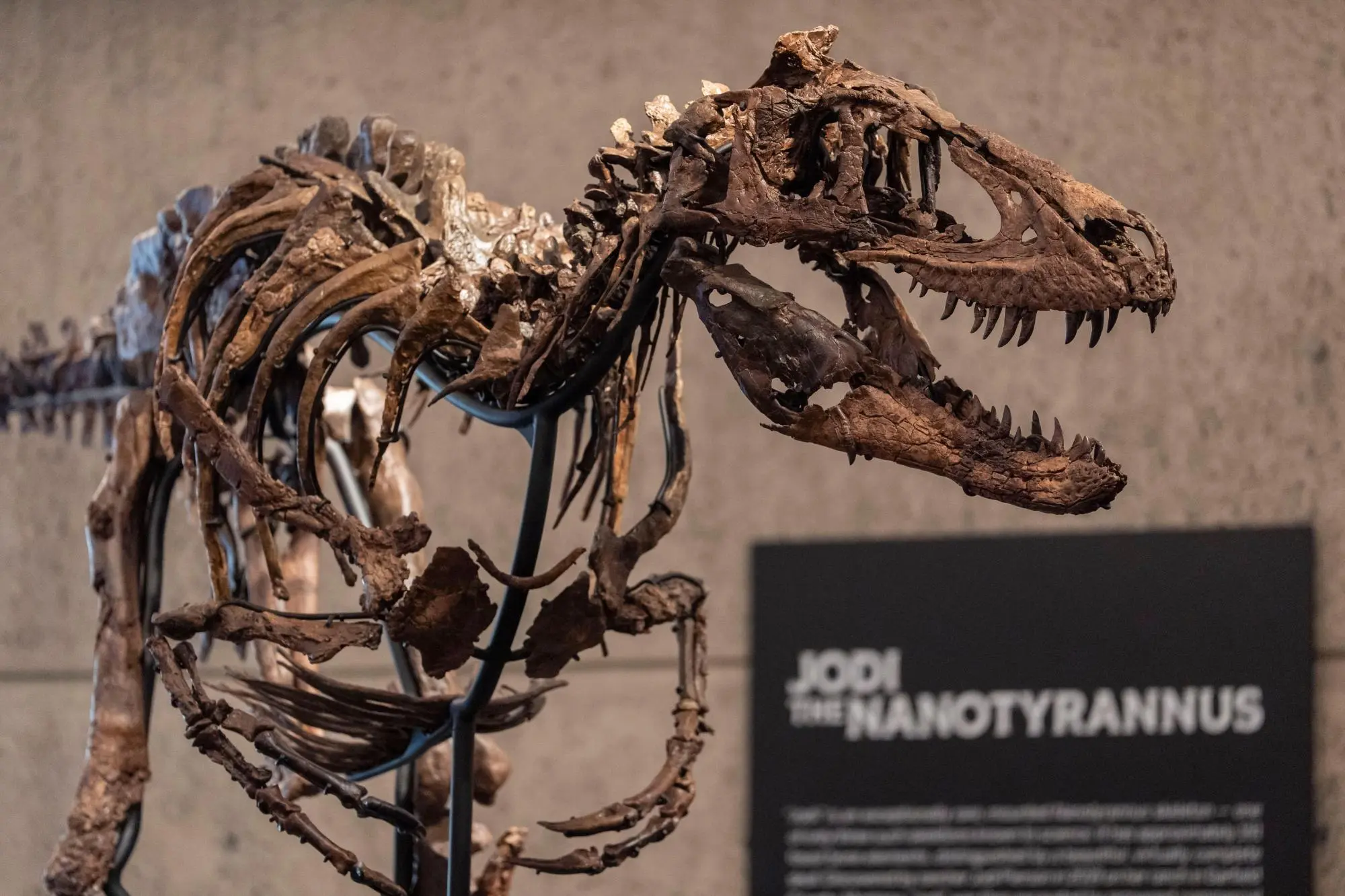
NEW YORK (AP) — On quick glance, the fossil unveiled Tuesday at a Manhattan auction house looks like an undersized Tyrannosaurus rex, with its signature gaping jaw filled with razor sharp teeth. But the proportions are off, as its arms and legs are much too long.
Read more Fueling your young athlete: a pediatrician’s advice
That’s because the dinosaur skeleton isn’t actually a T. rex but a recently confirmed distant cousin. The Nanotyrannus, as this smaller, nimbler predator is known, is on view in the lobby of Sotheby’s headquarters ahead of its Oct. 27 auction.
Standing 6.5 feet tall and stretching nearly 20 feet long, the rare fossil is one of only three such skeletons known to exist.
“What’s really exciting is that until they proved this genus existed, we thought that T. rex was the only apex predator of the Cretaceous,” said Cassandra Hatton, a vice chair at Sotheby’s. “We now know that they coexisted. They lived alongside each other, occupying distinct niches in the ecological system.”
Scientists long wondered whether Nanotyrannus was a young T. rex
A decades-long scientific debate kicked off with the 1942 discovery of what’s now considered the first Nanotyrannus head, the so-called “Cleveland Skull” housed at the Cleveland Museum of Natural History.
Fast forward to last October, when new research concluded that the Nanotyrannus was in fact a distinct genus of dinosaur that coexisted with T. rex.
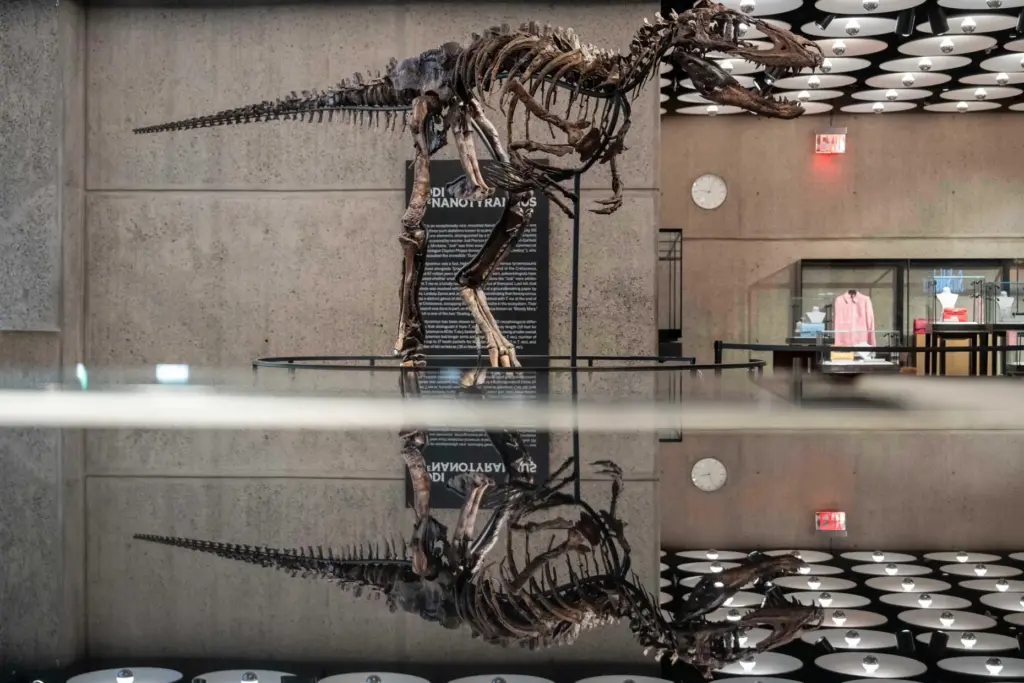 Jodi, a mounted Nanotyrannus skeleton, of the Cretaceous Period, approximately 67 million years ago, estimated at $6 – 9 million, is displayed at Sotheby’s, Tuesday, Oct. 13, 2026, in New York. (AP Photo/Yuki Iwamura)
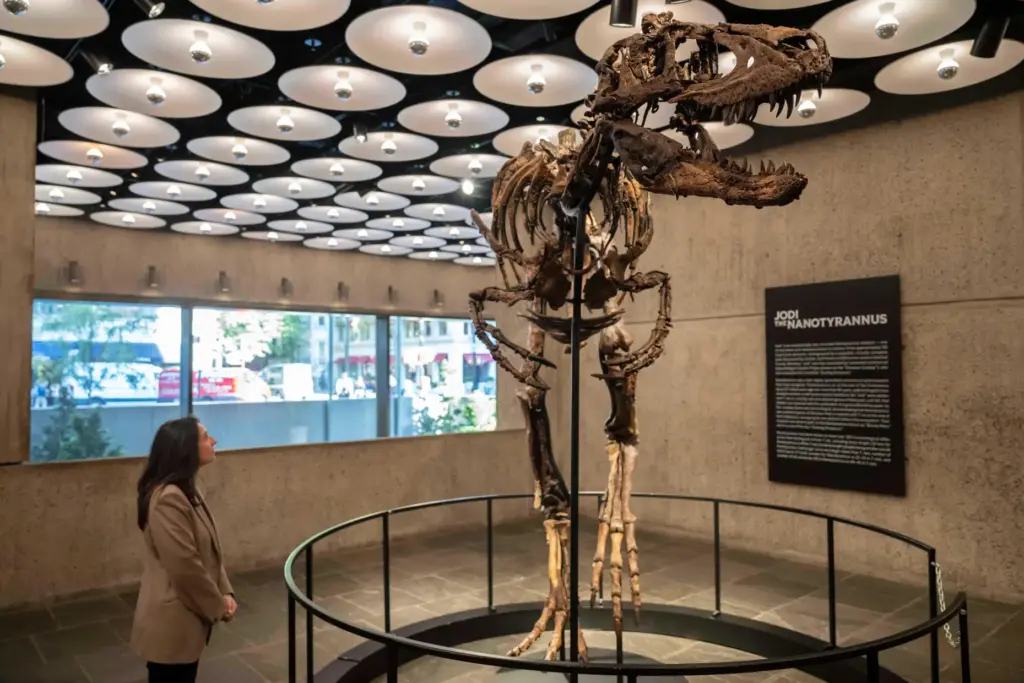 Jodi, a mounted Nanotyrannus skeleton, of the Cretaceous Period, approximately 67 million years ago, estimated at $6 – 9 million, is displayed at Sotheby’s, Tuesday, Oct. 13, 2026, in New York. (AP Photo/Yuki Iwamura)
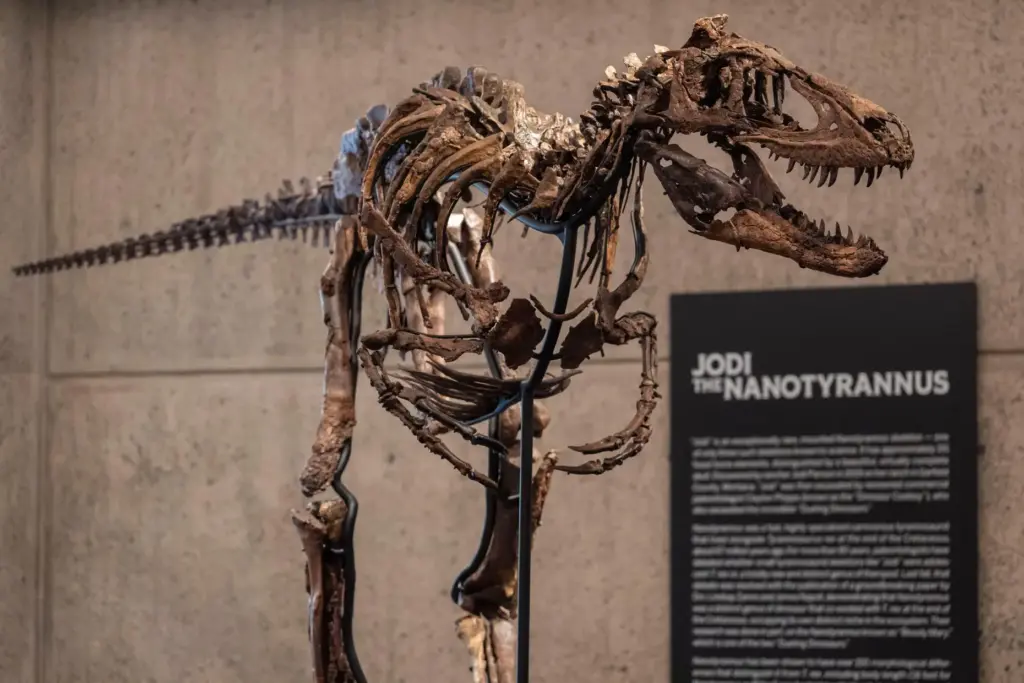 Jodi, a mounted Nanotyrannus skeleton, of the Cretaceous Period, approximately 67 million years ago, estimated at $6 – 9 million, is displayed at Sotheby’s, Tuesday, Oct. 13, 2026, in New York. (AP Photo/Yuki Iwamura)
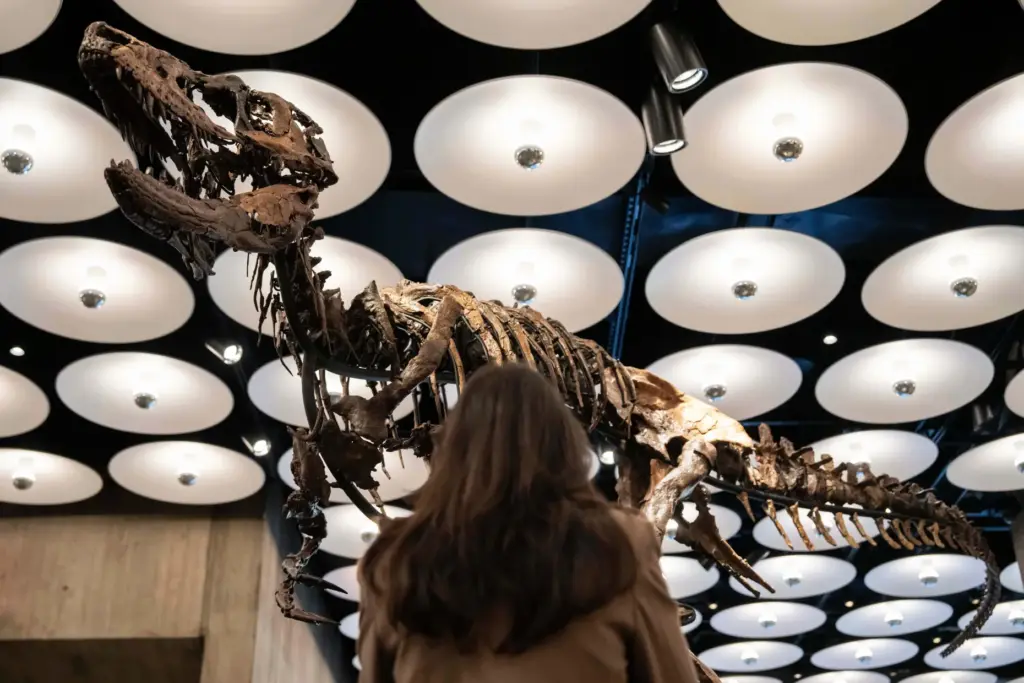 A person looks at Jodi, a mounted Nanotyrannus skeleton, of the Cretaceous Period, approximately 67 million years ago, estimated at $6 – 9 million, at Sotheby’s, Tuesday, Oct. 13, 2026, in New York. (AP Photo/Yuki Iwamura)
Scientists examining the growth rings within preserved bones found the dinosaurs were fully formed adults, not juveniles. The research challenged long-held assumptions that the mighty “King of the Tyrant Lizards” was the sole large predator of the Cretaceous period, some 67 million years ago.
“It’s like a lion and a cheetah,” Hatton explains. “They hunted different prey. They were around at the same time. It’s possible T. rex ate these.”
Indeed, there are more than 150 key differences between the Nanotyrannus and T. rex, the most noticeable being their sizes.
At about 18 feet long, an adult Nanotyrannus was about half the length of an adult T. rex. Instead of the T. rex’s famously stubby arms, its forelimbs were longer and its hand claws were larger.
Nanotyrannus also boasted more and different-looking teeth. Whereas the T. rex’s were bond-crushingly thick and almost banana shaped, the Nanotyrannus’ were more slender and almost bladelike.
Read more Battle lines shift in House races as Republicans retreat from front-line districts
“Those teeth would slash the meat off of the animal it was hunting. It went after faster prey,” Hatton explained of the Nanotyrannus. “You look at a T. rex, it’s big, lumbering. It went after slower prey, and it would eat the whole thing.”
Sotheby’s bills “Jodi,” as the dinosaur fossil is nicknamed, as the “finest and most complete” Nanotyrannus skeleton currently available. Hatton said it’s almost 70% complete, with a virtually complete skull and a jaw that has roughly 35 teeth.
The fossil is named after Jodi Pierson, the Montana rancher who discovered it on her land in 2019. Its discovery and excavation were the focus of the Discovery Channel documentary series “Dino Hunters” in 2020.
“Jodi” was found some 8 miles from where the so-called Dueling Dinosaurs fossil — which depicts a Nanotyrannus and a Triceratops — was unearthed in 2006.
That famous specimen, nicknamed “Bloody Mary,” is considered nearly 100% complete, but it’s housed at the North Carolina Museum of Natural Sciences and is not for sale. The third Nanotyrannus skeleton is located at the Burpee Museum of Natural History in Rockford, Illinois.
Some scientists oppose such sales
The Society of Vertebrate Paleontology, an advocacy group of scientists, scholars and students, has called for significant fossils like “Jodi” to be publicly displayed in museums and other research institutions rather than sold privately.
But Hatton argued that if it wasn’t for the professional dinosaur hunters, the world might not have known that Nanotyrannus existed.
“These people are crucial in the preservation of science,” she said. “We don’t have enough universities and museums out there digging and doing field programs. We absolutely need private diggers who invest their own money to go do this.”
Stuart Sumida, the society’s president and a biology professor at California State University San Bernardino, rejected the notion as a “blatant lie.” The latest auction comes after Sotheby’s sold a T. rex fossil for a record $50.1 million this summer.
“No peer-reviewed scientific study can be published on specimens that are not held in the public trust,” he said. “Once in private hands it can never be studied, and generations of children and adults alike will never see it again.”
Read more Orange County football season stat leaders, Oct. 13