
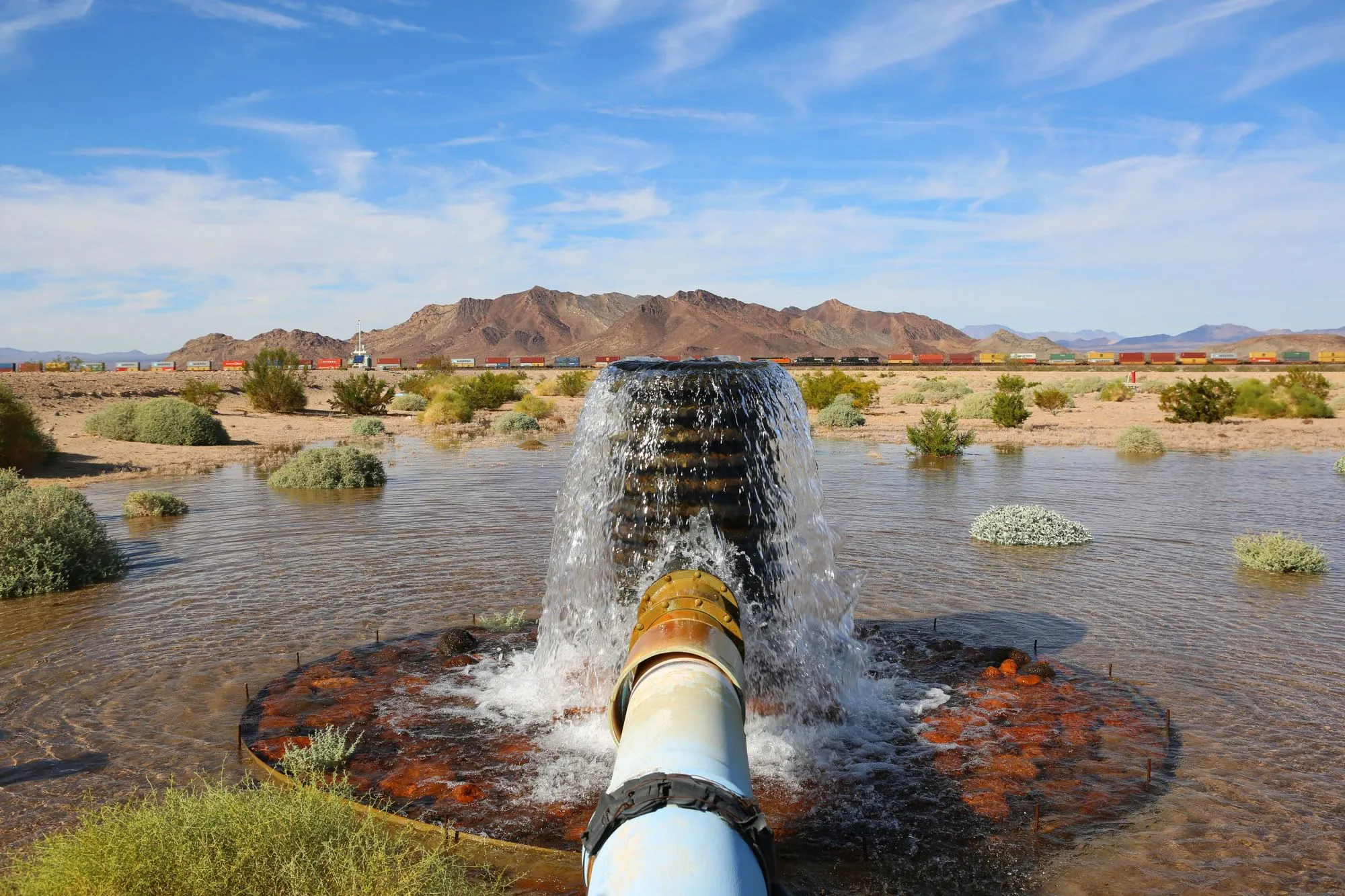
San Bernardino County has partnered with a Cadiz Inc. affiliate to establish a public financing authority that could advance the company’s controversial Mojave Desert groundwater pipeline project, which has faced years of environmental opposition and litigation.
Read more Iranians fear a possible return to all-out war as US and Israeli elections approach
The San Bernardino Water and Power Authority announced its formation Monday, Oct. 19, following an inaugural meeting on Oct. 5. The county Board of Supervisors unanimously approved the joint powers agreement with Fenner Gap Mutual Water Co., the Cadiz affiliate, on April 21.
The partnership marks another potentially significant development for Cadiz, which has spent decades trying to bring its groundwater in the Cadiz and Fenner valleys, near Amboy, to Southern California communities despite fears that pumping could dry up natural springs and damage fragile desert ecosystems.
Now, with a key federal pipeline approval secured under the Trump administration in July and San Bernardino County identifying its affiliated project as a regional funding priority, Cadiz has gained a new potential avenue for financing infrastructure needed to deliver its water. But whether the authority will actually fund any of the company’s projects remains undecided.
Neal Desai, senior Pacific regional director for the National Parks Conservation Association, accused Cadiz of using the new financing authority to advance its controversial groundwater project.
“It’s pretty obvious that this JPA is a front to help secure financing for its toxic project,” Desai said.
The authority can issue revenue bonds, seek state and federal grants and attract private investment to finance groundwater storage, pipelines, water recycling, stormwater capture, groundwater recharge and related energy infrastructure.
“The County approved creation of the Authority to strengthen regional cooperation and support development of essential water and power infrastructure,” Board of Supervisors Chair Dawn Rowe said in the Oct. 19 announcement.
She said the authority would provide a cost-effective way to finance infrastructure and help lower water and energy costs for county residents and businesses.
The authority’s governing board includes Inland Empire Utilities Agency board President Steve Elie as president; Barbara Lloyd, representing Fenner Gap, as treasurer; Dakota Higgins, representing county Supervisor Paul Cook, as interim secretary; and Supervisor Curt Hagman.
The IEUA formally joined the authority Sept. 2, while the Victor Valley Wastewater Reclamation Authority voted Sept. 17 to express its intent to join.
Fenner Gap’s participation gives a Cadiz-affiliated company a direct role in governing a public financing authority that could potentially fund infrastructure associated with Cadiz’s groundwater development plans.
Pipeline momentum
The Trump administration gave Cadiz the green light to convert approximately 162 miles of an existing 220-mile natural gas pipeline to transport water from Cadiz’s property through the Barstow area to Mojave in Kern County.
Cadiz says its Northern Pipeline project could help deliver water to underserved communities in San Bernardino County’s High Desert and Inland Valley regions, including Fontana, Rialto, Rancho Cucamonga, Victorville, Hesperia, Barstow and Adelanto, a company spokesperson confirmed.
The pipeline is a key component of Cadiz’s Mojave Groundwater Bank, a groundwater extraction and storage project under development on Cadiz’s 45,000 acre property adjacent the Mojave National Preserve.
Cadiz estimates the aquifer system contains 30 million to 50 million acre-feet of quality groundwater — roughly 9.8 trillion to 16.3 trillion gallons. The project calls for pumping an average of 50,000 acre-feet annually, or about 16.3 billion gallons, over 50 years, enough to serve approximately 400,000 Southern California residents, according to the company.
Cadiz also proposes storing up to 1 million acre-feet of imported water underground during wet years for use during droughts. A separate pipeline has been proposed that would connect the groundwater bank to the Colorado River Aqueduct, about 45 miles south.
In 2024, Cadiz disclosed agreements and preliminary arrangements to provide up to 5,000 acre-feet annually each to Fontana Water Co., the Cucamonga Valley Water District in Rancho Cucamonga, and the Santa Margarita Water District in Rancho Santa Margarita, primarily through regional water exchanges.
Fenner Gap also signed a letter of intent with the Victor Valley Wastewater Reclamation Authority to coordinate pipeline, recycled water and groundwater storage projects benefiting high desert communities, including Victorville, Hesperia and Apple Valley.
San Bernardino Water and Power Authority spokesman Anthony Fitzgerald said Fenner Gap representatives approached the county about forming the partnership, citing the need for sustainable, reliable and affordable water supplies. He said the authority could begin pursuing regional infrastructure grants as early as 2027, potentially reducing costs through shared investments and economies of scale.
Fitzgerald emphasized that no projects, including Cadiz’s Northern Pipeline, have been formally proposed for financing. The authority is still establishing its organizational structure and hiring staff.
Funding priorities
But San Bernardino County had already identified Cadiz’s Mojave Groundwater Bank as a priority for state and federal infrastructure funding.
In a June 2025 letter to Gov. Gavin Newsom and state legislators, Rowe and then-Board of Supervisors Vice Chair Joe Baca Jr. listed the groundwater bank first among four major water projects for which the county was seeking funding amid growing concerns about drought, population growth and long-term water security.
They described it as a “one million-acre-foot groundwater storage facility and 2.5 million-acre-foot water supply project” that would use regional pipelines and recharge basins to serve high desert and San Bernardino Valley communities.
The letter also identified the IEUA’s Chino Basin Program, the Victor Valley Wastewater Reclamation Authority’s One Water Concept and the San Bernardino Valley Municipal Water District’s Cactus Basins Recharge Project as funding priorities.
The county’s earlier endorsement of the groundwater bank as a funding priority, coupled with Fenner Gap’s role in the new authority, raises questions about whether Cadiz’s long-stalled infrastructure plans could eventually benefit from public financing.
Read more Ukraine disputes Elon Musk’s claim that its military violated Starlink’s terms of service
Years of controversy
Cadiz’s groundwater project has faced environmental opposition and legal challenges for decades, largely over concerns that pumping could deplete underground water supplies, dry up desert springs and threaten wildlife habitat.
Of particular concern is Bonanza Spring, about 11 miles from Cadiz’s wellfield near Mojave National Preserve. Environmental groups contend the spring is connected to the aquifer Cadiz intends to tap and could be harmed by pumping. Cadiz maintains that company-backed studies dispute that connection and insists the project would not damage the spring.
Desai said California officials have determined Bonanza Spring is connected to the aquifer Cadiz intends to tap, and that proposed pumping would exceed natural groundwater replenishment by 25 times.
He noted that California enacted legislation in 2019 requiring additional environmental review, while state courts upheld earlier project approvals without determining whether the underlying science was correct. Separate federal rulings invalidated pipeline permits in 2019 and 2022.
Two desert tribal nations also have challenged the Trump administration’s latest pipeline approval.
“Pumping water from one of the driest places in North America, or storing it there, fails the laugh test,” Desai said.
Image problems
The controversy also has complicated Cadiz’s efforts to gain political support and overcome its reputation.
In a January 2024 Los Angeles Times column, Cadiz CEO Susan Kennedy acknowledged the company’s image problems, saying, “In Sacramento, the Cadiz name is a poison pill.” She said changing public perceptions of the company was a priority.
San Bernardino County spokesperson Lauren Howland said the county’s participation in the new authority does not constitute an endorsement of Cadiz’s groundwater extraction project or its environmental sustainability.
She said the county approved the project in 2012 following an environmental review and continues overseeing compliance with its groundwater management, monitoring and mitigation plan. The authority’s role is limited to financing infrastructure, not evaluating groundwater extraction or environmental impacts.
Cadiz maintains its environmental approvals have repeatedly withstood legal challenges.
According to the company, an Orange County Superior Court judge rejected all 34 claims brought by opponents in six lawsuits in 2014. A three-justice panel of California’s Fourth District Court of Appeal unanimously upheld those judgments in May 2016.
But the rulings did not end the dispute over whether large-scale groundwater pumping could harm nearby springs and desert ecosystems.
Cadiz Chief Operating Officer Cathryn Rivera said nearly 50 studies and reports spanning decades support the project’s environmental sustainability.
“The Mojave Groundwater Bank has undergone extensive local, state and federal review across multiple administrations, and its environmental approvals have withstood court challenges,” Rivera said.
She said the project would use repurposed pipelines and existing infrastructure to capture groundwater otherwise lost to evaporation, store water underground and provide an affordable, reliable supply to Southern California communities under a county-enforced monitoring plan.
Who pays?
Beyond the environmental controversy, the new authority’s ability to issue bonds and incur debt raises questions about who would ultimately pay for projects it finances.
Under the joint powers agreement, the authority must have at least three members before issuing bonds or incurring debt. Bonds can be repaid through authority revenues, funds and pledged assets without automatically becoming obligations of the county or participating agencies.
The agreement does not require members to contribute to administrative expenses or appropriate funds to repay bonds. It also requires the authority to adopt conflict-of-interest, investment and debt management policies.
Fenner Gap’s dual role as an authority member and potential beneficiary of future financing raises questions about how conflicts of interest would be addressed if Cadiz-related projects come before the board.
Howland did not specify what independent environmental, hydrological, financial or legal reviews, if any, the county conducted before partnering with Fenner Gap.
Whether the authority will ultimately help finance Cadiz’s long-planned groundwater infrastructure remains uncertain, as does who would pay for it. Although the agreement shields participating agencies from automatically assuming the authority’s debt, costs ultimately could be passed along to water customers through future water purchase agreements or other financing arrangements.
Howland said any authority debt would not become a county liability without separate Board of Supervisors approval, and the partnership does not automatically commit taxpayer money to individual projects.
“The county’s participation in the JPA does not, by itself, pledge county funds or taxpayer revenues to finance an individual project,” Howland said.
Read more Trump’s midterm swing brings him to Michigan as Republicans aim to undermine El-Sayed in Senate race