

Should children, whether it be in school or at home, have their technology use limited in some way? Well, it’s complicated, experts say.
Read more Michigan played pivotal roles in shaping transportation over the last 250 years
While parents and educators shouldn’t base their decisions on kids and technology on fear, technology should also not be allowed to strip those kids of their own “creative agency” in online spaces, either, researchers and industry professionals said during a recent panel discussion at UC Irvine.
The middle ground between those two aspects, and the overall conversation around how kids learn and play in the age of generative artificial intelligence, should “move beyond talking about risk,” said Katie Salen Tekinbaş, a professor in UC Irvine’s Department of Informatics.
Instead, she said, parents and educators should focus on how to protect these spaces: not only to make them safe for children, but also to ensure children can express themselves freely while engaging with them.
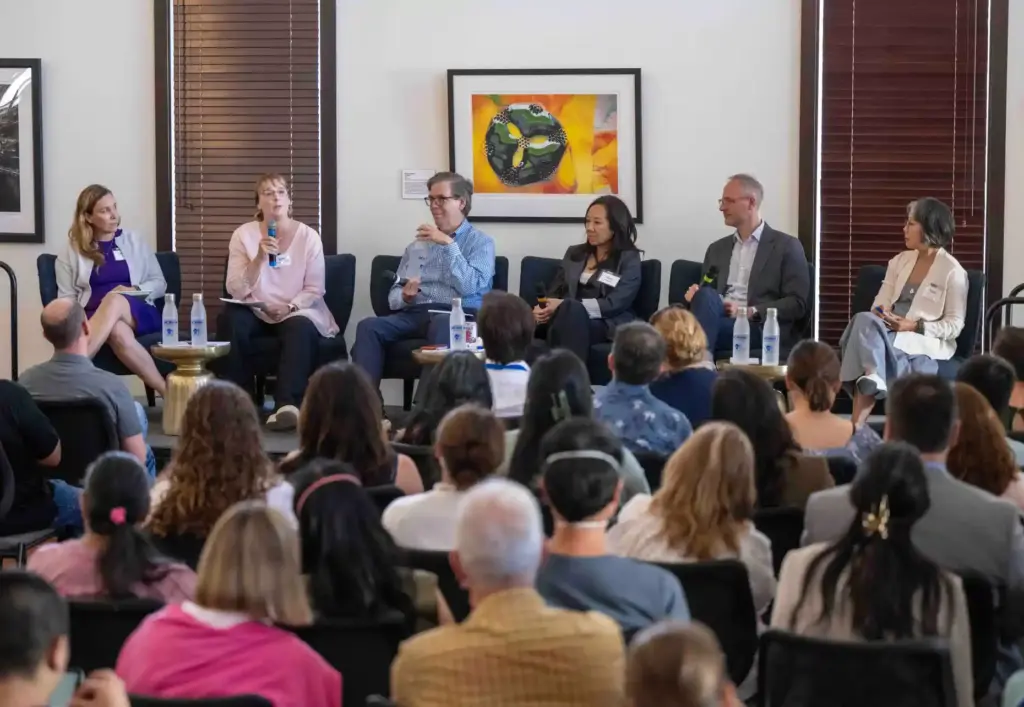 A panel of experts discuss how today’s children learn, play and thrive in the age of Artificial Intelligence, the second in a four-part series called Raising the Next Generation in the Age of AI, hosted by UCI at the Beckman Center in Irvine on Thursday, July 16, 2026. (Photo by Jeff Antenore, Orange County Register/SCNG)
 A panel of experts discuss how today’s children learn, play and thrive in the age of Artificial Intelligence, the second in a four-part series called Raising the Next Generation in the Age of AI, hosted by UCI at the Beckman Center in Irvine on Thursday, July 16, 2026. (Photo by Jeff Antenore, Orange County Register/SCNG)
 Moderator Gillian Hayes, left, a Vice Provost and Chancellor’s Professor at UC Irvine, welcomes guests and introduces the five panelists during a discussion about how today’s children learn, play and thrive in the age of artificial intelligence, the second in a four-part series, at the Beckman Center at UC Irvine on Thursday, July 16, 2026. (Photo by Jeff Antenore, Orange County Register/SCNG)
 Mimi Itō, right, Director of the Connected Learning Lab and John D. and Catherine T. MacArthur Foundation Chair in Digital Media and Learning at the UC Irvine, contributes to a panel discussion exploring how today’s children learn, play and thrive in the age of artificial intelligence, the second in a four-part series, at the Beckman Center at UC Irvine on Thursday, July 16, 2026. (Photo by Jeff Antenore, Orange County Register/SCNG)
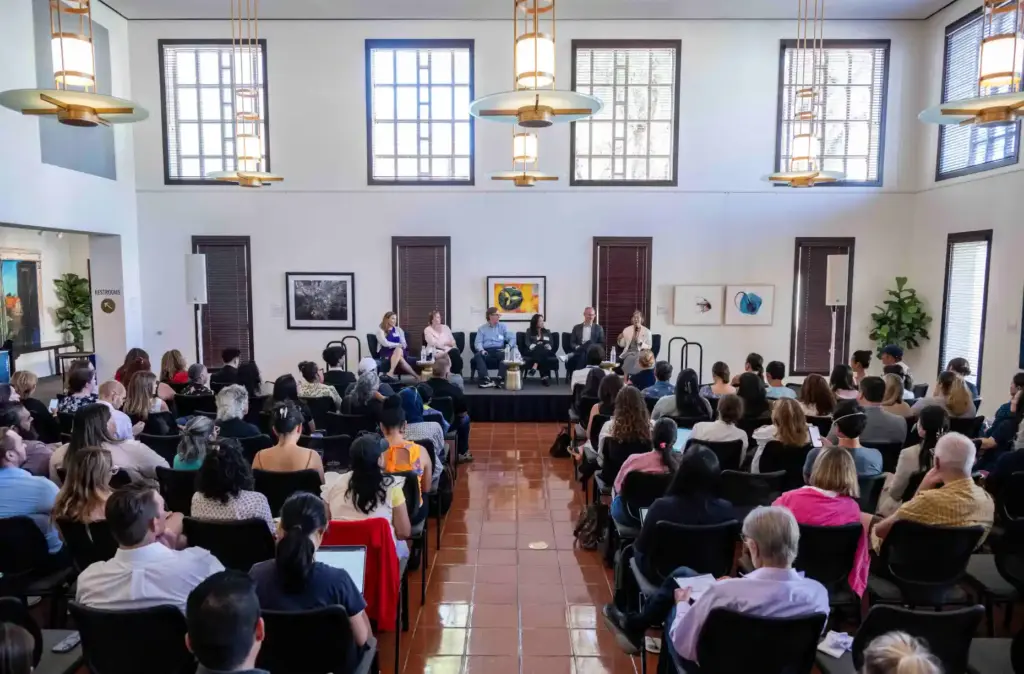 A panel of experts discuss how today’s children learn, play and thrive in the age of Artificial Intelligence, the second in a four-part series called Raising the Next Generation in the Age of AI, hosted by UCI at the Beckman Center in Irvine on Thursday, July 16, 2026. (Photo by Jeff Antenore, Orange County Register/SCNG)
 Moderator Gillian Hayes, left, a Vice Provost and Chancellor’s Professor at UC Irvine, welcomes guests and introduces the five panelists during a discussion about how today’s children learn, play and thrive in the age of artificial intelligence, the second in a four-part series, at the Beckman Center at UC Irvine on Thursday, July 16, 2026. (Photo by Jeff Antenore, Orange County Register/SCNG)
 Tami Bhaumik, center, Vice President of Civility and Partnerships at Roblox, where she spearheads the platform’s digital civility initiative, adds her expert voice to a panel discussion centered on how today’s children learn, play and thrive in the age of artificial intelligence, at the Beckman Center at UC Irvine on Thursday, July 16, 2026. (Photo by Jeff Antenore, Orange County Register/SCNG)
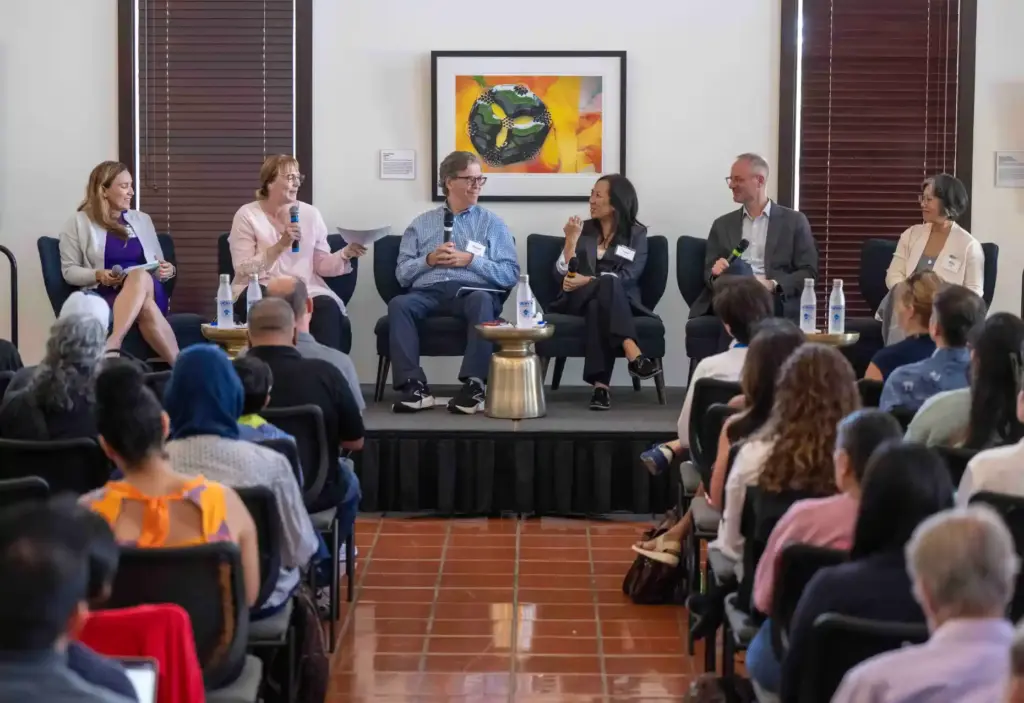 A panel of experts discuss how today’s children learn, play and thrive in the age of Artificial Intelligence, the second in a four-part series called Raising the Next Generation in the Age of AI, hosted by UCI at the Beckman Center in Irvine on Thursday, July 16, 2026. (Photo by Jeff Antenore, Orange County Register/SCNG)
More than 120 people gathered at UC Irvine’s Beckman Center of the National Academies of Sciences & Engineering Thursday evening, July 16, not just to mingle, but to hear Salen Tekinbaş and four other researchers and industry professionals in the online content space discuss how technology is being used by children, both in recreational and learning environments, and how parents and educators can support these online spaces used by children.
AI, the latest ‘tech panic’
The risks AI could pose to children, how their own creativity and curiosity could be affected and the safety of online spaces that AI is encroaching on are all just parts of the latest “tech panic,” said Michael Preston, executive director of the Joan Ganz Cooney Center, a research and development lab at Sesame Workshop, the production and media nonprofit behind Sesame Street.
These panics have always occurred whenever something new is released into the world, Preston said, but it’s different with more modern technology like AI because of the worry parents feel about how their children could be impacted.
One way generative AI impacts children is often overlooked, said Salen Tekinbaş, who has spent decades researching and designing spaces online that support adolescent mental health and wellbeing.
It can take away the improvisational, imaginative and creative aspects of the ways children play, Salen Tekinbaş said.
“We’re moving into a world, as AI moves into schools, into toys, into online play, into all aspects of childhood, (where a child’s) ability to remain in the developmental space of free and open creativity is slowly closing down,” she said.
While it sounds amazing, especially for kids, that artificial intelligence can generate universes or levels within games, finish a story or flesh out a character with minimal input, Salen Tekinbaş said, using AI to do that also “takes over the real developmental work that happens when kids are playing, when they’re learning.”
“It’s moving into a space of optimization, a space of selecting from a menu of choices,” she said. “I worry that that open space of play is going to get increasingly closed down.”
While there’s a through-line with all of these panics, Preston said, given how personalized AI can be and how it constantly engages the user, this cutting-edge technology differentiates itself from anything parents or educators have had to deal with in the past.
Despite that, Preston said, this cutting-edge technology introduces an opportunity, the same way that technologies of past generations like television or radio did: It’s an opening for researchers and educators to bring a developmental perspective into the conversation, he said.
“I think that is the challenge of our moment for the tech world, to bring that (perspective) to the doorstep and make sure that it is well attended to,” Preston said.
“And if we’re successful, that means that these products will be better, and that we have the opportunity maybe to ease some of the anxious generation of parents and caregivers.”
School policies aren’t ‘going to solve anything’
A large topic of conversation Thursday evening was the sweeping student screen-time policy approved by the Los Angeles Unified School District board in late June, which built on the district’s 2024 phone-free school day policy.
The school board established grade-specific limits on students’ screen time use, including no instructional screen time for early education through first grade and just 20 minutes of instructional screen time per day for second and third graders.
Read more Why no agent in real estate should forget ‘the trades’
School districts across the state had to develop their own policies regarding phone use on campus ahead of the upcoming school year, in accordance with state law. And the California Legislature is considering a bill that would prohibit students’ use of cellphones for the entire school day for kindergarten through eighth grade.
To varying degrees — and for a variety of reasons — panelists were hesitant to endorse such policies in schools.
While screen time is a valid concern for parents and educators, the question of how that screen time is being used should be the core of the conversation, said Michael Levin, director of strategy and partnerships at the Or Initiative, a Chapman University research program that designs tools and resources to help children develop digital literacy and civil discourse skills.
“I think the big issue here is not the minutes. As far as I’m concerned, the technology companies have a lot to answer for, so I’m not against cell phone bans in classrooms or social media limits. I just don’t think it’s going to solve anything,” Levin said.
“I think that we need to think, as parents, caregivers, educators, researchers, policymakers, in a more nuanced and sophisticated way,” he added.
Levin suggested the conversation should be centered around three Cs: the child themself and what they need individually, not just because they’re a certain age; the context of the screen use, how it’s being used, for how long and for what reason; and the content that child is accessing online and whether it’s high-quality, research-based and kid-tested.
“Those three Cs are much more important, as well as the community in which your child is living in and thriving in as they get older,” he said.
Phones, screens at home
The same goes for screen time at home, said Mimi Itō, a cultural anthropologist and research director of the MacArthur Foundation-funded Digital Media and Learning hub at UCI.
“One-size-fits-all solutions” are very easy to make while in a state of fear as a parent, said Itō, but what those blanket decisions impact — whether that be on the time a kid spends on their phone, social media or a video game — are not things they “can just extract” out of their teen’s life, she said.
“From a connected learning perspective, what I see is, when you have these blanket, unidirectional bans, it erodes trust between grown-ups and kids at exactly the moment when you need connection,” said Itō.
For Itō, the topic was personal. Growing up, her son played complex online strategy games with his friends that would run up against family dinner, an important time in Itō’s household, and create frustration between the two.
The solution to that problem wasn’t a hard cut-off or a limit on time like the LAUSD policy, she said, and it came from her son: He began asking what time dinner would be ready, so he could pick and choose what he would play, knowing he could be done in time for dinner. That let him enjoy his time with his friends and not let them down when they’ve dedicated their time to strategy games together.
“It feels easier to just say ‘gaming stops at 7′ or ‘you get one hour, and that’s it,’ but it doesn’t acknowledge the complexity of our lives and the fact that Dota happens when four friends don’t have basketball practice canceled,” Itō said, referring to the online multiplayer strategy game.
“That kind of connectivity makes for both thriving kids but also a thriving relationship that’s intergenerational,” she said.
“The combativeness” of kids’ gaming and dinner is something that comes up all too often in conversations around game design and fostering safe spaces for children online, said Tami Bhaumik, vice president of civility & partnerships at the gaming platform Roblox.
Bhaumik suggested parents navigate it just like Itō and her son: Parents and children keeping open lines of communication, and having conversations about a mutual agreement, even a contract, around time spent on video games or online in general.
“It’s a respect level for your child and for your child’s autonomy,” she said.
The panel, “How Today’s Children Learn, Play and Thrive,” was the second event in UCI’s four-part “Raising the Next Generation in the Age of AI” series that the university is hosting. You can watch the discussion on UCI’s School of Social Ecology’s YouTube page: www.youtube.com/@UCISocialEcology.
Read more Who’s playing in the World Cup today? TV schedule for July 18