
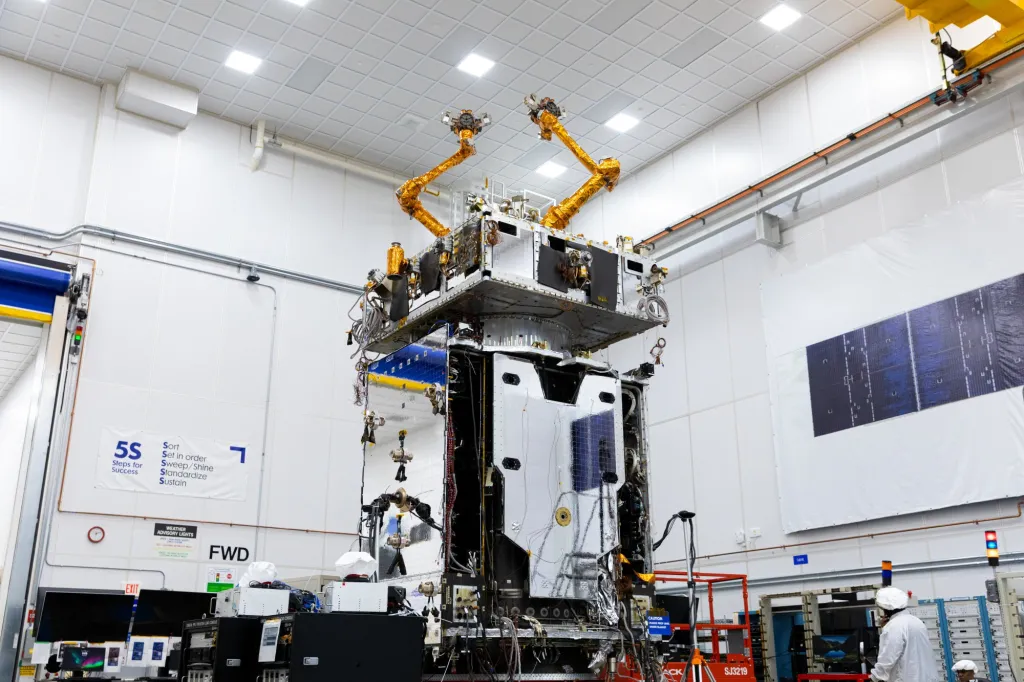
SpaceX sent up a Tuesday evening launch of a Northrop Grumman robotic vehicle featuring a pair of swiveling arms with clampy hands that aims to become an all-purpose Mr. Fix-It in space.
Read more How much caffeine a day is safe for your heart?
The Mission Robotic Vehicle (MRV) has been in the works for years, with Northrop subsidiary SpaceLogistics working with the Defense Advanced Research Project Agency (DARPA) and its Robotic Servicing of Geosynchronous Satellites program.
It was the primary payload on a Falcon 9 that launched from Cape Canaveral Space Force Station’s Space Launch Complex 40 at 5:15 p.m.
The first-stage booster made its 32nd flight but did not make a recovery landing, but headed for a crash landing in the Atlantic after getting the payload on its way to geosynchronous transfer orbit.
The booster was one of just four SpaceX had flown more than 30 times. The fleet leader made its record-extending 36th launch earlier this month as the company looks to certify booster reusability for as many as 40 missions.
This one flew without grid fins or landing gear since it was not needed on its farewell mission, more than 4 1/2 years since its first flight in December 2021.
Developed by the U.S. Naval Research Laboratory, the robotic arms on the MRV, which can adjust across “seven degrees of freedom” will be the primary tools for the spacecraft to fly up to other satellites and perform a variety of services.
Read more Homeowners of color pay higher insurance costs
The MRV is flying up with three Mission Extension Pods, versions of which Northrop Grumman had previously proven in space during missions flown in 2019 and 2020. Those pods are designed to hook up with satellites in geosynchronous orbit to provide fuel to extend their lives up to an additional eight years in space.
The MRV’s robotic hands can be used to install these life-extending jetpacks, but also can relocate, inspect, repair and upgrade target satellites or spacecraft while in orbit. A video of its capability shows one of the hands carefully extending a customer satellite’s unfurled solar array, for instance.
This would become the first commercial spacecraft with robotic servicing capabilities for commercial and government satellites in geosynchronous earth orbit.
“Innovative. Flexible. Adaptable. That is how we see the future of on-orbit servicing, and it is why we are the leading industry advocate for a model of future satellite operations that increases value for our customers,” said Rob Hauge, president, SpaceLogistics. “With advanced robotics technology and our proven experience in satellite servicing, we are delivering the next generation of in-space sustainment technologies.”
This was the 48th launch from the Space Coast in 2026 with all but seven flown by SpaceX.
United Launch Alliance has flown five with one Vulcan launch and four Atlas V missions. Blue Origin flew its New Glenn rocket once and NASA flew its Space Launch System rocket on the Artemis II mission.
Read more Bystander severely wounded outside White House says Secret Service failed him