
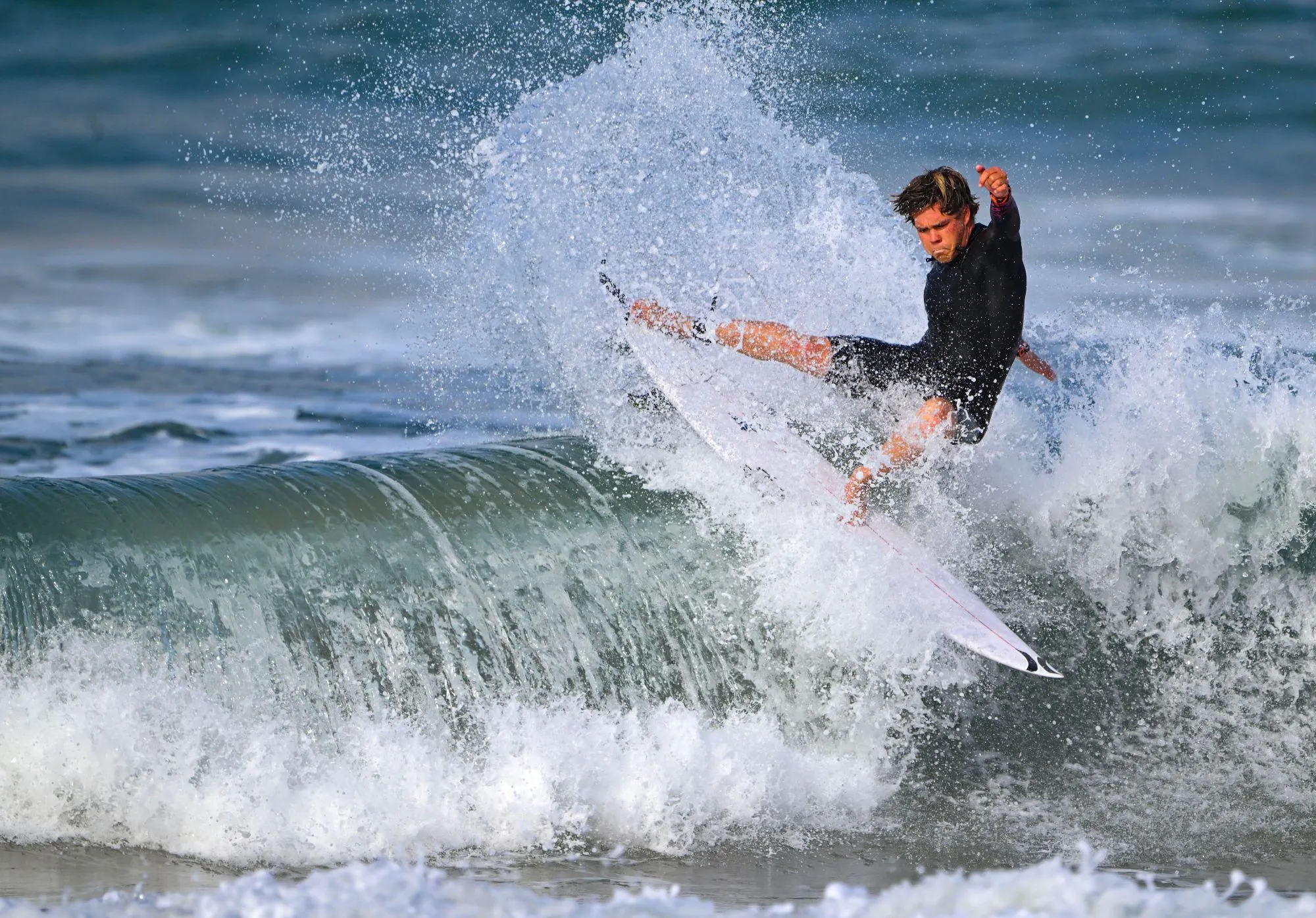
Surfing is a serious sport.
Not long ago, some die-hard ballsport fans may have scoffed at that statement, and maybe still look at surfing as a fun-in-the-sun pastime rather than an athletic pursuit.
Read more Jetting off for a summer vacation? How to eat and drink to minimize jet lag
But that stigma of yesteryear has wiped out. Today’s pro surfers are high-level competitive athletes who use a team of personal coaches, rigorous workouts, nutrition plans, Pilates, yoga and physical therapy, all in addition to the time they spend training on the waves.
And with surfing now a permanent fixture in the Olympics, the world is taking surfing seriously.
Surfers from around the world have been preparing physically and mentally to compete at this week’s Lexus US Open of Surfing in Huntington Beach.
“Surf, train, eat and sleep,” said San Clemente surfer Taj Lindblad, who has been meeting up regularly with USA Surfing coach Ryan Simmons this week in preparation of the Challenger Series event, part of the World Surf League tour that is taking the surfers around the globe. “Training is a big part of it, for sure. It helps mentally.”
The kind of serious training surfers undergo these days wasn’t always the case, especially for early-era surfers who were pushing the limits and boundaries in big waves back when professional surfing began.
Peter “PT” Townend, who is celebrating 50 years as the World Surf League’s first world champion pro surfer, said there was no entourage like surfers have today, just groups of surfers typically from the same country pushing one another to up their game.
“Back in our time, if you had any sort of injury, you took a couple aspirin and drank a couple beers and got up the next day and went for it again,” he said with a chuckle.
In his heyday in the ’70s, training was focused around surfing as much as possible, spending months on the North Shore of Hawaii where waves were bigger and stronger than Southern California.
Today, surfers have full-time coaches, nutritionalists, workout trainers and sponsors who help them keep in top shape, he said.
“That’s where the sport has gone, it’s become more pure athleticism than it used to be. They do so much more training,” Townend said. “The only training we did: We went surfing every day.”
There were coaches decades ago, but mostly for national teams. Individual pro surfers, with a few exceptions, didn’t start doing serious training until the 2000s, Townend said. One moment that stands out was when Australian surfer Mick Fanning tore a ligament off of his tailbone, needing intense rehab and training to get back to competing — and when he did, he won three world championships.
“Fanning was the one who took it to the next level,” Townend said. “Everyone followed suit.”
Simmons, now 52, was a competitive surfer in the late ’90s and early 2000s who retired at 28. His next gig was being a private surf coach for Erica Hosseini, a rising star out of Newport Beach, during a time when no one else had their own coaches guiding them.
“I would be the only guy, and it was that way for a few years,” the Seal Beach native said.
Back in the ’80s, surfers could rely on pure talent alone, Simmons said. “That’s out the window now.”
Simmons thinks the shift in surfing as a more serious sport started with the “Momentum Generation” in the ’90s, with now 11-time world champion Kelly Slater, Hawaiian Shane Dorian and San Diego surfer Rob Machado focusing on athleticism and nutrition, as well as mental strength, as part of their regimen.
Many of the surfers before them were partying all night, waking up hung over to surf their heats, Simmons said.
“Surfers looked at athleticism and other sports and said, ‘We probably have to tap into this to push out the elders,’” Simmons recalled. “It was like the changing of the guard.”
Simmons coached San Clemente surfer Sawyer Lindblad to her US Open of Surfing win in 2023, a victory that launched her career on the elite World Tour. Now, he hopes to do the same with her brother Taj.
“With Taj, he’s really talented. For him, I’m a second set of eyes for the lineup and an extra confidence booster in his arsenal,” Simmons said. “He gets a little ahead of himself, moving too quickly. We have to slow down, and that’s relevant for all the competitors.”
“Be in the moment and be positive,” Simmons advises.
Taj Lindblad also works out three to four days a week, Simmons chuckling at the light cardio he used to do at 24 Hour Fitness back in the day.
Nowadays, talent alone isn’t enough.
“You have to be a gnarly athlete,” said Simmons. “Surfing has come a long way in the past 20 years.”
Read more Investigators in Comey seashells case omitted key facts and distorted others, defense lawyers allege
Lindblad said heading into the US Open he’s been trying not to change much from his regular routine.
“It’s just sticking to the same program and simplifying things,” he said, noting that he also competes in rodeos, the time with horses away from the beach helping to clear his mind mentally.
Encinitas surfer Levi Slawson has also been putting in the work with coach Chris Gallagher from Hawaii, who helped coach him to last year’s win.
“I think it’s just saying the right thing at the right time, because when I was coming in for my heat and making it closer and closer to the win, subconsciously, you start to get very excited and it is very necessary to have someone there to kind of say the right thing at the right time to kind of reel you back,” Slawson said of last year’s win. “I think he kept me very locked in that whole day … he was just good at weighing out all the options and just being that guy I can lean on for a second opinion.”
Huntington Beach surfer Luke Guinaldo hopes to join the list of surfers with a US Open of Surfing title — many have gone on to become the best in the world.
Guinaldo said he has an overactive mind, so his mental preparation is to do visualization work.
“I want to think in this positive direction of how I want everything to go right. I visualize myself winning it, and how I would feel losing it, and how with both of those things I would be OK with,” he said.
There’s a balance, Guinaldo said, of doing too much training the week of the contest that may exhaust the body.
“You don’t want to do too much, you don’t want to overextend your body,” he said.
Two-time US Open winner Brett Simpson, who knows the surf break better than nearly anyone, is also on the sand coaching, this year helping Malibu native Taro Watanabe.
“Most of these athletes on the Challenger Series are traveling with a crew, and especially coaches. Everyone wants an edge and at this level a coach can be your best supplier of knowledge,” said Simpson, who transitioned to coaching after a stint on the World Tour and is also Hurley’s director of athlete marketing. “It’s important to be on the same page, but also have someone give you the good and bad news, or what you may need to work on to get to that next level.”
The actual surfing is just a small part of it, he said.
“When it comes to competing at this level, there’s a lot of cat and mouse, and understanding which priority you sit in the heat and when to capitalize on those moments,” said Simpson, who also coached Team USA in the Tokyo Olympic Games. “Everyone surfs really well, so the decision-making on wave selection and utilizing priority is very key.”
World Tour surfer Griffin Colapinto talks often about his regime focusing on both physical and mental health. Colapinto, who has entered the US Open of Surfing alongside brother Crosby, will be leading a workout on the sand with sponsor Red Bull at 9 a.m. on Thursday along with world champion and Olympic gold medalist Caroline Marks.
Colapinto has a sauna and ice bath at his San Clemente home for after workouts and makes sure to incorporate stretching. He’s big on meditation and journaling, and using breathing techniques before he paddles out that help him focus.
He also does Pilates every day when he’s not traveling to help his core and to connect his body and mind to combine balance and strength training, he said in an article with sponsor Red Bull. All that is combined with gym work with kettlebells and boxing for cardio.
With the incoming hurricane Genevieve expected to generate big waves the next few days, Simmons said the competing surfers are going to have to be very prepared.
“There’s a lot of paddling, running down the beach to reposition,” said Simmons, who also has decades of experience to tap into at the famed surf break. “It’s not going to be normal Huntington, where it’s mushy and you paddle back out.”
Surfers are also looking ahead as LA28 nears, hoping to land a spot on the USA Surfing team.
USA Surfing, the official governing national body for the Olympics, offers “Power Your Performance” training sessions with Olympic gold medalist Carissa Moore, sessions with Surfline forecasters to learn how to read swells, nutritionists and mental performance coaches.
There’s also more crossover into mainstream sports, at least in Southern California. Marks, following her world championship win in 2023 was invited onto the ice at an Anaheim Ducks hockey game. On Wednesday night, Taj Lindblad and Simpson are scheduled to throw out the ceremonial first pitch at the Angels game.
“There’s still more to go, I’m not going to say we’re a mainstream sport,” said Simmons. “But we are on our way.”
Read more Irvine, Great Park neighborhoods prepare for Daisy Chain Fields festival