
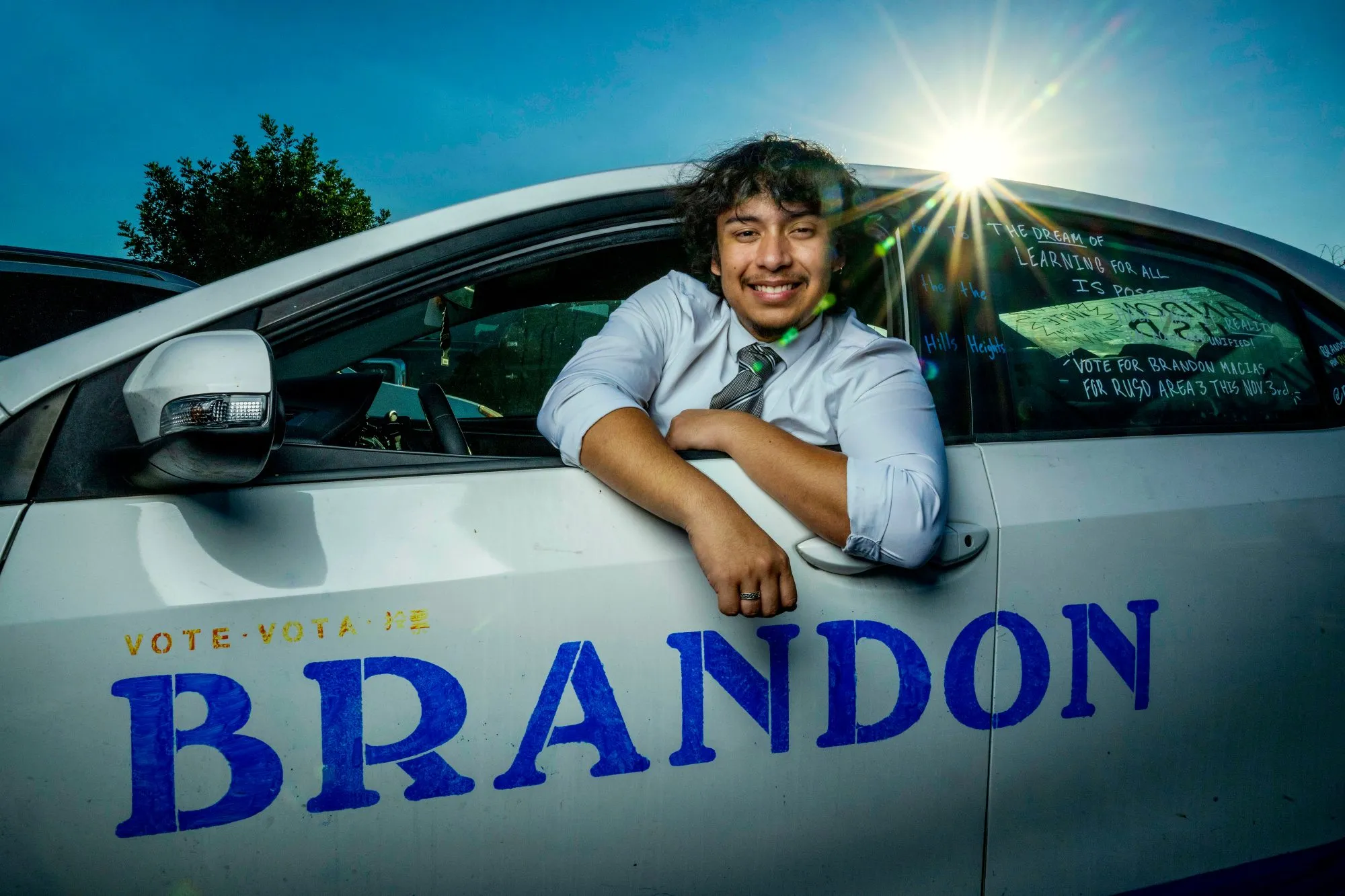
Some of the youngest candidates on Southern California ballots agree on one thing: their age shouldn’t be held against them.
Read more LAFC settles for draw with Vancouver
In fact, they believe it means they’re ideal challengers to the status quo, experts on artificial intelligence and social media and possess the energy needed to make change happen.
RELATED: Nov. 3, 2026, General Election Voter Guide
The hot-button issues these Generation Z candidates are championing include the cost of living, climate change, Trump administration’s immigration policies, data centers and warehouses.
“We’ve always had a history of some young people being animated and empowered for social change who want to go through the traditional institutions,” said Sarah Angevine, an associate professor of political science at Whittier College. “That’s something that’s always been fantastic about democracy.”
Angevine said what’s different now is “the ease and access to social media, and what that provides for those with political ambition to run for office.”
Because the median age of lawmakers in the U.S. Senate is 65, and the House of Representatives is 57, according to the Pew Research Center, it’s understandable that a 20-year-old would see generational tension.
Gen Z voters — usually defined as those born after 1997 — ask, “What have these (old) guys done to change things?” Angevine said. “The way the youth is politicized and socialized is through social media.”
One local politician knows what it feels like to be underestimated.
Jeremy Yamaguchi, a Placentia City Council member in Orange County, was one of the youngest elected in California in 2008 — when he was 19.
“I definitely had my fair share of people telling me not to run, that it wasn’t going to happen, you need life experience … but there are young people out there that are more experienced, dedicated and willing to put in more work than some people twice or three times their age when I ran,” said Yamaguchi, who’s now 37. “I applaud anyone who is young and shows enough interest and motivation to serve their community.”
Yamaguchi connected recently with Kaylee May Law, who in 2024 was elected at 19 to the Walnut City Council. Leaders like Law give him hope for the future of politics, he said, though the stigma of being “too young” has happened in every generation.
Many young elected local officials could be “your congressman or woman or senator in five or 10 years, as people continue to move up,” Yamaguchi said. “Not everyone can be great, but someone great can come from anywhere.”
Here are the stories of four young candidates running for office in Southern California elections on Nov. 3.
Brandon Macias, 20, Rowland school board candidate
Brandon Macias was 14 when he delivered on his first campaign promise — installing new water fountain stations at Giano Intermediate School in West Covina.
The $20,000-project had the then-Associated Student Body president researching water fountain models, writing a proposal and working with administrators.
“I thought, ‘This is what I want to do: policy work that makes things better for others.’”
Macias did such a thorough job that the Rowland Unified School District used his proposal to revamp water fountains districtwide.
Now 20, Macias is running for a school board post in the district, which serves Rowland Heights, Walnut, La Puente, City of Industry and West Covina. He’s majoring in politics at Occidental College in Eagle Rock and working as a teacher’s aide at Oswalt Elementary School in Walnut. Macias also serves on the Rowland Heights Community Coordinating Council and the Nogales School Site Council.
“I’m excited to deliver a victory for working-class people,” Macias said, noting that he’s received fantastic support while knocking on doors.
“What I’m hearing is people want something new, a new kind of politics that is centered on and looks like the people it’s supposed to serve,” he added.
Born and raised in La Puente by Monica Aragon, a single mother who immigrated from Nicaragua, Macias said she taught him and his older sister about the importance of education.
“She always told me I need to do something of value, to help others,” he said. “And I got this gift of a prestigious education. I want to open those doors to everyone.”
Should his grassroots campaign propel him to the seat, Macias already has a long-term goal — staying in town.
“I’m unlike a lot of people who climb the political ladder and move on to other offices. I want to stay here and build up public services. We’re new, we’re young, and we’re practicing politics that wants to talk to you and be a part of your community life.”
“Your water, your electricity bill, your property taxes, your schools, it all happens on the local level,” said Macias, who may later seek a city office. “The changes will come in local government.”
Jose Osuna-Tisnado, 20, Perris City Council candidate
A 20-year-old who calls himself “Warehouse Man,” is running for the Perris City Council.
Jose Osuna-Tisnado’s nickname is inspired by a poem bashing the industrial complexes that he wrote during high school.
Read more Ryan Poehling scores short-handed winner as Ducks beat Flames
The Riverside City College student and former cross-country athlete has fond memories of running across his hometown of Perris. But he disliked seeing more warehouses pop up over the years, ruining, he said, the clean air and mountain views. The Riverside County city has the third-most warehouses in the Inland Empire, according to an activist’s data, but the city has a moratorium on new ones.
“We can’t stop development, but I started to question, ‘Does it have to be this way?’” Osuna-Tisnado said. “If we don’t act smart now, our town will be covered in warehouses. And people are being priced out.”
In an effort to do something and after being encouraged by Perris Councilmember Elizabeth Vallejo, he decided to run for council. Osuna-Tisnado hopes his first run for office leads to him representing District 3, which includes parts of central Perris.
For Osuna-Tisnado, who goes by “JOT,” the voting power of Gen Z and millennial voters is huge, especially this midterm election cycle.
“The most politically passionate people I know are my age,” he said. They can have “less experience, but more properly represent their constituents,” and “have the same voter power as someone who’s 89, so what’s the difference?”
Osuna-Tisnado hopes to inspire more young people to get involved in local politics.
“I get that we don’t like what’s going on nationally, but while you’re getting distracted, your community is building an AI data center,” he said. “Or a new warehouse.”
Young voters should realize that their votes matter and pay attention locally, he said.
“You should care about this election because your vote will affect your community, the people behind you in life: younger siblings, the kids in your high school, etc.,” Osuna-Tisnado said. “Your voice matters just the same amount as someone much older than you. Young people, we have to care, we have to ‘lock in,’ to use Gen Z slang.”
Sophia Castillo, 19, Colton school board candidate
Sophia Castillo, 19, knows the knock on young folks.
“The stigma of our generation is that we don’t care about things,” Castillo said. “But we are the future of the world, and that future starts now.”
A makeup artist and court reporter in training, Castillo is running to represent Area 1 — which includes Bloomington, parts of south Rialto and Fontana — on the Colton Joint Unified School District board in San Bernardino County.
The 2025 Bloomington High School graduate said she wants to show young people that besides being civically engaged and casting ballots, they can use their knowledge as power and seek leadership roles.
Castillo, who lives in Bloomington, wants to ensure that AI doesn’t take over independent learning, that warehouses don’t overrun her city and that more students are offered internships and real-world skills so they can enter the workforce.
Castillo questioned why more school districts and boards that oversee minors don’t have adequate youth representation — particularly from recently graduated alums. She wants to break that mold and noted that a college degree isn’t required to know what students care about and are experiencing.
“For me, in doing this, I want to show other young people that their voices and perspectives are just as valuable — especially in their school district,” she said. “At times our voices are suppressed — but if you want to have a seat at the table, sometimes you have to bring a chair.”
Rylee Joseph Peak, 18, Moreno Valley mayor candidate
For 18-year-old Rylee Joseph Peak, this is his first election — voting and running for office.
Peak, already a city commissioner in Moreno Valley, is hoping to become the youngest mayor in the Inland Empire city.
“It’s my first ballot, and I get to mark myself,” Peak, a first-year political science and global health student at UC Riverside, said.
The biggest challenge is his age and being seen as “untrustworthy.” Peak joined the parks, community services and trails commission at just 13 years old, when he was in eighth grade. He’s now had six years of public service.
“Sometimes I’m more educated than the people saying I’m too young to do this,” he said. “One thing I wish people would understand is that a lot of teens and youth have the same issues and concerns many adults face,” he said, citing immigration enforcement fears, the presence of Flock cameras and the rising costs of education.
He wants to improve residents’ lives, bring more parks and green spaces, boost student representation on city panels and the school board and build up community trust.
“We need to change the status quo and show that more of us are educated, we do our research,” Peak said.
As more youths get active in their communities and what’s going on in the world, they need representatives to assure them that they’re being heard, Peak said.
“Young people are honest and real. They’ll tell the truth and be transparent if something is going on,” he added. “Politics is often about finding where to place blame. But I think young people are trying to go from ‘Who can I blame?’ to ‘How can I fix this?’”