
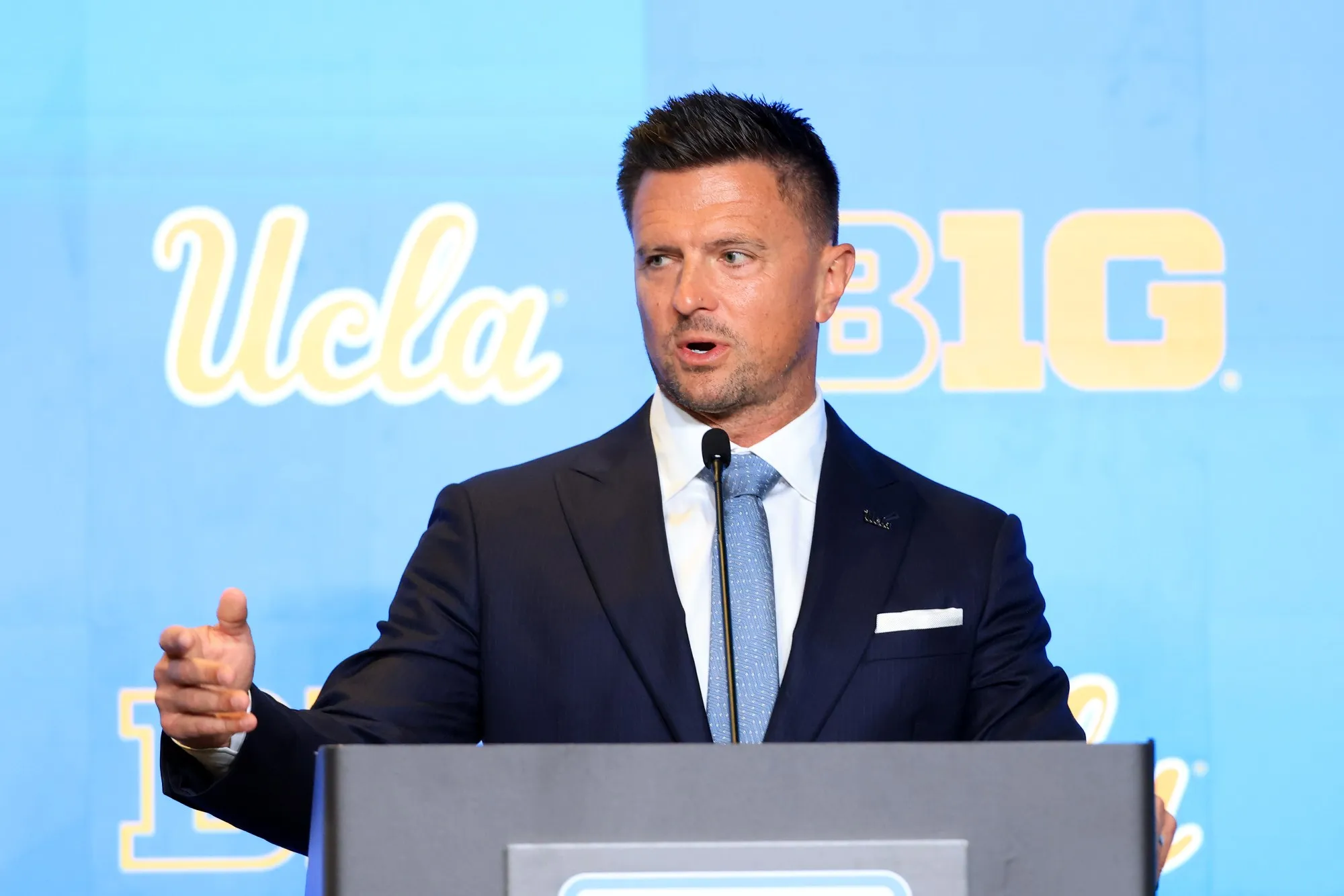
When new UCLA head coach Bob Chesney spoke at Big Ten Media Days, there was no confusing UCLA’s location. The humble, yet confident Chesney has placed the Bruins back on college football’s map before coaching a regular-season game.
Read more Wisconsin judge says voters who have returned absentee ballot for state primary cannot get a new one
On Wednesday, he continued to reshape the image of Bruins football. He addressed the Big Ten with reverence, thanked commissioner Tony Pettiti, expressed gratitude for UCLA’s administration and recognized the program’s history.
“It’s obviously an honor to represent such a great university and a historic football team that is the UCLA Bruins,” Chesney said in his opening statement. “I’m really proud to be on this stage and really, you know, just admire all of these other head coaches. … There’s no better place I’d rather be at this moment in time, and I strongly believe in the power of what UCLA is.”
There’s a time and place for coach speak, and the Big Ten Media Days are that platform. Chesney toed that line while offering a light into UCLA’s expectations for the 2026 season. Here are four takeaways from Chesney’s remarks:
Finding continuity in change
UCLA football fans may not know much about Chesney or the staff accompanying him from James Madison. They’ve had the slimmest of looks at a roster featuring 63 new players, including 42 transfers. But internally, the Bruins don’t share that unfamiliarity.
The coaching staff features seven members from Chesney’s regime at JMU, including offensive coordinator Dean Kennedy and defensive coordinator Colin Hitschler.
“That continuity part is really reassuring to me,” Chesney said, “and sets you at ease just a little bit. … Really reassuring to me to know who we are and to know that these guys all speak our same exact language.”
That’s not to say Chesney won’t tailor his system to the Big Ten, but the fundamentals and communication remain consistent.
Then there are the players relaying that message. Ten players followed Chesney from JMU, ones he chose meticulously – for their ability to play at the Big Ten level, and lead and act as conduits between the staff and the newcomers.
Because of this continuity, UCLA’s bones are composed of the best parts of a mid-major program that qualified for the College Football Playoff.
Managing expectations
It’s supremely difficult to place a projected win total on UCLA given the turnover. Many argue for optimism and others remain skeptical. Chesney understands that, so that’s not how he’s defining success in Year One. UCLA fans shouldn’t either.
“To me,” Chesney said, “success looks like a united, disciplined group that continues to grow every moment they have. I want to lead the nation in development.”
There will be ups and downs, but if UCLA shows incremental improvement over the course of the season, that is a win for a program that’s been inconsistent over the past two seasons. In fact, an improvement Chesney’s already confident in, is the top-down alignment.
Read more Study suggests the threat of mold-associated illnesses may be underappreciated
“One of the words and things that I think lead to the most amount of success is this word ‘alignment,’” Chesney said. “And when you have that within your athletic department, from the chancellor all the way down, you know you have a chance to be really good.”
Alignment, Chesney added, leads to trust. That hasn’t always been present at UCLA. These are the incremental positive changes fans should grasp rather than banking on results early into Chesney’s tenure.
Nico Iamaleava provides a strong baseline
UCLA quarterback Nico Iamaleava had no desire to leave Westwood after the 2025 season, Chesney confirmed Wednesday. Rather, it was on Chesney to provide Iamaleava with a plan. Once his retention was squared away, everything else became simpler.
Having stability at quarterback appeals to transfers and convinces returners to stay. Iamaleava led that charge.
“He was unanimously voted the leader of our football team when we voted for our leadership council,” Chesney said. “He was at the top by a large margin, and that just speaks to the way he carries himself on a day-to-day basis.”
“We’re going to need him to be really, really good on Saturdays, as well,” Chensey added.
Leadership is the baseline requirement of playing quarterback. Iamaleava will need to produce on the field, and quickly, after a 2025 season in which he threw for less than 2,000 yards and held a 13-to-7 touchdown-to-interception ratio.
Nothing in spring camp stood out glaringly in either direction, but Iamaleava will have better weapons than last year, and a longer runway as he arrived at UCLA in July last year.
Brian Rowe Jr. praise continues
South Carolina transfer Brian Rowe Jr. was the spring camp darling. The sophomore wide receiver stacked highlights with his sticky hands and natural ability to track the football.
However, given his production profile at the Division I level is basically nonexistent – he had 19 receptions for 149 yards and one touchdown as a freshman – it’s tough to blindly accept a spring camp showout will translate to regular-season success. Hearing Chesney single him out increases that belief.
“One guy that just pops off the screen a little bit every day is Brian Rowe,” Chesney said.
Chesney’s endorsement holds more value than any rep in a free-for-all spring camp because he is the decision maker. The drumbeat has only been positive for Rowe. If that continues, the reward will be playing time.
Read more Asian Garden Mall’s Night Market sizzles during summers