
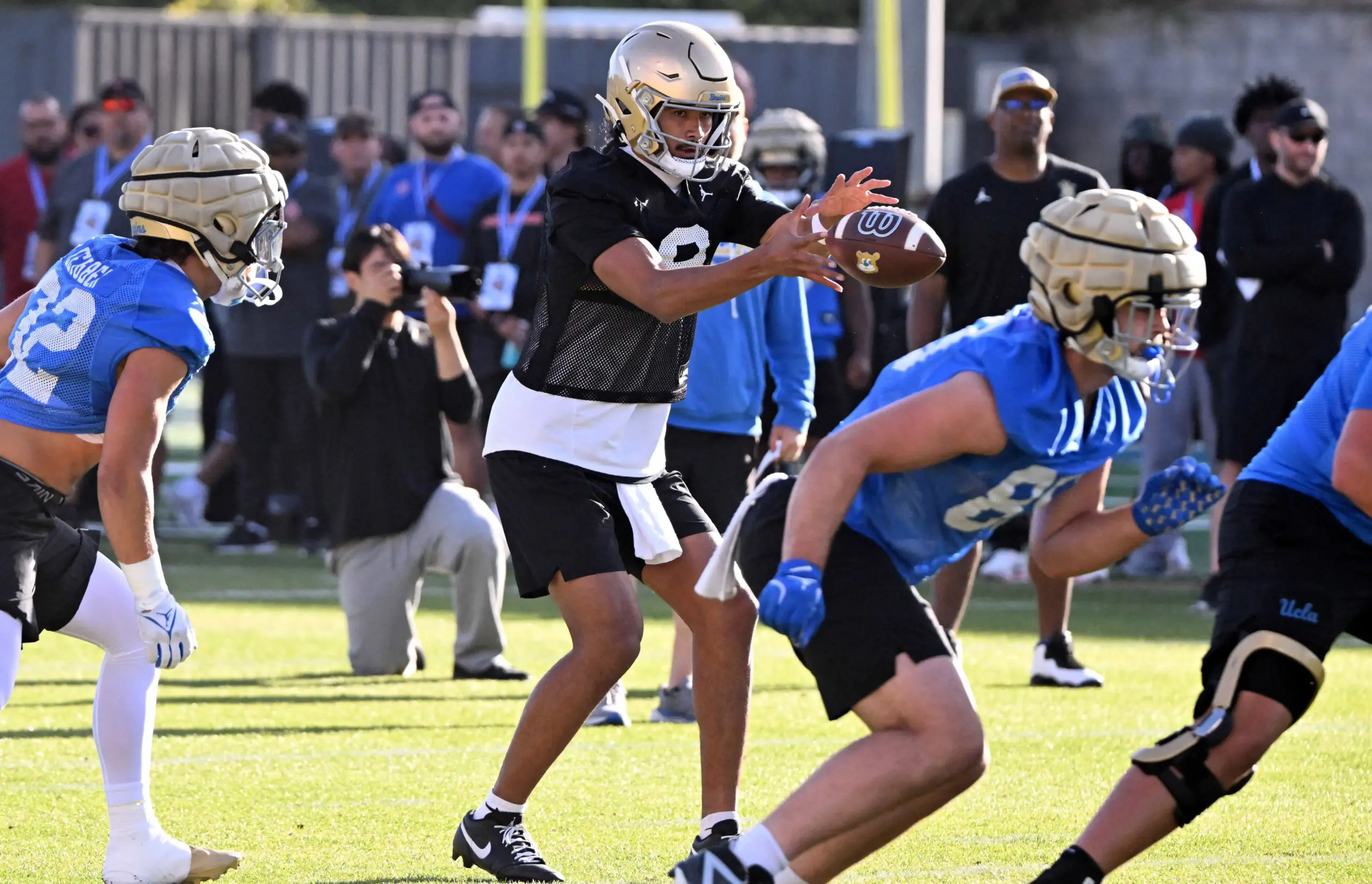
LOS ANGELES — UCLA quarterback Nico Iamaleava finds himself in a familiar, yet antithetical position to where he was one year ago. When UCLA football’s fall camp begins Thursday, he’ll be both the veteran and the new guy.
Read more In Texas, a political group bets $6 million on Latino voters coming back to Democrats
Unlike most of his teammates – UCLA’s roster consists of 63 newcomers – Iamaleava has been in Westwood for a little more than a year. That means less ambiguity than when he arrived at UCLA, after a late summer 2025 transfer from Tennessee just days ahead of fall camp. Yet for the third straight season, Iamaleava must learn a new system, play under a new head coach and offensive coordinator, and lead a plethora of new teammates.
If this brings Iamaleava uncertainty, he’s not alone in that feeling. He represents a theme throughout the Bruins’ roster – bits of continuity in a sea of change.
Offensive coordinator Dean Kennedy is at the forefront of introducing those nuances. He followed head coach Bob Chesney from James Madison, where he spent two seasons, including a 2025 College Football Playoff appearance. While the offensive system is new to UCLA fans, and holdovers such as Iamaleava, there’s trust in Kennedy from the staff and the six offensive players that transferred from JMU.
So what are Kennedy’s offensive philosophies?
“The biggest thing is explosives. We talk about explosive plays a lot,” Kennedy said at UCLA’s fourth spring practice April 9. “That’s one of the key factors, in our opinion. I believe it’s the second stat that can define wins and losses from an offensive standpoint, and so we talk about that a lot.”
Kennedy’s definition of an explosive play: a rush of 12 yards or more or pass of 16 yards or more.
Creating those chunk plays begins with discipline in the ground attack and air raid. The Bruins have a three-headed running back room that can certainly establish it, with returning backs Anthony Woods and Jaivian Thomas and JMU transfer Wayne Knight. None of the three separated themselves as the starter during spring camp, and each will certainly contribute.
Knight averaged 6.6 yards per carry, leading the Sun Belt with 1,373 rushing yards last season. Entering his fifth college campaign, he’s the veteran of the group, and carries the most experience with two years in Chesney and Kennedy’s system. He’s proven an ability to break off long runs with nine runs of 30 or more yards in 2025, including a 73-yard touchdown run in the Sun Belt championship against Troy.
Read more Taco Bell met with Michigan on cyclospora parasite weeks before recall
Judging Woods (4.7 ypc) and Thomas (3.6) off last season is unfair. Each running back will have a solid workload throughout fall camp, and each must have the patience and willingness to take the short yards for them or their teammates to break away.
“I think they’re one of the stronger groups on this team,” Chesney said of the running backs April 14.
As for the pass-catchers, South Carolina transfer Brian Rowe Jr. has seemed the most likely to provide the “explosive” plays. Although he recorded only 7.8 yards per reception as a freshman, Rowe popped in spring camp. During his address at Big Ten Media Days on Wednesday, Chesney singled Rowe out as a player “not enough people are talking about.” That compliment is validating as spring camp highlights aren’t always indicative of success. Rowe can solidify himself as a downfield threat on the outside during fall camp.
JMU transfer Landon Ellis can accompany him on the outside and excel in the intermediary areas. San Jose State transfer Leland Smith, Michigan transfer Semaj Morgan and returner Mikey Mathews should also contribute.
Kennedy also has plans to utilize UCLA’s tight ends in versatile roles. A group led by JMU transfer Josh Phifer and Kansas State transfer Brayden Loftin will be expected to be involved in pass protection and the run game, and be an extension of the receiver room, Kennedy explained April 14.
UCLA also made drastic improvements to its offensive line after finishing 12th in the 18-team Big Ten in rush yards per game (139.6) and 12th in sacks allowed (27) in 2025. Jordan Davis, a South Alabama transfer, will protect Iamalaeva’s blindside after earning a sixth year of eligibility through an NCAA waiver. Hall Schmidt, a Boise State transfer, will bookend the right side of the line. JMU transfer Riley Robell will be the leader of the group at center. JMU transfer Carter Sweazie and returning guard Eugene Brooks complete an offensive line brimming with experience.
Throughout spring camp, Kennedy expressed confidence in Iamaleava’s connection with his linemen. While his relationship with his protectors and weapons is far from complete, the depth of change in UCLA’s offense is for the better, and will continue to grow during fall camp.
Read more Board of Peace envoy meets with Netanyahu on Gaza disarmament deal, urges halt to strikes