
Ninety minutes before James Madison played Bucknell in its first game of its second FBS season, Curt Cignetti delivered a message Josh Phifer will remember forever.
Read more Can Dodgers’ hitters carry September momentum into October?
“It’s Bucknell, they suck.”
Hardly a motivational speech.
JMU beat Bucknell 38-3 that afternoon in 2023.
Nearly three years later at UCLA football’s media day, Phifer’s voice raises multiple octaves as he mimics his old coach, whose quips now resonate with a national audience.
“Cignetti was a brilliant coach,” the JMU transfer tight end said. “He would go into meetings and he wouldn’t talk to us a lot. But everyone would listen.”
One-liners accompanied Cignetti’s rise atop college football, the apex being Indiana’s undefeated 2025 national championship season. Purdue, Ohio State and the entire SEC joined Bucknell as fodder for his putdowns. Cignetti is a man of few words, yet boundless confidence.
You wouldn’t catch his JMU successor saying, “I win. Google me.”
Bob Chesney’s pregame pep talks drone on in comparison. He’s respectful. He’d never “go out of his way to put a target on his back,” Phifer says of the coach he followed to UCLA.
But Chesney shares a résumé worthy of those comments. Like Cignetti, he brought JMU success. Chesney continued on Cignetti’s path, becoming the head coach for a flailing Big Ten football school revered for basketball.
Now four games into that new job, with No. 23 UCLA (4-0, 2-0 Big Ten) ranked inside the Associated Press Top 25 for the first time since 2023, Chesney is proving he can succeed like Cignetti has at the Power Four level, laying the bedrock for a rebuild at a program in desperate need of one.
Does that mean UCLA will qualify for the College Football Playoff this year and win it in two seasons? At this point, it wouldn’t be surprising
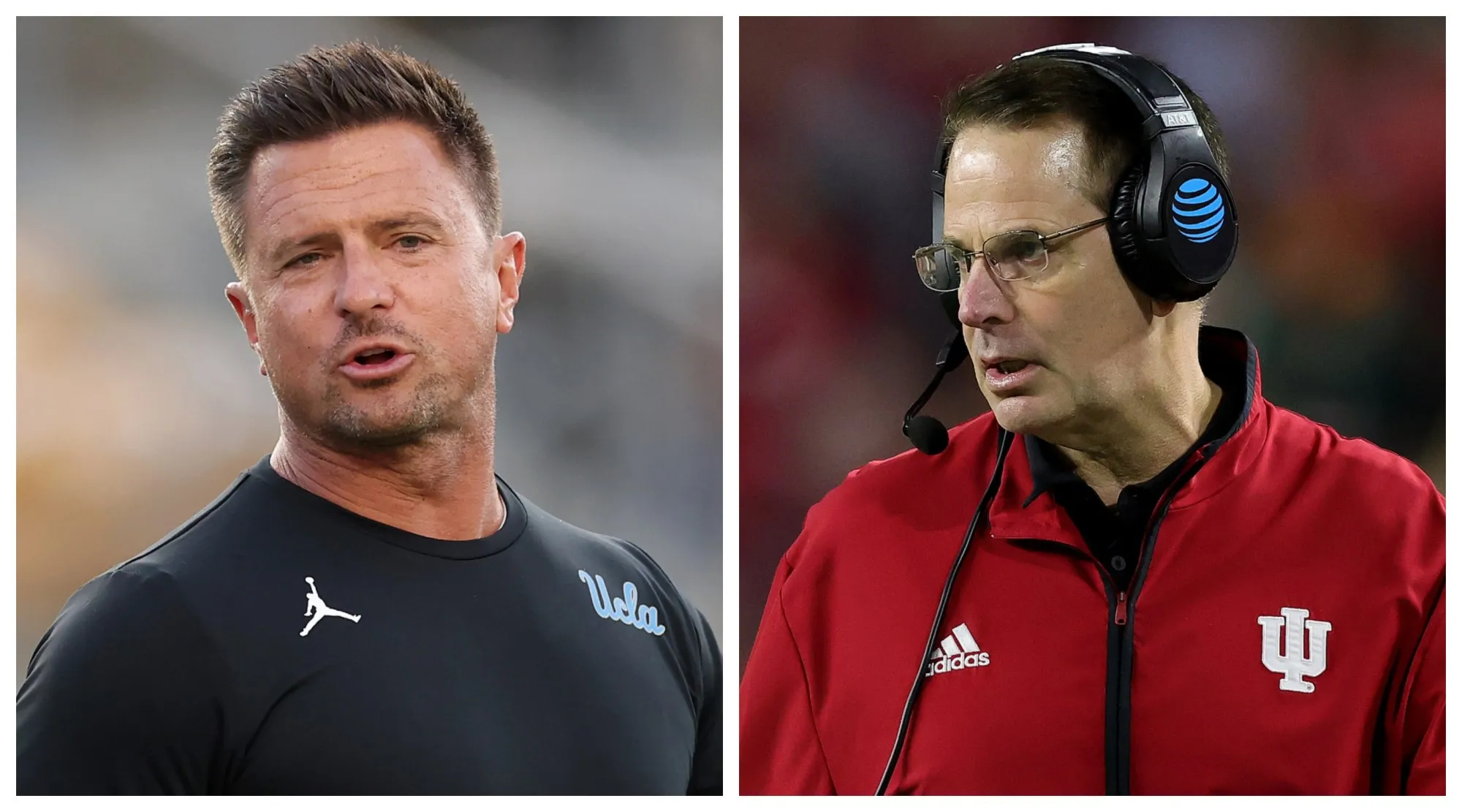
UCLA might be the next Indiana, and because of their mirroring journeys, Cignetti’s achievements will provide a measuring stick for Chesney’s expectations. Yet the two coaches couldn’t be more different.
“They’re night and day,” said running back Wayne Knight, another former JMU player now at UCLA.
“They’re two different people,” said defensive tackle Darold DeNgohe, who played under both coaches. “They go about it differently. But the result is the same.”
Hubris vs. humility
Cignetti started at JMU in 2018 and helped bring the program to the FBS level before the 2022 season, leaving for Indiana after the 2023 season. Chesney picked up where Cignetti left off, helping the Dukes achieve what he described as “arguably the best year in the history of that program at the FBS level.”
JMU football’s culture sets a standard for any coach. To flourish in Harrisonburg, Virginia, Knight explained, required a “good eye in recruiting” and getting players to “buy in.” Cignetti and Chesney attracted and maximized talent in alternative methods.
Cignetti’s hubris demanded players’ attention.
“His confidence was so transferable,” UCLA and former JMU guard Carter Sweazie said. “It was like, ‘We’re not losing this game. We’re not supposed to lose this game. That’s not even a possibility.’ And we would go out there believing the same exact thing.”
He compelled players to blindly follow his lead, and because his teams won – regardless of the competition level – his wit remained inspiring. His unabashed conviction isn’t a façade, rather the result of perfectionism. With Cignetti, no stone went unturned in preparing for any opponent. Therefore, when the moment came, a clever slight was all that needed to be said.
But, Phifer explained, Cignetti expected the same ambitious preparation from his players – to the extent that “sometimes, it felt more scary to mess up than you felt confident to succeed.”
When Chesney arrived at JMU, like he has at UCLA, he established a family-like atmosphere. He convinced players Cignetti had recruited – Knight, Phifer, DeNgohe, Sweazie, etc. – to remain at JMU and later to join him at UCLA.
Where Cignetti earned “buy-in” with results, Chesney “pours into his players” to win them over, Knight said.
“He honestly just cares more about his players,” Knight said. “He does everything in his power to put us in the best situations possible.”
Chesney matches Cignetti’s obsessive preparation, but those extra walkthroughs and film sessions are catered toward the players.
“They’ll never embarrass us on film,” Phifer said of Chesney’s staff. “They’ll never make us feel like we’re bad football players. They always have positive reinforcement.”
Under Chesney’s guidance, Phifer said he “actually loved playing football again,” and valued the space afforded to correct his mistakes.
Read more Ducks 2026-27 season preview: 3 questions after a frenzied offseason
“I think Coach Chesney brings a little more energy and a youthful approach and Coach Cignetti is very much more business model-like,” Sweazie said. “I think they’re very different. But both ways work. I have tons of respect for both of them. I’ve won a lot of games with both of them.”
All about results
To compare their stats at JMU, Cignetti went 33-5 at the FCS level with an appearance in the FCS championship in 2019, and 19-4 in two FBS seasons. Chesney went 21-6 in two seasons, culminating in a trip to the 2025 CFP.
Cignetti stepped up to a football program at a school known for Bob Knight’s success in hoops. Hoosier football had one winning season in 15 years when he took over, so a no-nonsense approach was required.
His recruiting prowess translated. In his first two seasons at Indiana, Cignetti turned underrated transfer portal quarterbacks – Kurtis Rourke (Ohio) and Fernando Mendoza (Cal) – into stars. So who’s to doubt Cignetti’s latest experiment, TCU transfer Josh Hoover?
Indiana hung with eventual CFP runner-up Notre Dame in the first round of the 2024 playoff. In Year 2 under Cignetti, the Hoosiers went 16-0, defeating Ohio State in the Big Ten championship game and Miami in the CFP title game.
Naturally, there was a twinge of hope in many UCLA fans’ minds that Chesney would remain stride for stride with Cignetti’s journey and rebuild a flailing Big Ten football program at a school known more for thriving on the basketball court under John Wooden’s Pyramid of Success.
Four games into his first season, that seems to be the case as the Bruins have defeated each of their opponents in different ways.
UCLA football had won more than Indiana pre-Cignetti, but its last 10-win season came in 2014. Chesney’s first step in reawakening UCLA was restoring the image around the program.
He brought 10 players – 11 after linebacker Trent Hendrick received a fifth-year of eligibility in late August – from JMU’s CFP roster to set a baseline for UCLA’s culture. His eye for talent also translated as UCLA acquired 43 total transfers, many speaking glowingly about the tight-knit atmosphere Chesney promotes.
Unlike Cignetti, he retained a holdover at quarterback in Nico Iamaleava, extracting his leadership qualities and building parts of the offense around his dual-threat ability.
Many of the players who followed Chesney from JMU and UCLA were confident he could win at the Power Four level because he did so against teams of that caliber in Harrisonburg. In 2024, the Dukes defeated North Carolina 70-50. In 2025, they competed valiantly as visitors against Louisville and Oregon in the CFP.
“Chesney has already proved it,” Phifer said before the 2026 season.
“He’s got the right things in place structurally,” Sweazie said when asked why Chesney would succeed in the Big Ten.
More than words
Through four games, the Bruins’ players have been proven right, as has the brass who hired Chesney last December. UCLA began the season traveling to Cal to defeat its former Pac-12 rival on the back of 21 unanswered fourth-quarter points as Chesney won the battle of offseason coaching hires against Tosh Lupoi. In their home opener versus San Diego State at the Rose Bowl the following week, the Bruins won with resolve, finding momentum after a scoreless first half. Next came a true shootout when UCLA dropped 52 points against Purdue as Iamaleava threw for a season-high 276 yards and three touchdowns.
Then on Saturday, UCLA went cross-country and embarrassed Maryland in its own stadium with a 54-3 blowout. Both sides of the ball clicked as the offense totaled 475 yards and the defense created five turnovers, including consecutive pick-sixes.
Throughout the Bruins’ exciting start, Chesney has excelled as a tactician and motivator. He maximized a committee approach to the running game – Knight leads the Big Ten with nine touchdowns – taken effective risks on defense and put Iamaleava in positions to succeed.
Before each game, he’s inspired players with soliloquies. Speeches, DeNgohe explained, “that just get you going.” Chesney’s energy gives off the vibe that “he wants to put the pads on and go out there and play.” He participated with the players throughout summer conditioning, and has continued to get in on midseason lift sessions.
Each win has been emphasized with a message from Chesney, game balls and a dormant chant he revitalized in Westwood.
Fight songs aren’t surfacing from Indiana’s locker room. Three years ago, if the Hoosiers had squeaked out a two-point victory over Northwestern as they did Friday, it would have been celebrated. Now it’s concerning as No. 6 Indiana (4-0, 1-0) chugs along trying to defend its title, carrying Cignetti’s stringent standard.
Meanwhile, UCLA strives to reach that consistency. The Bruins are improving each week in a way that’s eerily similar to Indiana, as Chesney inches closer to becoming the next JMU disciple to win Big Ten Coach of the Year.
Where Cignetti is short and dry, Chesney could lead public speaking Ted Talks. Where Chesney is endlessly positive, Cignetti brings a guarded pessimism.
Yet both inspire players to follow them, and continue to lead their teams to success no matter the level.
Read more Seal Beach activates local emergency in preparation of El Niño