
If El Niño-aided storms surge into the burn areas of Altadena, what kind of havoc will they wreak?
Read more Nearly 2 million ballots are on their way to Orange County voters
No one can say for sure.
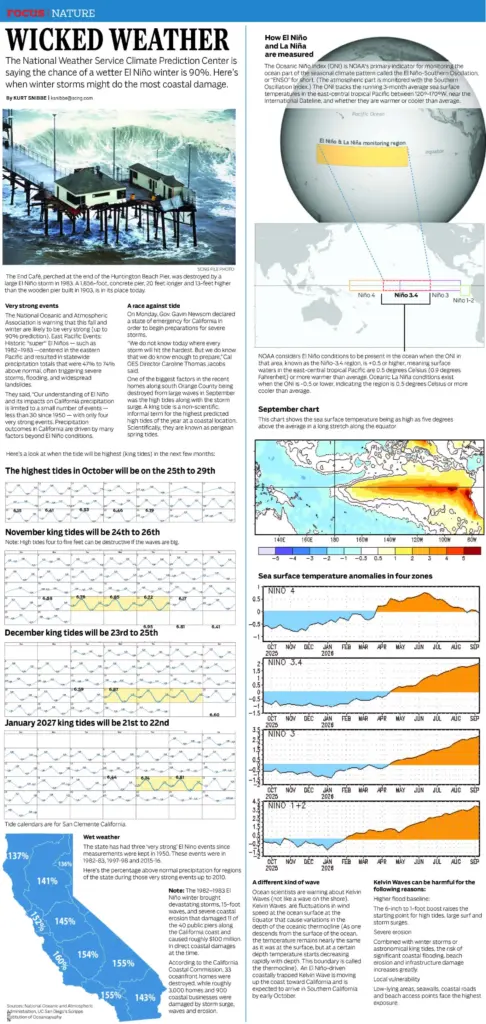
But evidence of a strong El Niño building in the Pacific, along with high odds for this phenomenon causing above-average rainfall to fall in California this winter, dousing the burn-scared landscape from the January 2025 Eaton fire, has Los Angeles County officials on high alert for debris flows and flooding.
Others are worried that already-lagging rebuilding rates could slow even further during any kind of rain delay.
“We prepare for the worst, hope for the best. We make sure our flood control system is ready for the storm season,” said Sterling Klippel, assistant deputy director for county Public Works who oversees storm operations, engineering and county dams.
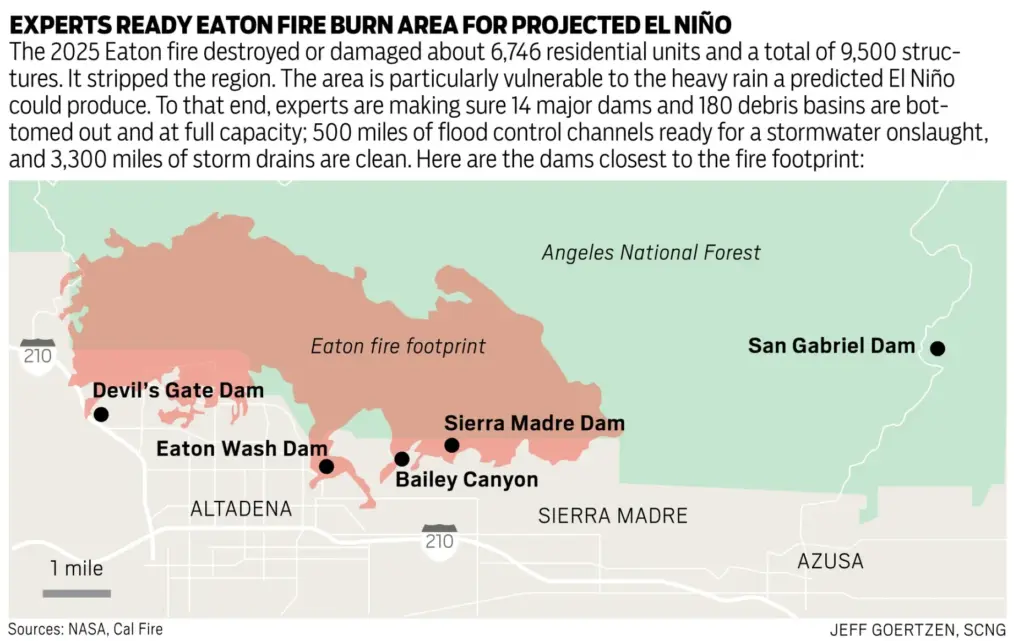
He’s responsible for making 14 major dams and 180 debris basins are bottomed out and at full capacity; 500 miles of flood control channels ready for a stormwater onslaught, and 3,300 miles of storm drains whistle clean. Because if these don’t work perfectly, there could be property damage or loss of life.
Rain falling on burn scars often test these systems at a faster pace, and therefore, can be damaging to hillsides, roads, mountain trails and even threaten the lives of hikers from flash floods, or those in their cars overcome by flooded streets or debris.
“When you have burn scars, that significantly increases the amount of rocks, boulders, sand and mud that washes down (after a major storm),” Klippel said.
Even without a recent wildfire, Devil’s Gate Dam in Pasadena, Eaton Wash Dam in eastern Pasadena across the street from where the fire raced up nearby canyons into the San Gabriel Mountains, and Sierra Madre’s dams and debris basins can fill up with rocks, boulders, tree branches and mud after winter storms because they take water and sediment from the region’s largest watershed, the 700,000-acre Angeles National Forest.
“Our dams and debris basins hold back all this debris, so the channels don’t get overwhelmed downstream and the capacity of those channels don’t get exceeded,” Klippel said during an interview on Monday, Sept. 28. Getting exceeded is a nicer way of saying overflowing their banks and flooding roadways, freeways and homes.
Public Works has removed 3.7 million cubic yards of debris and other organic materials from all its dams and debris basins between 2025 and early September 2026, he said. This amount of dirt can fill the Empire State Building almost three times over.
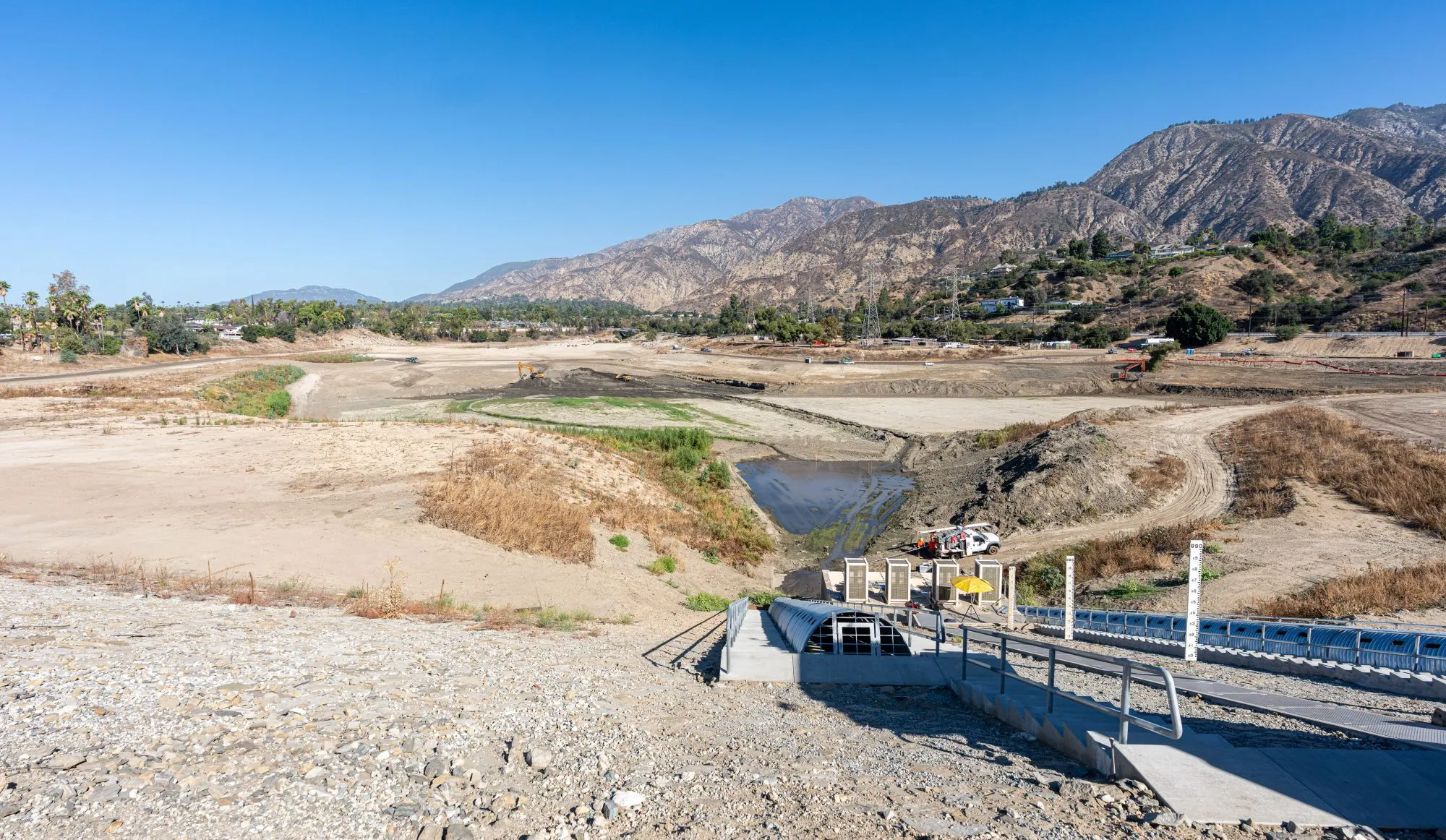
At Eaton Wash Dam, a critical facility at the base of nearby denuded canyons and mountains from the Eaton fire, excavators on Sept. 28 were scooping up piles of dirt and debris into large trucks, which carries the stuff to empty mining pits in Irwindale for fill. Some material goes to the Sheldon Pit in Sun Valley, he said.
The goal is to dig out the basin and bring this critical reservoir to its full capacity — about 956 acre-feet of water. (One acre-foot of water equals about 325,851 gallons).
From Sept. 22 to Sept. 28, the county removed 147,930 cubic yards of sediment from Eaton Wash Dam, county officials said. Klippel said sediment removal will continue there, at Devil’s Gate and at San Gabriel Dam high up in the Angeles National Forest north of Azusa for a few more weeks.
“Our goal is to remove and complete the sediment removal projects by Oct. 15,” he said. The rainy season runs from Oct. 15 through April 15 — or about six months.
After-fire storms turn deadly
Even with a cleaned-out flood control system, unexpected squalls especially in the mountains can unleash flash floods, sometimes with deadly consequences. Burned out canyons can smooth the path for debris flows, which can look like liquid concrete flowing at rapid speeds downstream.
In October 1993, the Kinneloa fire, near where the Eaton fire started, torched 5,485 acres and destroyed 196 structures, including 121 homes in Altadena, Pasadena and Kinneloa Mesa.
Virginia Kimball was heading up a disaster preparedness center with federal and state
“People don’t understand what happens in a debris flow,” she said. “It is a specific type of flash flood that occurs in areas recently burned within the past three to five years. And these can occur very suddenly and kill people.”
In Baily Canyon north of Sierra Madre on a sunny day in March 1994, John Henderson, 34, and his 9-year-old son, Matthew, were hiking in the canyon, as were many others. A video that Kimball helped produce in 1995 talks about a sudden lightning storm in higher elevations that created a debris flow as high as 20 feet.
The father and son were washed away. Their bodies found a week apart much later, buried in piles of mud downstream, officials said in the video.
Four years later, on Feb. 7, 1998, during a storm created by one of the largest El Niños in a century, 20-year-old Nathan Cook was riding his mountain bike in the normally quiet Arroyo Seco in Altadena when a wall of water swept him away. In an instant, the experienced mountain biker and Occidental College student was dead. They found his body four days later pinned against a tree near Devil’s Gate Dam.
That year, there were were 17 storm-related deaths in California from rainstorms, mudslides, floods and fallen trees. That month set precipitation records at 19 stations in California. Many were not expecting that much rain.
Read more The life and legacy of bald eagle Jackie are celebrated in her home territory of Big Bear
Kimball said part of the issue is the aggregate, often loose soil in the San Gabriel Mountains made more unstable by past wildfires. “The higher mountain ranges are always sloughing off soil, that’s why we have debris basins along the base of these mountains — to catch rocks, boulders, mud and tree trunks coming down with the rain.”
She said there are two things not to do when a severe storm is forecast for the burn-scared foothills and mountains: Don’t hike there and don’t drive near there.
“Choose some other places to go hiking in. Don’t take the risk. Or find flat land to walk on,” she said.
That same month in 1998, a eucalyptus tree on College Avenue in Claremont fell, crashed through a car and killed two Claremont College sophomores, Brian G. Cressner and Yuta Peter Kurahashi. The ground was soaked and unstable.
In the San Fernando Valley, Frank Metz, 84, of Los Angeles, died when his car plunged off a road that had been undermined by rains and runoff.
Tim Martinez, land manager and planning director overseeing canyon areas owned by the Arroyos & Foothills Conservancy, said he will be watching canyons badly torched by the Eaton fire: Millard Canyon and Rubio Canyon and also, the area along the Chaney Trail, a popular hiking area closed since Jan. 7, 2025.
He said natural regrowth of plants and vegetation that has grown since then, aided by seeds bursting upon from the heat of the fire and watered by subsequent rains in March and December 2025 and also early January 2026, have made the slopes stronger. “That’s not to say there will not be slides and washouts,” he said.
He cited new growth of laurel sumac and mountain buckwheat, both native plants that grip the soil and hold slopes in place during rainfall.
“It will be almost two years of regrowth before we get rains and that will help and go a long way,” he said. “It’s not as dire as we think it would be.”
Martinez said he’s more worried that the use of goats to eat up vegetation in the summer along the lower Arroyo Seco in Pasadena has denuded that area, making is more susceptible to sliding slopes and mud flows. He has joined a working group that is assessing the problem.
Victoria Knapp, who lost her home in the fire and is rebuilding, also served on the Altadena Town Council until recently. She said the unincorporated community depends on the county. She hopes the county will stock sandbags at fire stations and maintain K-rails on the curve along Altadena Drive, so if there’s a lot of storm water it will flow away from residential properties.
She agrees with Martinez, that the slopes in the canyons and hillsides have gotten greener. “Given the amount of growth on the ridges, there is less of a concern. But I don’t think we are out of the woods,” she said. That will depend on the intensity and frequency of winter storms.
Another concern, aside from mud and debris flows, is for those rebuilding their homes. She’s worried that those getting started might see their new concrete foundations ruined by torrential rains. Or too much water could collapse dirt footings.
Knapp’s new home is 85% built, with a metal roof in place. She hopes to move in around early or mid November. But last year, during construction, builders had to pump out water from the property after spring and winter rains.
When asked if she’s heard of builders that will stop building at first rain or before, she answered: “Oh God, I hope not.”
The Eaton fire destroyed or damaged about 6,746 residential units within the fire footprint, and a total of 9,500 structures were destroyed. About 213 homes have been completed with 2,310 homes under construction, Knapp said, quoting county statistics on Wednesday, Sept. 30.
There are 4,012 building plans that have been approved, but the bulk have not started construction. She says most builders will go ahead with construction plans despite the El Niño-based winter rains forecast, perhaps with plastic sheeting at the ready for protecting wood framing from the rains.
“What is a builder going to say?,” she wondered. “I think they’ll say: ‘let’s get started.’ But what if that first storm ends up being as bad as that first storm right after the fire? How will the weather affect that rebuilding?”
Like a lot about weather forecasting and even El Niños, which sometimes have resulted in below average rainfall or drought conditions, the outcome is unpredictable.
“Remember, El Niño is not a storm,” said Klippel. “It doesn’t guarantee we will see significant storms. However, the odds of more significant storms are higher.”
Read more Wildlife education events in honor of bald eagle Jackie continue Sunday