
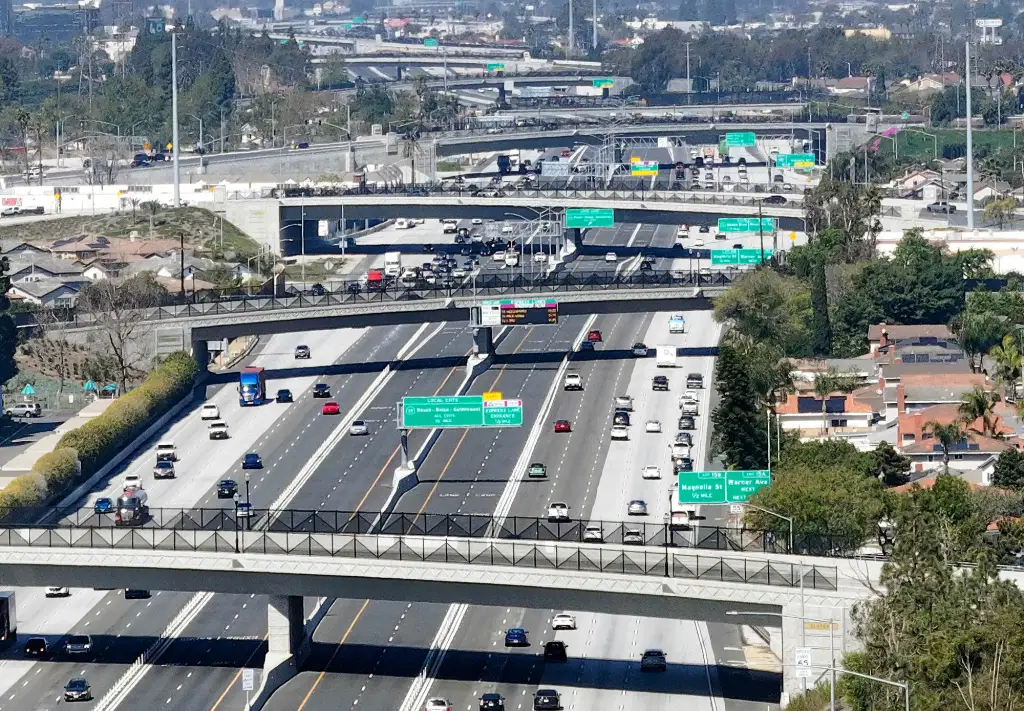
More than two years into operating the 405 Express Lanes, Orange County Transportation Authority leaders are setting policy for how to spend the millions in excess toll revenue that is being generated.
Read more Markets on Wall Street quietly mixed while oil prices slip after OPEC+ plans August output hike
Showing regular monthly growth in their use, the toll lanes that opened in December 2023 between the 605 interchange and the 73 collected about $4.5 million in revenue in March, the latest month for which information was available.
Deciding how to earmark those funds after loans to improve the 405 Freeway are paid, the OCTA’s Board of Directors recently approved an initial expenditure plan. While the money won’t be available until 2029, OCTA Chief Executive Officer Darrell E. Johnson said the board is getting a jump on planning ahead for how excess toll revenue will be spent.
When the $2.1 billion expansion of the 405 Freeway was completed in December 2023, its carpool lanes had been turned into tolled lanes, which has improved daily commutes and traffic congestion since, officials said.
On average, the lanes service roughly 53,000 daily trips, almost catching up with the usage it has taken the 91 Express Lanes 23 years to build.
In their first year of operation, the 405 Express Lanes saw more than 17 million trips, and getting those cars out of the general use lanes helped reduce travel times, for example, northbound by up to 12 minutes during weekday evening rush hours, according to an annual report. The express lanes exceeded $43 million in total gross potential toll revenue during that first fiscal year.
In the deal with the federal government for a Transportation Infrastructure Finance and Innovation Act loan that helped with the 405 expansion – $650 million was outstanding as of March – the OCTA agreed half of a projected $168 million in excess revenues that will have been built up by 2029 will go toward that debt, Johnson said.
The remaining funds will be directed back into the 405 Corridor Investment Zone – the three miles around the 405 Freeway through which the express lanes stretch, including the cities Costa Mesa, Fountain Valley, Huntington Beach, Seal Beach and Westminster.
Maintenance of the express lanes is already included in the county transportation agency’s annual budget – 3% of the $2 billion in this fiscal year.
From the beginning of the freeway’s expansion, the OCTA has been set on locally reinvesting any excess toll revenues, Johnson said.
Read more California lawmakers address the ‘missing middle’ with a bill streamlining townhome projects
The OCTA has three main objectives: alleviating traffic congestion throughout the 405 corridor, improving the roads and bikeways that intersect with the freeway and investing in technological advancements that will enhance the toll user experience.
For now, Johnson said the OCTA is not focused on revenue maximization or ridership increases, but rather on balancing the performance of both the paying and non-paying freeway lanes.
“We’re not focused on how many trips are made or how many transactions are made,” Johnson said. “What we’re focused on is: How can we ensure that we can continue to give people a reliable and safe trip at the speed limit during rush hour?”
In order to maintain the effectiveness of the express lanes, prices are intended to keep the number of vehicles within an optimal limit — approximately 1,700 cars per lane per hour at 65 mph. And, that is why commuters won’t likely see a big drop in the cost to use the express lanes.
“What we want to do is make sure that when you do choose to pay the toll, you get the trip as close as possible — on a regular basis — to the speed limit at rush hour,” Johnson said.
Though some may still be reluctant to pay toll prices, Johnson wanted to assure riders that the toll policy framework continues to offer price incentives for those traveling with two or more people. And, revenue generated by the express lanes will benefit all drivers, not just toll users, he said.
Johnson said the OCTA’s board, along with Caltrans and the express lanes-adjacent cities, will begin to develop a more comprehensive planning process for future projects later this year to be finalized in 2028.
When the excess money becomes available, Johnson said the board is committed to improving commutes along the 405 Freeway for all travelers, as well as routes in other areas of the corridor.
“We will also see some opportunities to improve local streets leading up to and crossing over the I-405 — that can be better pavement quality, pothole repair,” Johnson said. “Also, we’ll see some opportunities to invest in active transportation that will make trips across the freeway easier, whether it’s pedestrian or bicycle.”
Read more 3 firefighters killed in Colorado remembered for their bravery as wildfires churn in the West