
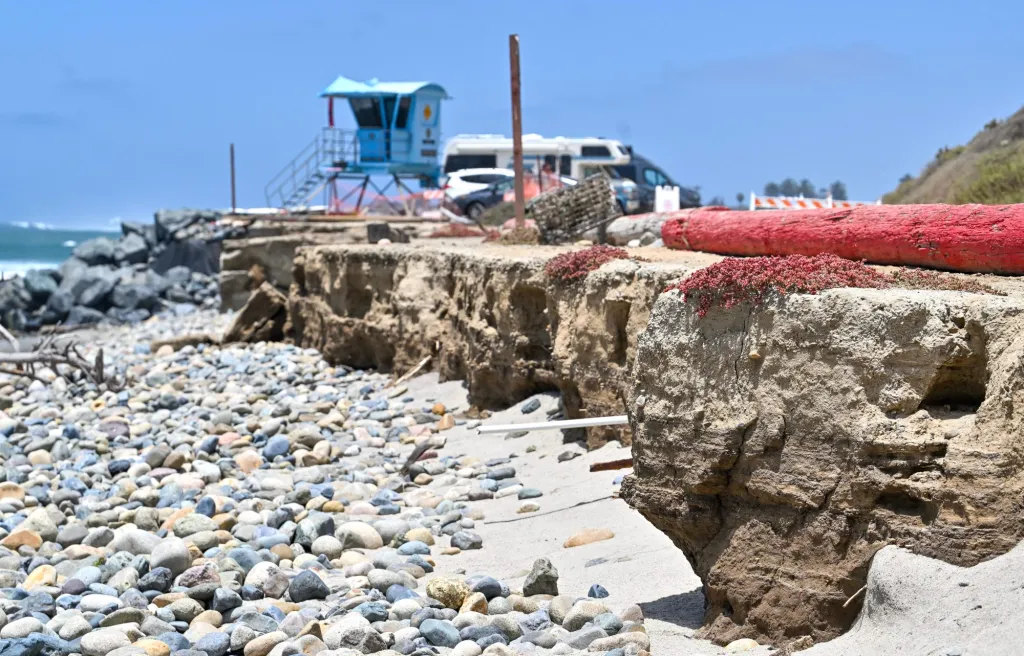
With its limited development, San Onofre Surf Beach is a step back into coastal California’s past — but its future is uncertain.
Read more Trump won big spending promises from NATO last year. This week in Turkey, he’ll try to enforce them
Surfrider Foundation and State Parks recently held public workshops to talk about ideas for maintaining access to this beloved beach, a place tucked between Orange County and San Diego, as erosion chomps away at a dirt access road and beachfront parking. More than half of the parking spots have crumbled away in recent years.
Surfrider Foundation received a $1 million grant in 2024 from the California State Coastal Conservancy to explore solutions for preserving San Onofre’s public access, with ideas ranging from nature-based solutions to ease erosion to parking solutions as the dirt lot continues to shrink and disappear.
This is just the start of what Surfrider hopes will be a multi-phase project, the current grant funding allowing planners to get 30% of necessary engineering design work complete. Another round of grant funding would be needed to obtain permits to do an environmental review.
Since 2024, Surfrider has gathered feedback through small group discussions, pop ups on the beach and community gatherings to figure out what people see as the most important part of the San O experience. A survey also went out.
One of the most common responses was maintaining a sense of “community.” Parking and access were also repeated concerns for people.
“This is by far the biggest recurring theme we’re hearing people talk about,” said Alex Mignogna, coastal adaptation manager for the group’s Coasts & Climate Initiative.
James Jackson, a civil and coastal engineer with Environmental Science Associates, said Surf Beach was fairly wide in the 1900s, as shown in an image from 1932.
“Surf Beach is what it is because of many decades and centuries of erosion from both the ocean and the waves and tides, as well as rainfall and local runoff at the site,” he said. “The waves and water levels over time have eaten the bluff materials, which contain a lot of river deposits, gravels, and cobble.”
Sand comes and goes along the beach and is transported up and down the coast, leaving behind cobble and boulders.
Recent impacts to the beach’s width include an El Niño that hit about a decade ago, in 2015 and 2016, and eroded a large section of the beach. The damage prompted State Parks to fill in about 900 feet of rock revetment to stabilize that portion of the parking lot in 2017.
“But since then, we’ve seen ongoing erosion downcoast, up to 40 feet in some areas since that El Niño and the rocks were placed,” Jackson said.
Just this last winter, another 20 feet of parking lot erosion was measured.
Sea level rise is expected to make matters even worse, based on projections that show in the past 100 years, there’s been a two-thirds foot of rise. Researchers have tracked spikes in sea levels during El Niño years in the early ’80s, the ’90s and again a decade ago. El Niño conditions are expected later this year.
“We’re at a chronically low beach condition at Surf Beach, and the parking lot is flooding regularly,” Jackson said.
Just a few weeks ago, high spring tides and large surf inundated the beachfront parking lot and it was closed.
With low sand delivery because watersheds have been developed and constraints due to flood control infrastructure, along with persistent drought conditions, there’s not a lot of sand coming into the beach.
“Sea level rise is going to place added pressure on the remaining beach,” Jackson said.
Some solutions being looked at are dune systems, adding more cobblestone to the shoreline, adding a cobble reef or simply allowing erosion to take place.
Dunes are a topographic feature that forms along the back of a wide, undisturbed beach. San Onofre had sand dunes as recently as the 1950s, but because the beach is so narrow, it would be challenging to establish new ones, the experts said.
Cobble berms are a natural formation that occurs along erosive bluffs, often buried under sand and exposed seasonally. Adding more of the rocks to the existing cobble berms would be the “most practical and site-compatible nature-based solution for San O,” Jackson said.
Cobble reefs already, as a natural feature, exist offshore, helping to create the iconic surf breaks the area is loved for, such as Old Mans and the Point. Adding more cobble to those, however, may impact the waves and is an untested solution with uncertainty of how it would impact the surfing resources.
Read more Millions in funding from 405 Express Lanes to be reinvested in local roads
The bluffs are constantly crumbling down and rolling sediments into the parking lot, which is managed by State Parks. Utilizing that material for the standard maintenance process could be used beneficially on the shoreline.
There could be a way to make more room at the bottom of the bluff for additional space, Jackson said.
Riley Pratt, environmental scientist with State Parks, said the loss of parking is a top concern. Prior to the El Niño season in 2015, there were 330 beachfront spots on the dirt road; these days down to 160.
“We’re exploring options for providing alternative parking opportunities,” Pratt said.
In 2023, water rushed down the hillside and collapsed the road into the beach, highlighting how vulnerable the existing access has become, he said.
The road has become so narrow following several king tide events in January and February that State Parks had to proactively close the lower lot for several days to avoid vehicles being stranded without a safe way to exit the park, he said.
While work on the beach and shoreline helps address near- and mid-term solutions, bluff-top access planning helps prepare for longer-term changes, Pratt said.
“The reality is that there is unlikely to be a single solution that works forever,” he said.
State Parks controls only a small portion of the bluff top area, so a limited amount of parking could be added there. Other areas are under the control of the military or under lease with Southern California Edison’s nuclear power plant.
One option is converting the existing queuing line into a public parking lot. Currently, cars on busy days line up and enter the park when another leaves, sometimes waiting for hours just to get a spot.
Another option would be to park along the old Highway 1, though that would require a longer walking distance. A third potential option would be to use a large paved lot leased by Edison, but the nuclear generating station is undergoing decommissioning, likely through 2028.
“After that, future public use of the site would depend on decisions made by the federal government, the Department of Navy, specifically,” Pratt said. “So we don’t really have control over that.”
State Parks and Surfrider want public feedback on what options should be explored, with respondents being asked if they support blufftop parking and other thoughts on access, with a survey available online.
The next question in the survey: if blufftop parking is created, what route should people use to walk into the park?
Should they walk in using the current road configuration, or should a pathway from the top be built using switchbacks or a staircase for a shorter, steeper trek?
Stairs would be the more expensive option, would have more of an environmental impact and could take years to build, Pratt noted.
There was also discussion about how people with disabilities could access the beach, with ideas such as a shuttle service at certain times or select parking spots near the dirt road entrance, but that would be subject to closures when water impacts the road.
“In both scenarios, users would still need to find a way to get their watercraft to the water or get to the beach,” Pratt said.
The current project funding sunsets at the end of the year, with ESA compiling the feedback and coming up with a report by early fall with recommended next steps.
Surfrider, surfrider.org, will have the survey available to the public through July 12.
Read more Markets on Wall Street quietly mixed while oil prices slip after OPEC+ plans August output hike