
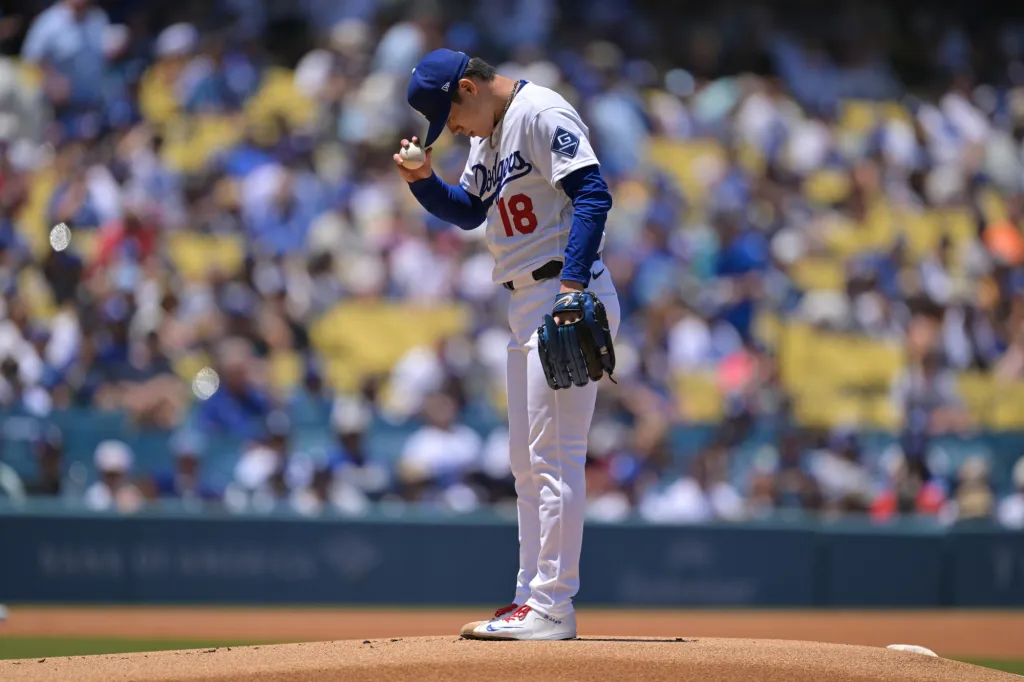
LOS ANGELES — Seriously, was there ever any doubt that Yoshinobu Yamamoto is the Dodgers’ ace?
Read more Dodgers rookies provide power in win over Phillies
Any questions should have been dispelled last October, when Yoshinobu was a throwback to the guys of legend who were slackers if they didn’t go nine innings. He pitched a complete game in Game 2 of the National League Championship Series in Milwaukee, putting L.A. halfway to a sweep. Then he went nine more in a 5-1 victory in Game 2 of the World Series in Toronto, after the Dodgers had been smoked in Game 1, 11-4.
Then, for the pièce de résistance, Yamamoto pitched six innings, allowing five hits and a run, in the 3-1 victory in Game 6 that forced a deciding game in Toronto. And the next night he came out of the bullpen to pitch 2⅔ scoreless innings, close out Game 7 and help bring the Dodgers a second straight championship.
After he was named the World Series MVP that night, I asked a couple of Japanese journalists how they would pronounce “Bulldog” in their language, given that this was a Hershiser-ian postseason performance.
“Burudoggu,” was their response. Sounds like “Bulldog,” so fair enough. Excellence sounds the same in any language.
And right now, in 2026, with almost half of the pitching staff on the injured list and projected starters Tyler Glasnow and Blake Snell unavailable, the guy who can take his turn regularly and give you a competitive outing each time out – even when he doesn’t have his Grade A stuff – is more important than ever.
There was a gentle discussion in the interview room before Sunday’s game, a 9-1 Dodgers victory over the Phillies in which Yamamoto pitched 5⅓ shutout innings: Would he be considered the ace, or might it be Shohei Ohtani?
Yes, the Unicorn has a 5-2 record and a 0.82 ERA in his nine starts, with 61 strikeouts and 17 walks in his first full season as a pitcher since 2022. And he also carries the burden of two full-time jobs.
Part of the ace’s job is to stop losing streaks, even tiny ones, in their tracks. After Saturday night’s 4-3 loss to the Phillies – a defeat that happened in large part because reliever Tanner Scott reverted to some old, bad habits in surrendering a 3-1 lead in the eighth – Yamamoto understood Sunday’s assignment.
He blanked the Phils on four hits and 104 pitches, striking out 10, even as he struggled with his command and ratcheted up the pitch count (33 after two innings). He battled, he navigated his way through a tough lineup, and was particularly stubborn – bulldog-ish? – in the fifth, with men on first and third and the top of the Phillies lineup – Kyle Schwarber and Trea Turner – awaiting.
Schwarber went down swinging on a 97.5 mph four-seamer. Turner took a 95.9 mph sinker for strike three, and when he challenged it, plate umpire Sean Barber’s call was upheld.
That, as it turned out, was a rarity. The umpire had one of those Really Bad Days, with six calls overturned in the first four innings before he finally had one upheld, and eight of 10 overturned all told. (This, of course, is the unintended consequence of the ABS challenge system, an umpire subject to public humiliation thanks to the gentle tapping of the helmet.)
Read more Angels burned by Rays’ speed, walks in latest loss
But those challenges helped Yamamoto, too. Catcher Dalton Rushing challenged two calls in the first inning, a 2-and-2 pitch to Schwarber that Barber called a ball, and a 3-and-2 pitch to Bryce Harper that Barber also called a ball. When both were overturned, maybe that settled Yamamoto down somewhat.
“Yeah, that was a good challenge, because I believe I was hitting my spots,” Yamamoto said through his interpreter.
Rushing said he’s been working on recognizing when to challenge and when not to, and getting it right twice and helping his pitcher was quite satisfying.
“The command was a little touchy in the first compared to where he’s usually at,” Rushing said. “And just to be kind of able to kinda, quote unquote, save him a little bit with those two challenges felt great. And I think it allowed him to settle in.”
Maybe this is another characteristic of an ace: To be able to succeed without your best stuff, or without your normal command.
After Yamamoto struck out Brandon Marsh with his 104th pitch of the game for the first out of the sixth inning, Dodgers manager Dave Roberts came out to get him, two outs shy of what would have been his ninth quality start in 11 outings.
“I didn’t want to push him too much further,” Roberts said. “… He could have probably found a way to get through that sixth inning, but I just felt, you know, to what cost? But yeah, it just speaks to these guys. The good ones, the really good ones, know how to get major league hitters out when they don’t have their best stuff. And for the most part, you don’t always have your ‘A’ stuff every outing.”
Before the game, building on that conversation mentioned above, I asked Roberts what the main characteristics of an ace would be.
“He beats good teams,” he said. “He manages stress, can limit damage. He can take a punch early and keep going. You can essentially bank length in a game. Yeah, those are kind of some of the qualities.”
Aside maybe from the length, we saw it Sunday. Yamamoto is now 5-4, his ERA is 2.86, and he has 69 strikeouts, 15 walks and a 1.00 WHIP in 69⅓ innings. (And, additionally, in all four of his losses the Dodgers had scored two runs or fewer. Sunday, in contrast, they had a 6-0 lead by the time he left the game.
So, I asked Rushing, is he the ace?
“Take your pick,” he responded. “Look in the room and you tell me. We got plenty of aces. It’s fun to work with. I think he deserves that name after last year, if you want me to be honest. But at the same time, we have a rotation full of aces. … It’s fun to work with all of them, and I’m glad he had a good one today.”
Read more Newport Harbor, Rancho Alamitos start CIF regional baseball playoffs at home
The catcher needs to be diplomatic, and that’s fine.
The columnist’s view? Yamamoto’s the ace. Case closed.