
Who exactly are social justice scholars? They’re professionals who help transform classrooms so they reflect society’s wide diversity of students. Conversely, they remind us of how school systems based on only one language and one way of living can negatively influence not only students who speak two or more languages, but they also inhibit the growth of English-only students.
Read more Polymarket cuts ties with George Santos as regulators probe trades on rival prediction market
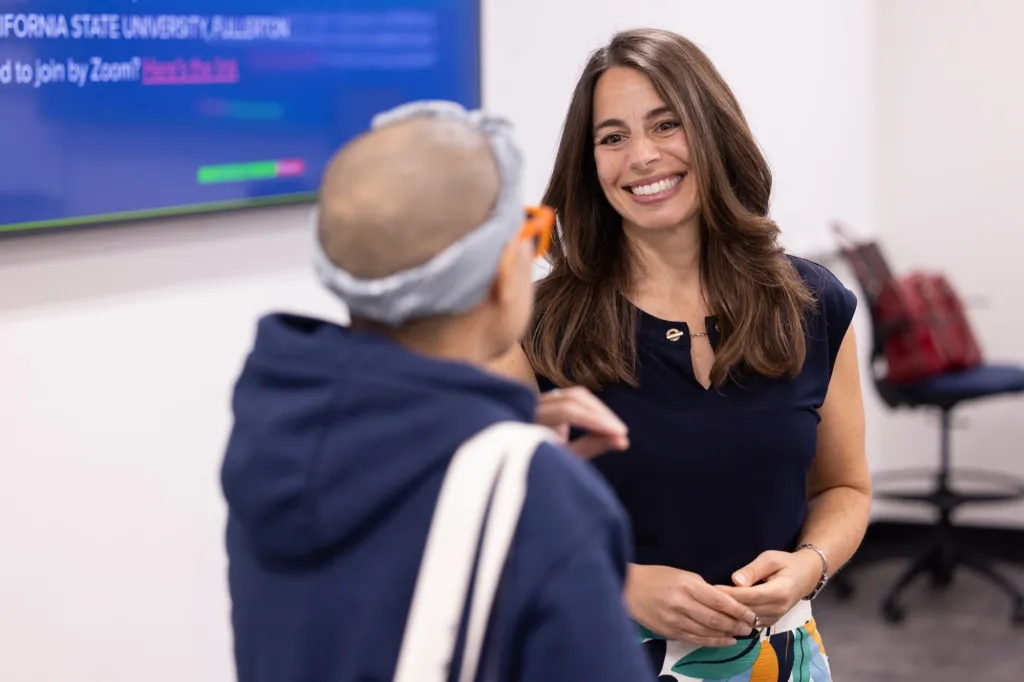
For her many years of dedicated service as a social justice scholar, Alison Dover, Cal State Fullerton professor of secondary education, recently received the university’s 2026 Outstanding Professor Award, the top honor bestowed upon CSUF faculty. Her work — rooted in teaching, scholastic research and mentoring — is continually focused on advancing social, racial and economic equity in secondary education classrooms.
“Today we have this incredible diversity here in California and in our greater world,” Dover said. “Some 40% of students in the state speak a language other than English at home. Yet our schools haven’t kept up (with this diversity). The curriculum and ways of communicating in the classroom still reflect a monolithic student body.”
Among her many roles, Dover directs and serves as the graduate adviser for the university’s Master of Science in Transformative Teaching in Secondary Education program. “We need to create educational systems in which everyone truly benefits,” she said. “Yet so many of our schools and classrooms are still grounded in English only. Speaking only one language, or being comfortable interacting with speakers of one language, is a tremendous deficit.
“So (with transformative teaching), we create spaces in which students entering our classrooms speaking more than one language are growing in the language that they speak, while developing their skills in English. In doing so, they’re also helping kids who are raised in monolingual English households stretch themselves linguistically.”
Dover grew up in a working-class family, which affected her future career path. “My parents always placed tremendous value in education,” she said. “The idea that college was possible, that was just ingrained.”
After earning bachelor’s degrees in women’s studies and English from Tufts University, Dover eventually earned a master’s degree and a doctorate in social justice education from the University of Massachusetts Amherst. “Other students in my classes would go skiing in Europe over the weekend, while I was hungry, struggling with food insecurity,” Dover said. “Still, I realized that not every working-class kid had my opportunities. So I dedicated not just my career, but my life, to creating social, economic and educational justice.”
Along with teaching and mentoring, this ongoing dedication involves rigorous academic research. The result: 32 scholarly publications, 75 local, national and international presentations, and two books. One of them, “Radically Inclusive Teaching with Newcomer and Emergent Plurilingual Students: Braving Up,” co-authored with fellow CSUF professor of secondary education Fernando Rodríguez-Valls, won two national awards.
Read more Treasury Secretary Scott Bessent refuses to say whether Trump remains exempt from IRS audits
Their academic rigor has led to real-world change. Dover and Rodríguez-Valls serve as co-directors of the Summer Language Academy, now in its 11th year in Southern California. “It’s a summer arts- and literacy-based program for plurilingual students,” Dover said. (“Plurilingual” is preferred over “bilingual,” since many of these students speak more than two languages.) “We’ve worked with about 1,400 students and 200 educators. Students who are silenced or marginalized in their day-to-day lives engage in some really robust experiences.”
Thanks to her efforts, Dover has received more than $800,000 in research funding, including $400,000 earmarked for Project LEARN (Language, Equity and Action Research with Newcomer Students), a program that built on the success of the Summer Language Academy and serves as a prime example of Dover’s ability to apply research to practice.
Before wrapping up in 2024, Project LEARN supported newcomer students and their teachers as they collaboratively developed research questions based on the students’ experiences, gathered data and then used their findings to improve the students’ classroom experiences.
Some of the master’s students first entering CSUF’s Transformative Teaching in Secondary Education program aren’t brimming with confidence. “Early on, one student was in tears,” Dover said, citing one example of many. “Now she’s gained this sense of leadership within her cohort, and I wouldn’t be surprised to see her bringing her expertise to a wider national education community over the course of her career. She’s now telling me about the research article she’s planning to write next year as her capstone project.”
This kind of transformation, fostered by Dover and her CSUF colleagues, mirrors the very same positive changes made by the students of those secondary education teachers Dover has mentored.
Dover remains grateful for the opportunities furnished by Cal State Fullerton. “It’s such a privilege to work in a space like this,” she said. “The university really has a deep commitment to our students. … I work with some of the most brilliant minds around, and I feel tremendously grateful to be able to do so.”
Read more Riviera Country Club takes center stage for U.S. Women’s Open