
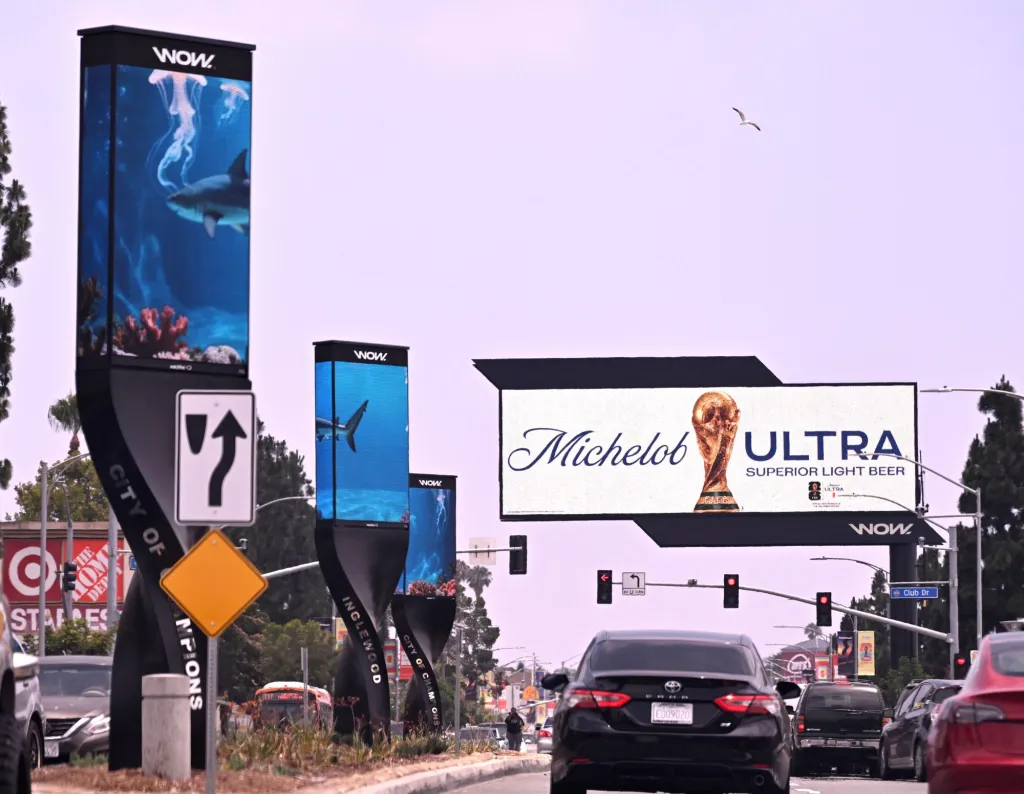
The World Cup’s arrival at SoFi Stadium this week marks yet another colossal win for the resurgent City of Champions, but — behind the scenes — the alliance between the developer and City Hall that helped revitalize Inglewood over the past decade has soured.
Read more Companies are testing baby formula for heavy metals — a new bill would make them share results
The two sides now are duking it out over two major disputes: who has the right to display digital billboards in town and $448 million in reimbursements allegedly owed by the city for the developers’ previous public improvements and services.
The outcome will not affect the ownership of SoFi Stadium, but it could dismantle the long-term agreement that enabled the world- class stadium’s construction and could put its operators at a disadvantage if forced to renegotiate terms with the city.
In an interview with the Southern California News Group, Inglewood Mayor James T. Butts Jr. shrugged off the ongoing battles with the developers behind SoFi Stadium and the neighboring Intuit Dome as a “business dispute.”
“Those relationships will continue on,” he said. “Both entities are going to be here for a very long time.”
Butts, who once described the agreement with SoFi’s developers as “the best financial arrangement in the history of stadium deals in this country,” is now challenging its validity, all while the two parties prepare for one of the venue’s largest sporting events yet.
Eight World Cup matches will be played at the $5 billion stadium starting Friday, June 12. And by the end of its first decade in operation in 2030, the home of the Rams and Chargers will have hosted the World Cup, Wrestlemania, the Super Bowl (soon to be twice) and served as the site of the opening ceremony for the 2028 Olympic Games. That’s on top of sold-out concerts by Taylor Swift and Beyoncé that drew in 700,000 people in a 12-day period in 2023.
A 2024 report by Micronomics Inc., a Long Beach-based economic research and consulting firm, estimated Inglewood will see about $17 million in economic benefits from the World Cup alone.
Digital billboard revenues
Fighting began last year after the City Council approved an up to 40-year lease agreement allowing WOW Media to place dozens of digital billboards and signs on public property near the Hollywood Park project, where SoFi Stadium is located, and the Intuit Dome, the Clippers’ multibillion-dollar arena across the street.
Hollywood Park, the Intuit Dome and the Kia Forum, fearing the lease would hurt their own advertising revenues, sued to try to undo it, arguing it was not properly approved and went against their own deals with the city.
Those cases are still pending. A tentative ruling in the Hollywood Park challenge indicated the judge, at least initially, was inclined to side with the city, but, following arguments last week, a final ruling has yet to be issued.
The blog 2UrbanGirls first reported on the lawsuits last year.
Mayor: Need to work together
The litigation has since sparked further escalations, including a separate $448 million breach-of-contract lawsuit and a series of voter-backed initiatives that could threaten the city or the stadium’s bottom line, depending on which, if any, pass.
Butts, in a letter sent to Rams owner Stan Kroenke shortly after the billboard lawsuit was filed in July , expressed disappointment that Kroenke hadn’t reached out to him, according to court filings.
“We started our relationship face to face and together set the foundation for you and the Rams to gain the support of your colleagues and the NFL for the Rams to move back to the LA market in Inglewood,” Butts wrote. “I would have expected a call from you personally and not just a lawyer’s letter and a lawsuit.”
The city, upon receiving the lawsuit over the WOW Media lease, discovered a legal precedent out of Moreno Valley that appeared to void the stadium’s development agreement entirely, the mayor wrote. In 2018, an appellate court in the Moreno Valley case concluded that a development agreement could not be adopted through a ballot initiative — in the same way the stadium project was launched in Inglewood — and instead must be negotiated and approved by a legislative body.
“I’m writing to invite a dialogue about how to address and hopefully resolve these issues,” Butts wrote. “I think we should handle the situation, as we have in the past, by working together in a productive manner as partners — not by way of lawsuits.”
In the interview, Butts said the decision in the Moreno Valley case requires “a true and meaningful negotiation” of the development agreement, and the city will follow that standard if the courts rule in its favor.
Dispute over reimbursements
Hollywood Park filed a breach-of-contract lawsuit in response to Butts’ letter, with its lawyers arguing that Inglewood is attempting to pull the “rug out from Hollywood Park by refusing to perform its own obligations” after the company invested billions of dollars in the city over the past decade.
Hollywood Park’s attorneys contend state law sets a 90-day time limit for contesting a development agreement, a deadline that passed in 2015. But Butts said the city did not learn of the Moreno Valley decision until the billboard case was filed last year and is challenging the agreement appropriately.
As part of the stadium’s construction, Hollywood Park alleges it paid $376 million toward public improvements — sidewalks, roads, utility upgrades — and $72 million toward public services on the promise that Inglewood would pay back the developer over time. The developer’s lawsuit asks a judge to force the city to honor that obligation.
The development agreement requires Inglewood, once tax revenues from the project exceed $25 million, or $32 million with inflation according to Butts, to make payments of any amount over the threshold to Hollywood Park as reimbursement. If, for example, Inglewood made $26 million in tax revenues in a year, it would need to pay $1 million toward the costs.
The developer alleges Inglewood has exceeded that threshold every year since 2022 and has paid $20 million so far, though the city has since demanded the return of those funds on the grounds that the development agreement is no longer valid and, thus, the payment could constitute a misappropriation of public funds under the law.
Inglewood disagrees on when the cap was first exceeded and the total amount owed, according to Butts. The city does not believe all of those costs qualify as reimbursable, Butts said.
‘Broader questions’ loom
In a statement, Otto Maly, the managing director of Hollywood Park, said the attempt to unwind the development agreement raises “broader questions about the certainty and reliability of long-term commitments that underpin major development projects and economic growth.” The impact extends “far beyond Hollywood Park,” he said.
Read more Most new moms get the baby blues. But it could be something more serious: postpartum depression
“If those commitments can be revisited or undone years after substantial investments have been made, it risks discouraging future investment, including in sizable projects that create jobs, drive economic activity, and deliver long-term community benefits precisely as Hollywood Park has done in Inglewood,” Maly stated. “Despite our concerns about the impact to continued investment from other entities, we remain committed to continuing our investment in Inglewood.”
In its lawsuit, Hollywood Park credits its investment into the City of Champions with decreasing the city’s unemployment rate from 17% to 4.7% and for increasing real estate values from $9 billion to $17 billion.
Though Butts acknowledges that Hollywood Park has been “very good” to the city, he disagrees with the idea that it saved Inglewood.
The city was facing bankruptcy when Butts took office in 2011, and the first game was not played at SoFi Stadium until 2020, he said. The City Council cut positions, eliminated lifetime benefits and attracted new revenue sources, including the reopening of the Kia Forum, he said.
“The reality is that our finances were stabilized before the Rams deal ever manifested any money,” he said.
To split the cases or not
Hollywood Park wants the question of the validity of the development agreement split off from the rest of its breach of contract lawsuit and addressed first, according to court filings. Fast-tracking a decision on that portion would narrow the remaining claims and speed up the entire case, company attorneys wrote.
Inglewood is opposing the bifurcation, arguing that splitting the case would delay its full resolution.
“We want to settle the issue right now,” Butts said.
A hearing on the motion is scheduled for Tuesday, June 9.
Ballot initiatives
The brawl has extended beyond the courts, too. The companies on the two sides of the fight — WOW Media and Hollywood Park — each are backing ballot initiatives that, if successful, could financially damage the other.
The initiative that is furthest along, backed by Hollywood Park and filed by Neighbors for Beautiful Inglewood, has collected nearly 13,000 signatures, and would, if approved by voters, prohibit “off-site” advertising kiosks and billboards on public space from displaying nearly all “commercially sponsored advertisements.” It would effectively shut down WOW Media’s billboards while exempting the billboards on the private properties of the city’s sports and entertainment venues.
John Shallman, a political strategist managing the campaign whose past clients include the Clippers, said the initiative is not hiding that the city’s largest venues are helping to fund it, but he maintains the push is driven by frustrated residents opposed to billboard blight and who believe the WOW Media deal is flawed.
“You don’t collect 13,000 signatures because a venue decided they wanted it,” Shallman said. “The mayor wants this to be about who signed the check, we want it to be about who signed the petition, and that’s 13,000 Inglewood voters.”
Shallman alleges the WOW Media lease will generate “maybe” $1 million a year, a figure that Butts contends is much higher.
“Why are you risking the city’s biggest economic engine for what amounts to budget dust,” Shallman said. “You’re talking about billboards surrounding some of the most valuable entertainment destinations in America.”
The city estimates the deal with WOW Media will bring in $8 million a year, with those funds supporting various public services, including programs for families and seniors, according to Butts. He sees the initiative as a potential “transfer of revenues” from residents “to the venues that are excluded.”
“The residents of Inglewood have the right to self determination,” Butts said. “They have the right to derive income to support city services, particularly since those residents host 5 million people per year at 400 different events at our two arenas and the stadium.”
The initiative already has spawned its own lawsuits as well.
Inglewood sued proponent Shannon Roberts, a 29-year resident, on the grounds that the initiative violates free speech and gives the venues a “private advertising monopoly.” Roberts then sued the city, and a judge intervened in her favor when the city clerk’s office initially declined to provide a ballot title and summary for the initiative as required under the California Elections Code.
At the same time, WOW Media is funding two separate initiatives through the Inglewood Residents for Stadium Accountability that could cut into the venues’ revenues.
would limit parking fees to $20 within 2 miles of a major venue. The cost for an official parking spot near the stadium for the opening World Cup match currently ranges from $151 to $300, according to the stadium’s website.
initiative would remove a $15 million annual cap on the 10% ticket tax paid to the city by the stadium.
Scott Krantz, CEO of WOW Media, told L.A. Local that his company wants to push the stadium’s operators to contribute more to the city.
“Our commitment has always been to invest in Inglewood, and that commitment goes far beyond our network,” Krantz told the outlet.
According to a Reddit post, WOW used its billboards in the city to promote the initiative with mock advertisements calling on residents to “spare our billionaires the trauma of flying commercial” by funding the “stadium owner’s private jets.”
Read more Dodgers score 9 runs in 1st inning, rout Angels in Freeway Series