
Predictions that the FIFA World Cup 2026 games will attract more than $1 billion in spending at Southern California hotels, restaurants and tourist hotspots this summer are beginning to look a little shaky.
Read more Sea to Shining Sea LBC to celebrate America’s 250th with three fireworks shows at once — and more
A major hotel trade group is tamping down a previously upbeat forecast, saying FIFA itself has canceled “thousands of downtown Los Angeles rooms” while simultaneously, geopolitical events — including the U.S. and Israel-led war in Iran — have put a damper on international travel to the area as jet fuel shortages plague flights globally.
With the Iran soccer team playing in Los Angeles, the tight-knit Persian community in Westwood has lowered its expectations somewhat regarding visitors flooding their stores.
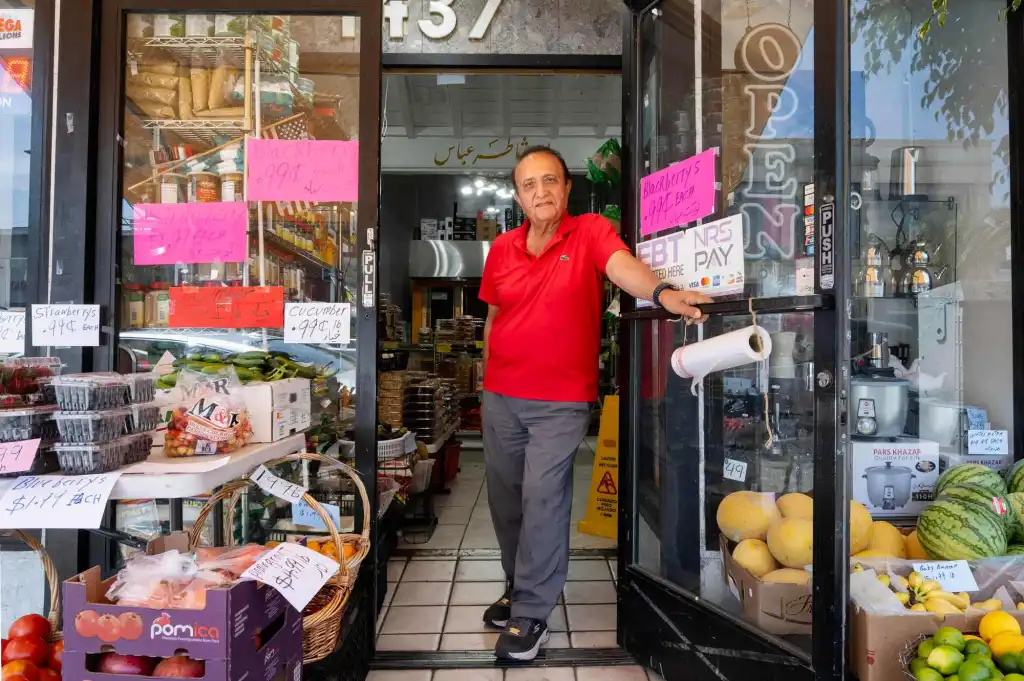
An American flag hangs at the front of Mohammad Ghafari’s Shater Abbass Bakery & Market along Westwood, where crates of pomegranates, oranges, watermelon and other fruit and vegetables crowd the sidewalk.
The expatriate has mixed feelings about the World Cup and his homeland’s team.
“The soccer team belongs to the Islamic regime, and it does not represent Iranians,” said Ghafari, who said he is torn between loyalty to his hometown of Mashhad and his disdain of the Iranian Revolutionary Guard Corps, which controls the country.
Others are eager for a win
“I don’t want to get political,” said George Chammaa, owner of the Sunnin Lebanese Cafe across the street from Ghafari’s market. “I’d love to see Iran win. It’d be good for the area.”
For sure, travel through major airports in the area are seeing a dip in flights — some due to airlines taking cost-cutting measures tied to higher fuel costs. On June 5, American Airlines became the latest airline to temporarily suspend some domestic routes serving Los Angeles and Ontario.
The FIFA games with 48 teams vying for the World Cup will feature 104 matches over 39 days from June 11 to July 19. The tournament is taking place across Canada, Mexico and the United States, with 11 of the 16 locations in the U.S.
Los Angeles is hosting eight of the matches — including two games with an Iranian soccer team that is being forced to stay in Tijuana due to visa concerns.
How many people will attend, dine out and sleep in local hotels remains to be seen.
Which flag to wave?
In Persian Square in Los Angeles, the largest concentration of Iranian-Americans outside of Iran, flags from before the Islamic Revolution of 1979 are visible in kabob restaurants, food markets and rug shops along Westwood Boulevard and Wilkins Avenue — nicknamed “Tehrangeles” (Tehran and Los Angeles).
Some of the Iranian diaspora were ready to celebrate their homeland roots while others didn’t want to be associated with the Middle Eastern regime.
The Iranian soccer team will play New Zealand on June 15 and Belgium on June 21 at SoFi Stadium in Inglewood. (SoFi has temporarily been renamed Los Angeles Stadium in order to comply with strict FIFA branding rules for the World Cup.)
Many of the Persians interviewed in Westwood said they would likely watch the games with friends and family at home rather than gather publicly in restaurants or bars. Most cited safety concerns as their primary reason for staying home.
Some shop owners who didn’t want to be identified, said that a parade may be planned along Westwood if the Iran team advances. Others aren’t so sure, though, with some considering protests outside the arena on game days.
Torn loyalties
For sure, L.A.’s huge Persian-American population is divided by their allegiance to the U.S. and their homeland.
Iran’s World Cup squad is to depart Saturday, June 6 from the Middle East for Tijuana while waiting out delays for their U.S. visas. The plan is for the team to make a four-hour bus ride to Inglewood to play, and then return to lodgings in Mexico.
“People here are sympathetic for the Iranian team, but they’re playing for the Iranian regime,” Ghafari said. “I’d love to see them win, but I can’t say whether I’d be happy or not. I don’t support President Trump’s war. If Trump wants to help the Persian people, he should arm the people to fight, not be hell-bent on spending billions of taxpayer dollars in destroying the oil infrastructure and the thousands who have died since the war began.”
Ghafari doesn’t see the FIFA World Cup bringing much tourist spending to the Persian community that extends between Santa Monica and Wilshire boulevards. “My store is empty because money is too tight to buy groceries,” he said. “Inflation is hurting my business. Nobody is walking the streets around here.”
The story is different for Shahrzad Tahouri, owner of a travel agency along Westwood, who was speaking Farsi on Wednesday with a client planning a trip to Los Angeles for a wedding during the World Cup.
Tahouri said she her tourism business has struggled since the Iran war began Feb. 28. Lately, that changed, she speculated, because of the World Cup.
Charter bus rentals to visit local hot spots have spiked in price to as much as $2,000 per day due thanks to growing demand. That’s quite a change from a near collapse in bookings after the war began, she said.
“Today, I’ve been very busy,” said Tahouri, who juggled answering her phone for “global clients” looking to make travel plans, and customers walking in off the street. “Getting a charter tour bus is tough because of the soccer games.”
Los Angeles County is home to 86,430 people of Persian descent with another 39,700 living in Orange County, according to the Iranian Data Dashboard, which is hosted by the UCLA Center for Near Eastern Studies. Nearly a third of the 794,900 people with Persian ancestry living in the U.S. live in California.
Rooms available
The American Hotel and Lodging Association, so far, reports disappointing bookings amid cancellations of hotel rooms in downtown L.A.
Read more Onetime allies Inglewood, SoFi Stadium brawl over billboards, $448 million in payments
“International visitors are central to the World Cup’s economic promise, yet they are not materializing at the levels initially forecast,” a spokeswoman with the lodging group said in a statement. “This shortfall is particularly significant because international visitors spend roughly 1.7 times more than domestic travelers when they visit the U.S.”
The group cited a range of issues affecting international travel, including airfare costs and uncertainty around ticketing.
The spokeswoman also said that typical summer demand is holding in L.A., but the tournament is not delivering “the significant incremental uplift that was projected.” She said that FIFA initially set aside large volumes of rooms across host markets for official use, and as those allocations were adjusted and released back to the open market, “demand forecasts built on those early commitments required significant recalibration.”
That anticipated demand has not translated into strong hotel bookings and local travelers are outpacing international visitors, according to an early May 2026 report prepared by the group, which surveyed 205 members covering 11 host cities.
The report also found that roughly half of respondents cited “visa barriers, high labor costs, and distance from venues as meaningful constraints.” FIFA’s cancellation of “thousands of downtown Los Angeles rooms reflects these pressures and underscores how World Cup-related performance is proving uneven and highly location-specific, varying significantly by submarket and proximity to match activity.”
There are other signs of weakness brewing in parts of Southern California.
International travel is lagging after consumer backlash stemming from last year’s tariffs imposed by the Trump administration. Other travelers from Canada opted not to visit the region after President Donald Trump suggested the northern neighbor was to be the nation’s “51st” state.
There’s also inflation to blame as gas prices linger at record highs, commercial flights have been canceled and geopolitical tensions caused some consumers to hold back on spending.
At Los Angeles International Airport — which is fewer than 5 miles from SoFi Stadium — international passenger traffic fell more than 2% in the first four months of the year. That’s slightly more than the 1.6% drop in international travel seen in all of last year through the airport
John Wayne Airport, some 40 miles to the southeast and close to Disneyland, saw a 24% drop in international traffic in the first four months of 2026 and a nearly 9% drop in all of 2025.
High ticket prices?
World Cup ticket prices may also be turning off soccer fans.
Ticket prices range from several hundred dollars to the thousands. A check of prices on StubHub on June 2 for the June 12 match between the U.S. and Paraguay ranged from just under $1,000 in the stadium’s top rows to $23,500 at midfield behind the bench.
State Attorney General Rob Bonta is demanding that FIFA provide information on its marketing practices on the sale of tickets to determine if it had potentially misled consumers.
With sales possibly flagging, Bonta cited in concerns raised in a recent story by the New York Times that reported the soccer organization sold tickets based on seating categories displayed on stadium maps and later altered those categorizations before assigning precise seat locations.
Fans will come
Even with all the negative news, some World Cup forecasts remain optimistic.
“I don’t see any issues with tourism because of geopolitical tensions, or crime or anything like this,” said Haim Israel at Bank of America in an interview from Tel Aviv with the Southern California News Group. “The World Cup is the biggest sporting event ever, every four years, and this is going to be bigger than anything else.”
He pointed to the audience in general, with more than 6 billion people expected to watch the tournament and 6 million watching the games in person — a record audience.
“The numbers are astonishing. That’s almost 20% of the world population. It’s almost 1.5 billion people watching 90 minutes,” Israel said. “We keep looking at this as an economic event. This is not an economic event. This is an emotional event.”
A joint study conducted by FIFA and the World Trade Organization says the tournament could boost the financial health of the world by $41 billion in GDP — or gross domestic product — and create 824,000 jobs. Of these totals, the FIFA-WTO says the U.S. would get an economic jolt of $17 billion in GDP and 185,000 jobs.
The March 2025 analysis also says that the World Cup games could draw 6.5 million people and generate nearly $13.9 billion in “event-related total expenditures” in the tournament’s 11 host cities in the U.S. The U.S. expenditures account for $11.1 billion, including $2.9 billion for FIFA, and $6.4 billion from anticipated tourism spending.
Two years ago, the Los Angeles Sports & Entertainment Commission said that the economic impact of this summer’s FIFA World Cup could approach $594 million and attract nearly 150,000 out-of-town visitors. The findings were cited in , a Long Beach-based research and consulting firm.
In January, the nonprofit commission, which works to attract high-profile sporting events like the Super Bowl, World Cup and Olympics to the region, said the tally would be closer to $892 million.
The updated economic impact projections from Chicago-based Epsilon Economics — which changed its name after merging with Micronomics — show that the highwater mark could actually surpass $1.1 billion if $230 million from increased advertising and other media spending is added.
Epilson economist Roy Weinstein, the author of the commission’s two reports, said that the difference in the two projections stems from the first report assuming fewer people would be coming to the area.
“We changed that initial assumption from one person coming who had a ticket — to half of the people who had a ticket would come with someone else. If you’re coming from half way around the world or even someplace in the United States, you’re probably not coming alone,” said Weinstein in an interview. “Actually, the right assumption is probably you bring at least one person who maybe doesn’t have a ticket, but who goes to restaurants with you, stays in the hotel, takes transportation and goes shopping. So that had an impact on our projection.
“If I owned a big hotel chain in the Los Angeles area, or even a small one, I’d be saying, ‘There’s plenty of space here, and it’s not going to cost you that much.’ “
Read more Companies are testing baby formula for heavy metals — a new bill would make them share results