
By ERIC OLSON AP Sports Writer
OMAHA, Neb. — The Southeastern Conference has a record five teams in the College World Series, and the last six national champions hail from the conference.
Read more NBA Finals: Spurs still believe, but it’s Knicks who are 1 win from a title
But it’s not just the same old, same old this year, not with Troy (38-30) and West Virginia (45-15) squaring off in Friday’s opener as first-time participants on college baseball’s biggest stage. North Carolina (50-12-1) plays Mississippi (41-21) in the other Bracket 1 game at Charles Schwab Field.
Play begins in the all-SEC Bracket 2 on Saturday with Oklahoma (38-22) meeting Alabama (42-19) and Georgia (51-12) facing Texas (45-13).
SEC dominance in baseball dates to the 1990s, long before the professionalization of college sports with name, image and likeness (NIL) opportunities and revenue sharing. A popular belief was that the start of NIL in 2021 would make access to the CWS, always difficult for teams outside the power conferences, even more so for them.
After Cal State Fullerton reached Omaha in 2017, there wasn’t another mid-major in the field of eight until Oral Roberts in 2023. Last year, Murray State and Coastal Carolina made it, and Coastal reached the best-of-three championship series.
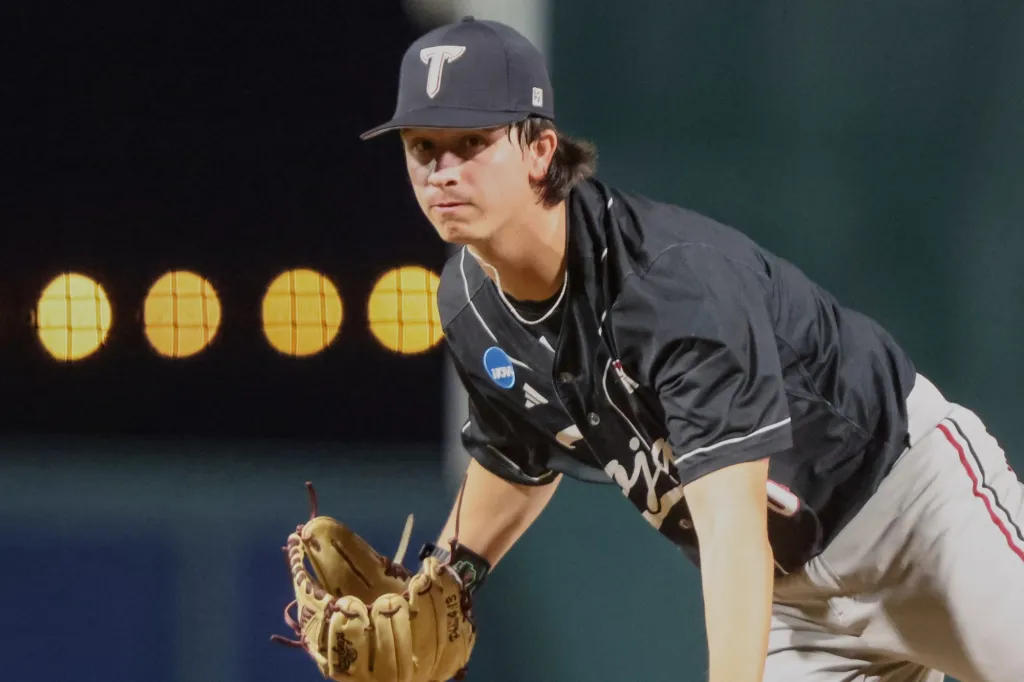
Troy, which received one of the last four at-large bids for the 64-team NCAA Tournament, carries the flag for the little guys this year.
Just don’t call the Trojans a Cinderella.
“Yeah, the crowd loves the Cinderella story, but us in the locker room and as a staff, we don’t really love that term,” said Jabe Boroff, who has hit six of his 11 home runs in the last five games. “We don’t really consider ourselves that. We know what type of firepower and talent we have in this locker room. It’s almost like a sour taste to hear Cinderella story.”
Troy has been aiming toward the CWS since coach Skylar Meade was hired five years ago from South Carolina, where he was the pitching coach for four seasons. The Trojans, by design, played the toughest nonconference schedule in the country this season and sixth-toughest overall. They are the first 30-loss team to make the CWS, but that’s partly because they were, in Meade’s words, an “honorary member of the SEC.”
They went 4-4 against SEC teams with all but one of those games on the road. They have wins over fellow CWS teams Georgia and Alabama, and they outscored host Florida 26-13 over two games in the regionals.
Meade said there are three critical pieces to his team’s success. Many of the Division I transfers who came in were underutilized at their previous schools and have thrived. He and his staff identified high school recruits overlooked by SEC schools who could be developed into stars, like Sun Belt Conference Player of the Year Jimmy Janicki. Teammates also developed strong bonds from playing such an ambitious schedule and overcoming adversity.
“If you do that, then runs such as this are actually possible,” Meade said. “I think without it, they’re not. You can’t just be a bunch of nomads that come together. You can maybe do that in the SEC. If you just procure the best-of-the-best talent and you have the elite coaching you have in there, it can happen, I believe. But I think for everyone else, you have to have a lot of pieces gelled together in the right way.”
BEEN THERE, DONE THAT
A total of 23 different schools have filled the combined 24 CWS spots since 2024. North Carolina is the only one to make it twice. Coach Scott Forbes doesn’t see that as much of an advantage because there are only two players left from the 2024 team that went 1-2 in Omaha.
Forbes said he’s better prepared this time. He showed his players documentaries about Super Bowl teams that got caught up in distractions around the event and lost but won in their second Super Bowl because they knew how to handle the atmosphere.
LOOK WHO’S BACK
Mississippi is back for the first time since it won the 2022 national championship. So is Hunter Elliott, who as a freshman started the Rebels’ title-clinching game against Oklahoma and pitched a strong 6⅔ innings. Elliott missed most of the 2023 season and all of 2024 with an elbow injury. He’s been the No. 1 starter for all but one series this season. Coach Mike Bianco announced Taylor Rabe would start against the Tar Heels.
THE SEC BRACKET
The NCAA has never re-seeded teams for the CWS, and this year that has created a significant power imbalance between the brackets.
Bracket 1 has national seeds in No. 5 North Carolina and No. 16 West Virginia. Bracket 2 has No. 3 Georgia, No. 6 Texas and No. 7 Alabama.
Oklahoma’s Justin Lebron has no gripe. “You’re going to be in tough moments throughout the season,” he said, “so it will really come out in the postseason.”
Alabama won two of three at Oklahoma in April. Texas and Georgia haven’t met since the Longhorns swept the Bulldogs in Austin in April 2025.
Read more Dodgers beat Pirates but Shohei Ohtani, Justin Wrobleski leave with injuries
MOUNTAINEERS NEARLY SCRAPPED PROGRAM
Oliver Luck had a decision to make in the fall of 2011, a few weeks after the Big 12 announced the addition of West Virginia effective the following year. Should he recommend dropping what had been a mediocre Big East baseball program or commit to giving the Mountaineers what they needed to be competitive going forward in one of the sport’s top conferences?
“Obviously, I was biased toward the latter,” Luck, the school’s athletic director at the time, said this week.
It’s been apparent for years Luck made the right choice but never more than now with the Mountaineers set to play in the CWS for the first time when they square off with Troy on Friday.
For West Virginia, the trip to Omaha is the realization of the vision Randy Mazey had when he was hired as coach in June 2012, the summer before his team’s first Big 12 season. Relying on players from traditional recruiting areas in and around the state, as the Mountaineers continue to do, those early teams were surprisingly competitive.
The Mountaineers in 2017 earned their first NCAA Tournament bid in 21 years, hosted a regional in 2019 and were on the road for regionals in 2023. They reached their first super regional in 2024, and after Mazey retired and handed off the program to longtime assistant Steve Sabins, they made supers again in 2025 and 2026.
“Looking back, the 14-year timeline based on where the program was, on the brink of extinction, that’s probably the timeline that should have taken place,” Mazey said.
This year’s Mountaineers (45-15) set a school record for wins and their style of play fits well at Schwab Field. Teams that can take advantage of the gaps in the cavernous outfield are rewarded, and West Virginia ranks among the national leaders in doubles and, with more than 100 stolen bases, can take the extra base. Maxx Yehl (9-2, 2.10 ERA) and Chansen Cole (10-1, 2.81) lead a pitching staff that has a 3.76 ERA, best among the eight CWS teams.
“I said about halfway through this season that this team not only can go to Omaha but this is a team that can win it,” Mazey said.
Jedd Gyorko has seen the worst and the best of the program’s history. He was the Mountaineers’ star shortstop from 2008-10, played eight years in the major leagues and is now special assistant to Sabins.
It’s 980 miles from Morgantown to Omaha but, from a baseball perspective, the distance was far greater for Gyorko and his teammates.
“It was more of a pipe dream back then,” Gyorko said. “You thought about it and you wanted to make it happen. When you look at what it takes, we were pretty far away from being there back then.”
Until 2015, the Mountaineers played at the dilapidated Hawley Field. Bad bounces on the infield were common – “Hawley hops,” they called them – and there was no clubhouse. If a coach or player needed to use the restroom during a game, they would use the same one as the few fans who showed up. The Mountaineers had to play their 2013 home conference series more than 150 miles away, in Charleston or Beckley, because Hawley Field didn’t meet Big 12 standards.
“We used to change into our uniforms in the parking lot behind right field right next to the tennis courts,” Gyorko said. “That was our clubhouse back in the day. We wanted to play ball, and that’s what was most important.”
Now the Mountaineers have some of the best baseball facilities in the country. The Kendrick Family Ballpark, originally Monongalia County Ballpark, opened in 2015 and a state-of-the-art baseball biomechanics center used by Paul Skenes of the nearby Pittsburgh Pirates, among others, opened a year ago.
Luck, who lives in Colorado, planned to drive to Omaha to join the thousands of Mountaineers fans who have jumped on the team’s bandwagon. Luck signed off on West Virginia’s commitment to baseball 15 years ago, but he said it took Mazey, Sabins and a host of others to make the Omaha dream come true.
“It’s a great thing not just for the university community but the entire state,” he said. “The Mountaineers are the flagship school and there are no professional teams in the state. When WVU plays the major sports, the entire state rallies around it. As you can imagine, I’m over the moon.”
Read more The American Dream: World Cup glory