
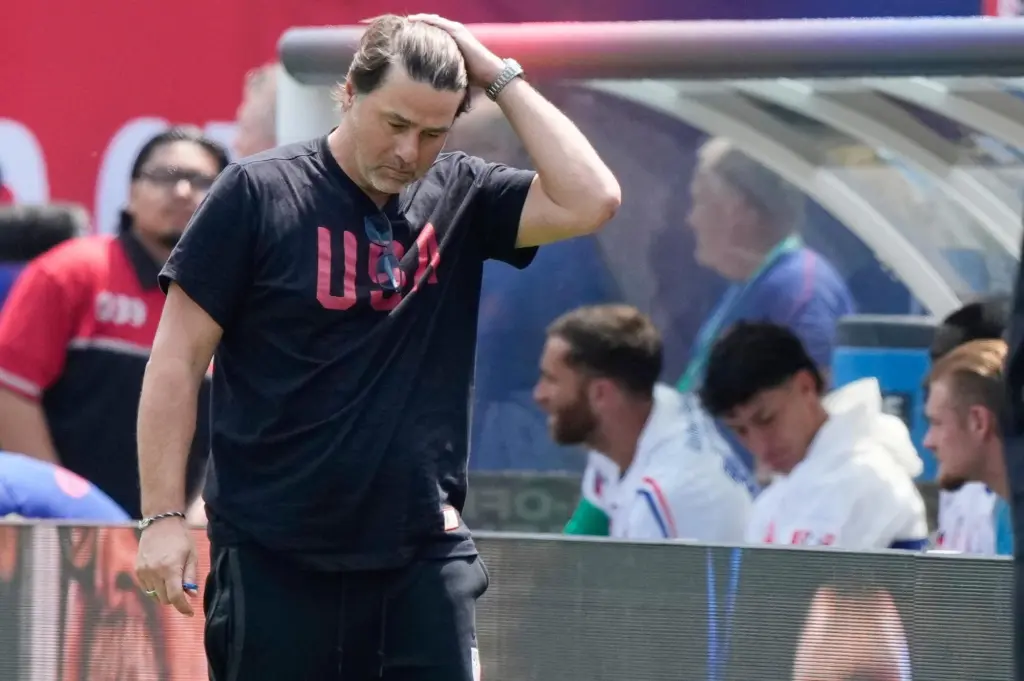
INGLEWOOD — Mauricio Pochettino subscribes to “energia universal,” or universal energy, a spiritual and philosophical concept that an invisible, omnipresent force flows through the cosmos and impacts everyday life.
Read more College World Series: Upstart Troy joins another SEC-heavy field in Omaha
“Decisions, personal relationships and absolutely everything else are a matter of energy,” Pochettino said in a 2017 book about his time coaching England’s Tottenham Hotspurs.
“I’ve had the ability to notice something powerful that you can’t see but does exist.”
This is the coach entrusted with guiding the U.S. men’s national soccer team at the 2026 World Cup, starting at 6 p.m. Friday from SoFi Stadium.
“Different,” star forward Christian Pulisic said of his coach, “in a lot of ways.”
Pochettino’s resume is impeccable. He is Argentine, for starters, as are five other coaches in this World Cup, the most of any nation. He played in a World Cup, in 2002, fouling Michael Owen in a move that led to David Beckham’s penalty kick in a 1-0 loss to England. He has coached three of the planet’s largest clubs: Tottenham and Chelsea in England and Paris Saint-Germain in France.
He has won everywhere he’s been.
But he’s also lost, and been fired, everywhere — with the exception of a brief stint at England’s Southampton. And usually just months after his teams seemed to be humming.
He took Tottenham to the Champions League final in May 2018 and was gone by the following November. He lasted 18 months at PSG. When Chelsea dismissed him after one season, the Guardian newspaper quoted a source describing his training methods as “antiquated.”
Now 54, he has followed a similar trajectory with the U.S. men, showing promise with a run of positive results followed by sudden, rollercoaster dips. Four straight wins, four straight losses, then unbeaten in 10 of 12, then losses in three of the last four.
Different, in a lot of ways.
His news conferences in his second language of English are an equally capricious adventure, ponderous and meandering, at once charming and confusing, at once incisive and incoherent.
He was asked Thursday about his team’s preparations since he was hired in September 2024, succeeding interim national coach Mikey Varas before he took over San Diego FC.
His answer: “I’ve seen in terms that we designed in between, of course, the coaching staff, the federation, all the areas of the federation in the best way as possible we can, trying to create the best platform for the player not only to perform, if not to set some principles and barriers during the dynamic of the group in the last three weeks, trying to arrive in our best condition.
“And I think we arrive in a very good condition. If you say to me that you are so happy, if you say to me that this is the best experience that I am living after I was a player or a coach, that the camp has been amazing; time flies. When people arrive to the end of the day and people are happy and say, ‘Oh, we need to go to sleep, we need to go to sleep,’ that is because I’m seeing we’re doing well. Something is growing in the group what we can tell so far until today, that only conditions are very positive and they’re so happy of the management.”
Pulisic wasn’t so happy a year ago, when he asked to skip some national-team friendlies after a long season with AC Milan and just join the national team for the Concacaf old Cup. Pochettino told him not to bother.
It was a bold, risky move pitting coach vs. superstar.
The guy nicknamed “The Sheriff” from his playing days won.
“When he came in, he laid the law down,” said San Diego State alum Marcelo Balboa, a veteran of three World Cups and now a Major League Soccer commentator. “He made it very clear: ‘This is how we’re going to play, this is my team. If you can fit into this, great. If you can’t, you can’t.’
Read more NBA Finals: Spurs still believe, but it’s Knicks who are 1 win from a title
“I think we saw the big battle right before Gold Cup when Christian didn’t get called in, that whole story. He let everybody know right there, this is how it’s done here. I’m the man, I’m the boss, it’s my job on the line, this is how it’s going to work.”
There have been some curious tactical decisions, and Pochettino appears to have reluctantly scrapped his preferred 4-2-3-1 alignment for three center backs with two wingbacks to bolster a leaky defense. But even in Saturday’s 2-1 defeat against Germany in Chicago, the final World Cup dress rehearsal, there were some flashes that they are arriving in their best condition.
“He’s had that intensity, he’s had that different personality, a bit different passion, I feel like,” defender Alex Freeman said before practice Thursday. “He’s one of those guys who puts … his mind into something, and that’s how he wants it. For me, it’s how can I apply that to my game, knowing that it’s a different philosophy than maybe I’ve been used to before.”
Friday’s opponent, Paraguay, offers a scrappy — if less talented — foe that is also coached by an Argentine, Gustavo Alfaro. They met in a friendly last November in Chester, Penn., the Yanks prevailing 2-1 in a match that turned contentious in the final minutes.
Next up is Australia in Seattle. Then back to SoFi for the group finale against Turkey.
It’s a group that doesn’t present the kind of navigational challenges of a 32-team World Cup, given the safety net of eight third-place teams advancing to the knockout stage. Still, a certain level of anxiety surrounding this team and its $6 million per year coach persists.
Asked for his definition of success at this World Cup, Pochettino conceded: “I don’t know, it’s difficult.”
What we do know is, fairly or unfairly, he’ll be judged not by the last 20 months but by the next 20 or so days, whether he can steer a nation that has won only one knockout game in its World Cup history into the quarterfinals or beyond.
Whether his team will have enough positive “energia universal.”
“I think they hired the right guy,” Balboa said. “I think he came in with the right mentality, but I think it took us time to understand what he wanted, because we’ve never had a coach like this besides Bora.”
Bora Milutinovic, a Serbian with wild hair who likewise preferred Spanish over English, was the U.S. national team’s coach for the 1994 World Cup. He told Alexi Lalas to cut his hair (he did) in a test of subordination. His practices, like Pochettino’s, didn’t adhere to a punctual schedule. His press conferences were linguistic adventures. He switched tactics. There were questions, doubts, concerns and skeptics.
Then it all magically coalesced at the World Cup, upsetting Colombia at the Rose Bowl and advancing to the round of 16 before pushing eventual champions Brazil to the brink in the round of 16.
Pochettino was asked what he’ll tell his players in the locker room at SoFi Stadium before Friday night’s game.
“I already spoke, I already talked too much,” he said. “I said, ‘Don’t expect my unbelievable speech Friday.’ No, I am in the opposite. … If you know the player and the mindset of the player, they need before to get their best, they need motivational speech and inspirational when they need to go to train and improve in every single area.
“Because tomorrow is late. If they are not ready, they can’t be the best to motivate players with my speech. If you are not ready, sorry guys, it’s impossible to perform.”
Read more Dodgers beat Pirates but Shohei Ohtani, Justin Wrobleski leave with injuries