
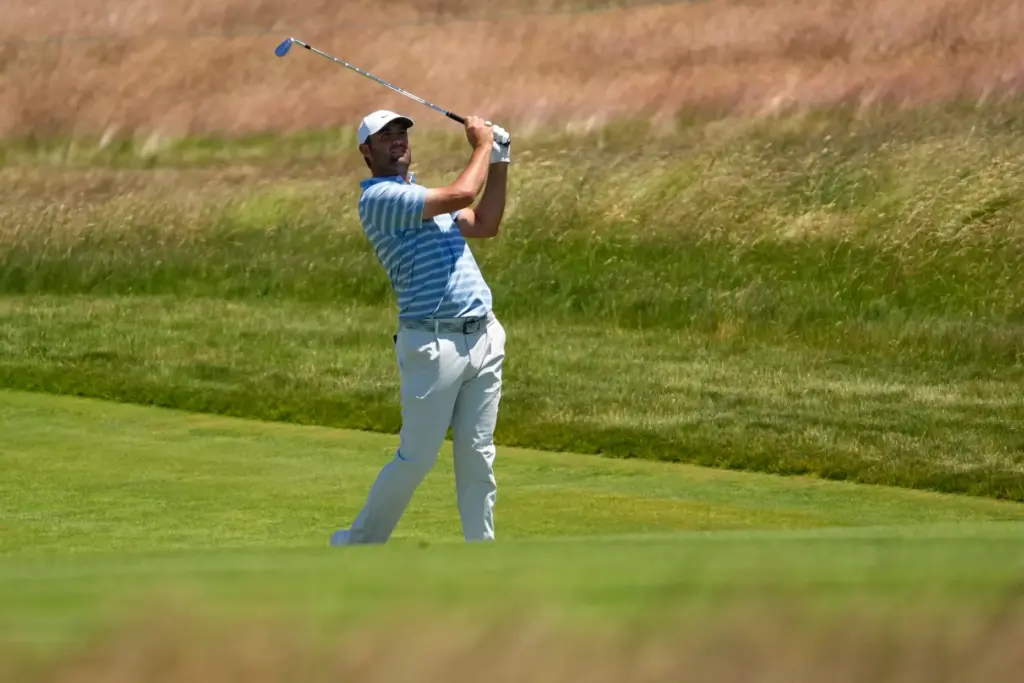
 Scottie Scheffler watches his shot on the 13th hole during a practice round on Monday at Shinnecock Hills Golf Club in Southampton, N.Y. (AP Photo/David J. Phillip)
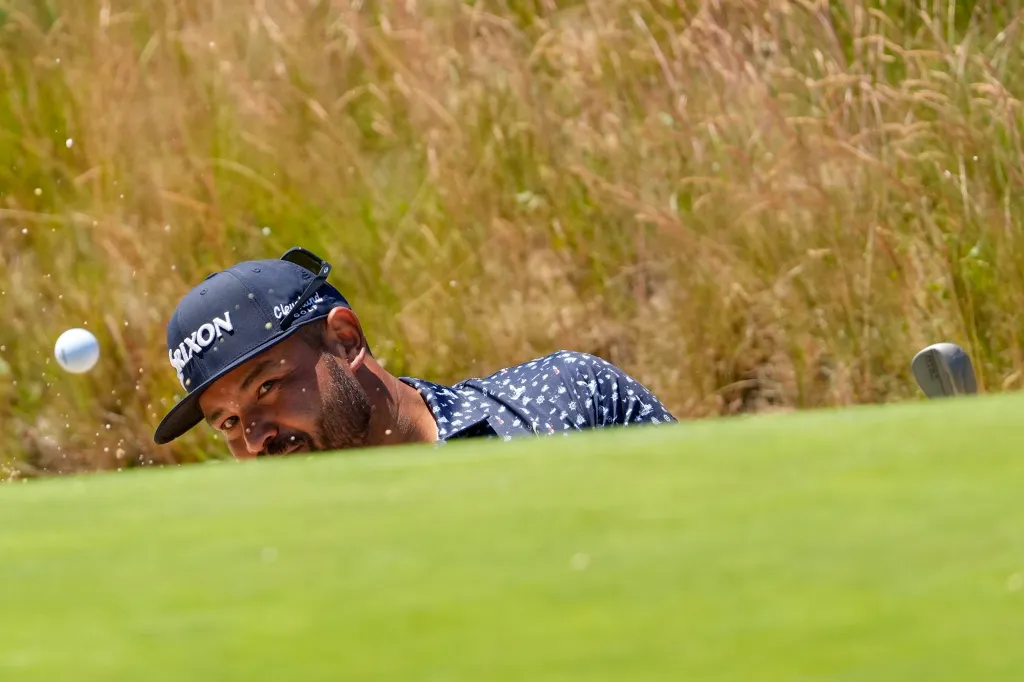
 Collin Morikawa hits from the bunker on the 11th hole during a practice round on Monday at Shinnecock Hills Golf Club in Southampton, N.Y. (AP Photo/David J. Phillip)
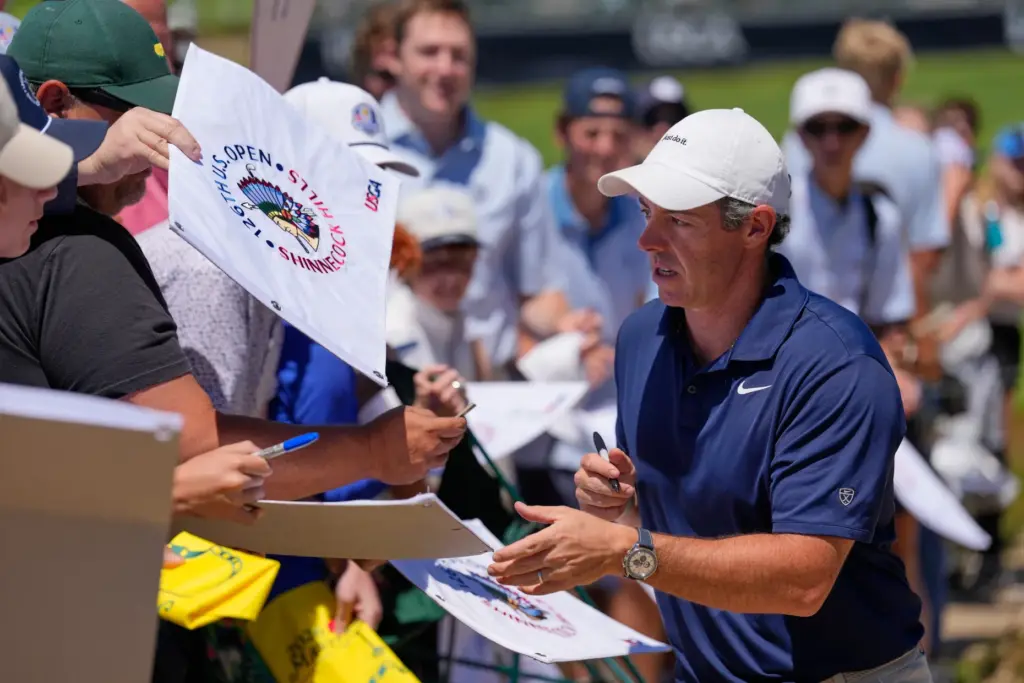 Rory McIlroy signs autographs for fans during a practice round on Monday at Shinnecock Hills Golf Club in Southampton, N.Y. (AP Photo/David J. Phillip)
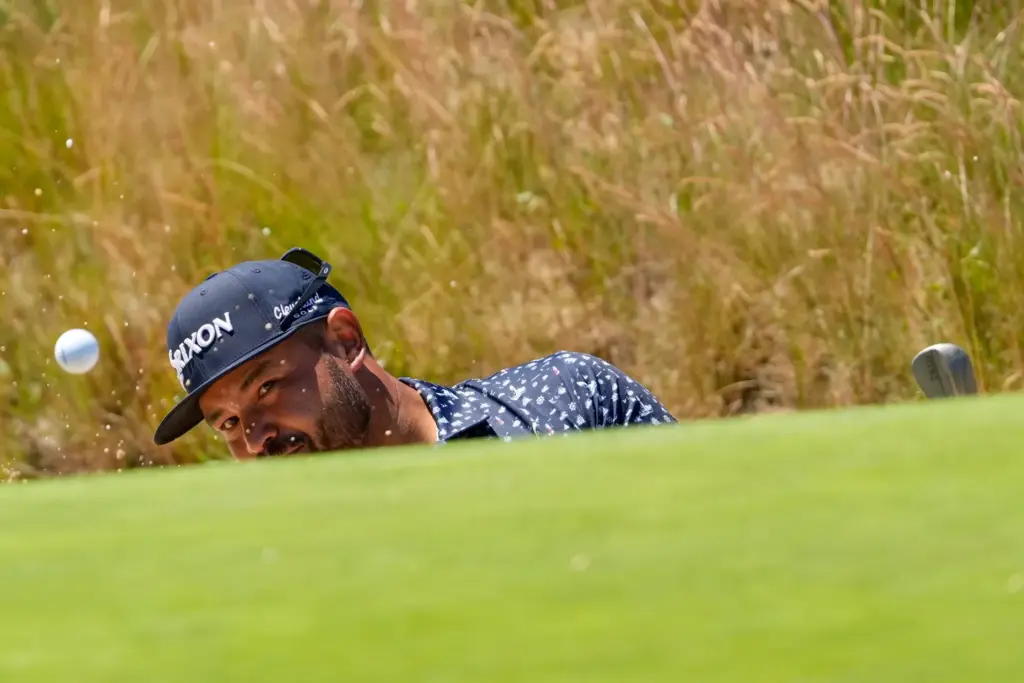 Defending U.S. Open champion J.J. Spaun hits from the bunker on the 11th hole during a practice round on Monday at Shinnecock Hills Golf Club in Southampton, N.Y. (AP Photo/David J. Phillip)
By DOUG FERGUSON AP Golf Writer
SOUTHAMPTON, N.Y. — The U.S. Open brought big wind and not nearly as much activity for a Monday, typical these days of practice rounds at majors that move to a different course each year.More players are coming early, not so much to avoid the rush but to avoid the wait.
Read more World Cup: Uruguay’s Maxi Araújo scores equalizer in draw with Saudi Arabia
“It’s gotten terrible,” Justin Thomas said leading into the third major of the year. “You have to sign up for tee times at the (British) Open and U.S. Open, and then people sign up with you and play in a foursomes. You can’t play nine holes in less than three hours.”
The way around that is to follow a script from Jack Nicklaus back in his prime – see the course early before it becomes populated with pros and amateurs, contenders and dreamers.
Scottie Scheffler and Rory McIlroy took a detour on their way to Ohio two weeks ago to play Shinnecock Hills, the first time seeing it for the world’s top-ranked player, a refresher course for McIlroy.
Jon Rahm arrived last Friday to see what he should expect for the U.S. Open. Patrick Reed, who hasn’t played since the PGA Championship last month, is said to have played the course more often than some of the Shinnecock members.
This is one of the most energy-draining weeks of the year, a product of the mental stress a course like Shinnecock – and a major like the U.S. Open – tends to elicit.
Thomas and Jordan Spieth arrived over the weekend and played practice rounds two days before the official start of practice rounds. They didn’t have the course all to themselves, but it felt like it. And it beat the alternative of long rounds when players hit different clubs off the tee, dozens of shots from the rough and closely mown area around the green, putting to all four corners of the green.
Their preparation largely done, official practice days are now light work. That’s the Nicklaus way.
“That’s why I never wanted to practice then,” Nicklaus said of the early part of the week at the majors. “I got my practice in the week before so I knew what I wanted to do, instead of waiting for everybody else. I didn’t like that. So I tried to get my practice in, and go back on Tuesday (of major week). I didn’t want to get stuck in that six hours.
“If I had been there the week before, why did I need to get there on Monday?”
McIlroy had limited practice time at the PGA Championship because of a nagging blister on his right toe. But then, he had come to Aronimink two weeks earlier for serious practice.
But there was one image during his practice round when McIlroy had a small army tagging along inside the ropes, from television personalities to equipment staff and photographers. It didn’t feel very productive to him.
“Too many people inside the ropes I think is the big part of it,” he said of the long practice rounds at the majors. “I think as well, guys are resigned to the fact that they’re going to play nine holes, so it’s OK to be out there for three hours. No one plays 18-hole practice rounds anymore the week of (a major). I guess it gives everyone the ability to play slow and hit as many balls as they like.”
Tiger Woods used to have his own routine, playing first to have at least nine holes to himself.
One year at the Masters, he walked out of the clubhouse at 7:25 a.m. toward the first tee unaware of a wooden clock at the tee box indicating the course would open at 8 a.m. Not to worry. His caddie, Steve Williams, moved the hands back a half-hour.
Woods stepped onto the tee at 7:28 a.m., saw the clock and moved the big hand back two more minutes and fired away. He was on the links courses of the British Open around 6 a.m. Anything much later than that meant he had overslept.
Scheffler had a dream day of practice at the PGA Championship before he won at Quail Hollow last year. He was the only PGA Tour player on the course the Sunday before official practice because most everyone else was at two PGA Tour events that day.
Monday through Wednesday can be as slow.
“I don’t remember it being as bad as it is,” Thomas said. “The U.S. Open and PGA Championship to me are the worst. It’s getting treated more like the range and chipping green. I get that you need to get used to it – I totally understand that. But it’s gotten to be a lot.”
The wind ushered away overnight rain clouds and bathed Shinnecock in bright sunshine on Monday. Wind and the greens are the greatest defense on this century-old course, and it was a preview of the test that awaits. Wyndham Clark already knew that.
“The one thing today is I actually didn’t do a practice round,” he said. “I came in earlier and did some work. This wind is not the normal wind, so if there’s any time to take a day off, it was today.”
Read more Dodgers’ Tommy Edman set to be activated on Tuesday
KOIVUN BACK FOR LAST EVENT AS AN AMATEUR
Jackson Koivun was so good at Auburn he already locked up a PGA Tour card after his sophomore season. He just didn’t think he was ready, regardless of results that suggested differently.
Now he is.
Koivun is in the U.S. Open for the second straight time – last year making it through a 36-hole qualifier, this year as the No. 1 amateur in the world. He had to remain an amateur to use the exemption for Shinnecock Hills. He makes his pro debut in two weeks at the John Deere Classic.
If the last month wasn’t enough of a whirlwind – another NCAA title for Auburn, the decision to turn pro and get ready for the U.S. Open – imagine what last year was like. He clinched a tour card at the NCAAs through the PGA Tour University program for underclassmen.
“I had about a week to make that decision, and I just wasn’t ready,” Koivun said Monday when asked why he didn’t turn pro a year ago. “And I’m very happy I made that decision.”
The game was never a question, and Koivun showed that after missing the cut at Oakmont. He tied for 11th in the John Deere Classic, tied for sixth at an opposite-field event in Kentucky, tied for fifth in the Wyndham Championship and then played in the final group at the Procore Championship, which Scheffler won in Napa.
“I think my golf game was there,” Koivun said. “I just think I wasn’t ready to leave college, and mentally just wasn’t ready for the potential hardships and the travel and everything like that. But taking another year to really wrap my mind around that was good for me, and now I’m definitely ready.”
He’ll find out how much progress he has made in the U.S. Open. Oakmont and Shinnecock Hills have reputations of being among the toughest courses for golf’s toughest test.
And then he’ll have around six starts on the PGA Tour to see what kind of progress he makes. He is assured a tour card through the 2027 season.
As for the hardships, Koivun said it was more adjustments from college. He won six times this year without facing constant travel, learning new courses or dealing with missed cuts.
“For me, it’s just finding acceptance in golf,” he said. “Coming into any event, I’m going to try to win it, but not pushing too hard and accepting that it’s not a game where you win every week. So understanding that and getting that through the head and just keep on going.”
ADD 7 MORE TO THE FIELD
J.T. Poston and Bud Cauley won the last two weeks on the PGA Tour, and that moved them well inside the top 60 in the world to be added to the field for the U.S. Open.
The USGA had set aside seven spots to account for players who could mathematically earn their way through exempt categories. The other five spots went to alternates from some of the 13 qualifying sites – Hennie Du Plessis, Bryan Lee, Harry Higgs, Spencer Tibbits and Jack Schoenberger.
Chandler Phillips previously made it as an alternate when Marco Penge withdrew.
The finally tally of this 156-man field shows only 68 players who had to go through 36-hole qualifying, a low number for a major that used to prefer half the field qualified.
Tibbits and Schoenberger were among 16 players who had to go through 18-hole and 36-hole qualifying. The addition of Schoenberger, who finished his senior year at Kentucky, gives the U.S. Open 21 amateurs in the field.
CLARK PLANNING ON A HAPPIER U.S. OPEN
Wyndham Clark has been in a better place this year, winning The CJ Cup Byron Nelson with a 60 in the final round, missing the playoff at the Memorial by one shot and contending briefly at the Canadian Open last week.
It was different a year ago, particularly at the U.S. Open. He missed the cut at Oakmont and got into trouble with the historic club for damaging his locker. The club banned him indefinitely until he fulfilled various obligations, starting with paying for the repairs.
Clark, the 2023 U.S. Open champion, acknowledged his regrets about that moment when he won the Byron Nelson, and it surfaced again Monday at Shinnecock Hills.
“That was a really challenging time and something I’ve deeply regretted and feel awful that I did that,” Clark said. “But there were so many good lessons in that that really taught me a bunch. I’ve really come a long way, and I’m excited for this year’s Open for some redemption and to move forward and enjoy the challenges of Shinnecock and how great this place is and how amazing this championship is.”
Read more Angels’ Mike Trout on track for his All-Star Game return