
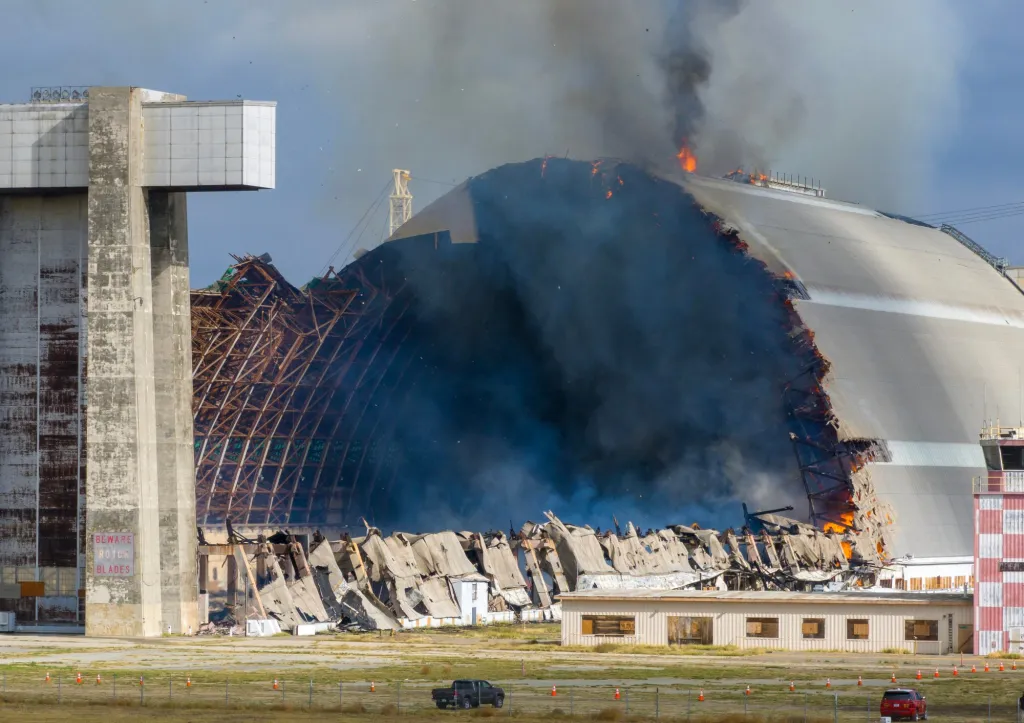
Tustin councilmembers have called off the local emergency declared in the aftermath of the north hangar fire, roughly 950 days after the blaze burned through the World War II-era landmark, spreading ash out into the community.
Read more NBA draft: Who should the Lakers target with the 25th pick?
Their decision on Tuesday, June 16, to terminate the local emergency declaration followed the California Department of Toxic Substances Control’s announcement earlier this month that remediation of the hangar property is officially complete.
The fire erupted after midnight on Nov. 7, 2023, in the hangar, a 17-story wooden structure built in 1942 to house blimps during World War II and later designated a historical landmark at the former Marine Corps Air Station Tustin.
The Orange County Fire Authority could not get in to extinguish the flames, which instead burned through the hangar over a span of 24 days. Ash and debris were reported across approximately 6.5 square miles of Tustin neighborhoods, prompting school and park closures.
Two days after the fire ignited, Tustin’s acting city manager issued the proclamation of a local emergency.
More than 600 emergency workers trained in hazardous materials traveled from across the country to assist, and the cleanup stretched roughly 18 months, costing Tustin about $105.8 million. The Navy has been reimbursing the city, which fronted the money and served as a federal “response action contractor” on behalf of the Navy, targeting off-site remediation while the military oversaw on-site demolition and stabilization of what remained of the hangar structure.
The emergency response was considered “unprecedented,” according to the post-fire action summary report, which noted it was the first time in history a municipality had served in that federal contractor role under the Superfund law for the Navy.
The cleanup of surrounding communities was broken into four distinct operational phases, with three ground-level sweeps, followed by a final above-ground phase targeting more than 400 roofs, gutters, and porches.
From November 2023 to June 2025, regulators collected more than 4,800 asbestos air samples and detected confirmed asbestos fibers in only four — all of which were at levels below the EPA’s school safety threshold, officials have said.
Read more Santa Ana police say drone feed helped guide response to January protest involving federal agents
The Navy’s contractor finished debris and hazardous waste removal from the north hangar footprint last summer, work that took about a year. The hangar’s remaining “ribs,” along with four large concrete towers, have been left in place until it is decided what to do with the property, officials said previously.
No official cause behind the fire was ever determined, and the investigation was closed in November 2024.
Now, as the remediation phase comes to an official end, the question going forward is what will become of the surrounding property.
Talks of redevelopment picked up steam late last year, with local stakeholders turning their attention to the roughly 500 acres of undeveloped land available for use.
The destroyed hangar’s southern twin also still stands among the homes and development rising out of the former airbase in what is now considered the Tustin Legacy neighborhood.
Part of the area, including the hangar sites, belong to the Navy and are licensed to the city of Tustin, which serves as the local reuse authority and acts as the point of contact between the Department of Defense, local stakeholders and the community. As part of that role, Tustin must develop and adopt a reuse plan for the Navy to act on.
The city hosted several open-house workshops in April this year to gather feedback on potential redevelopment uses as a new planning phase is underway for the completion of the Tustin Legacy core, which is considered one of the city’s most significant mixed-use development projects.
Significant updates regarding the status of the hangar site, including a potential land transfer from the Navy to the city, are expected to be discussed at the annual Tustin Legacy Local Reuse Authority meeting on Aug. 18.
Read more America 250: One hour in Trenton changed the course of the American Revolution