
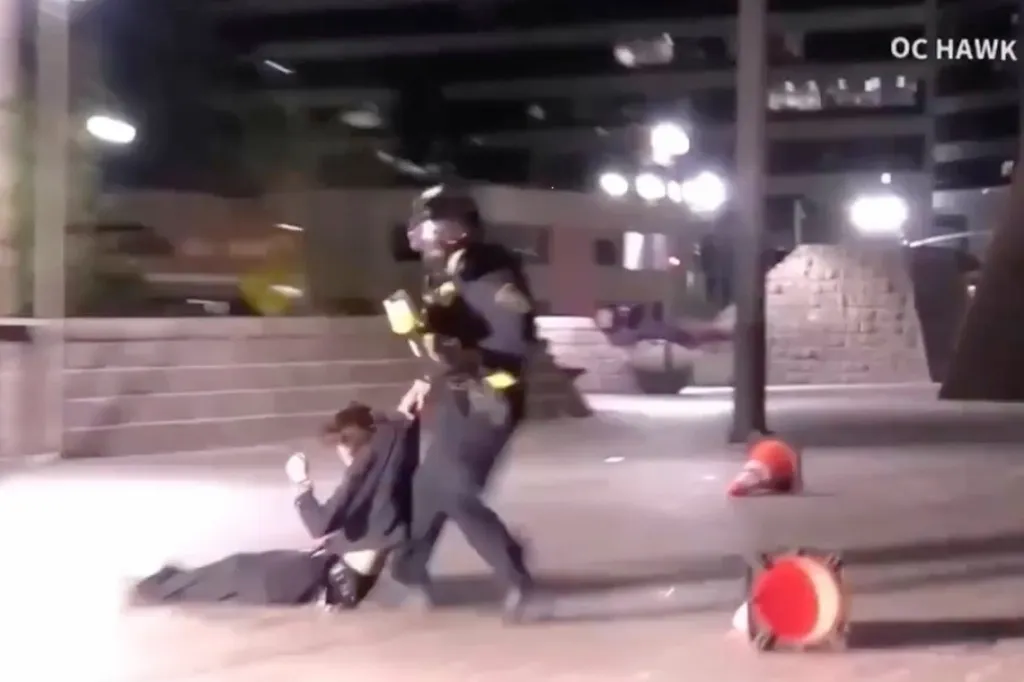
Using a live drone feed, Santa Ana police officials said they did not see the threat being reported by Department of Homeland Security agents during a January protest at the federal building in the city’s Civic Center and chose not to escalate the department’s response.
Read more America 250: One hour in Trenton changed the course of the American Revolution
The Santa Ana Police Department’s account of the Jan. 9 protest, during which one protester alleges being shot and left blind in one eye by a federal agent, emerged during a community meeting this week on the department’s annual military equipment report, which included information on the department’s relatively new use of drones.
SAPD Commander Matt Sorensen told community members he used the real-time aerial video in deciding that sending officers into the crowd was unnecessary.
“We got a phone call from (the agent) in charge, and he was saying he was taking lots of bottles,” Sorensen said. “That wasn’t the case.”
At least 100 demonstrators had gathered outside of Orange County’s Civic Center in downtown Santa Ana, where a U.S. Immigration and Customs Enforcement field office is also located, to protest immigration enforcement actions. Earlier that week, Renée Good had been shot to death by federal immigration agents in Minneapolis.
“I had people just kind of sitting around waiting for something to happen,” Sorenson said of the officers put on standby to respond to the protest if needed, adding that, as an incident commander, that is what he prefers the outcome to be.
When asked about the discrepancy from the Santa Ana Department’s assessment of crowd conditions, a DHS spokesperson said this week, “A mob of about 60 rioters threw rocks, bottles and fireworks at law enforcement officers outside the federal building in Santa Ana.
“Two officers were injured. Two violent rioters were arrested and were charged with assault on federal officer and disorderly conduct,” their statement said. ”This was a highly coordinated campaign of violence where rioters wielded shields. One of the rioters, who was arrested for disorderly conduct, was taken to the hospital for a cut and was released that night.”
In April, Kaden Rummler, 21, a USC student, filed a complaint against the government, saying he was left permanently blinded in his left eye after a DHS officer fired a less-lethal round from close range during the January protest..
Santa Ana police said they assisted the Orange County Fire Authority with two reported injuries, including one individual with a head injury and another who had been impacted by munitions, and officers did not make any arrests that night or take any reports regarding an assault on federal officers. Sorensen said he did not see any of the activity reported by DHS beyond a couple of orange rubber traffic cones being thrown, nor were local police in possession of any evidence corroborating that protesters were wielding shields or assaulting federal officers.
An Orange County Register reporter at the scene until just prior to the interaction when the protester was injured, noted that while the majority of demonstrators were peaceful, a small group near the federal building were seen throwing a few orange rubber traffic cones.
The use of drones is a relatively new tool for SAPD, which formally launched its program earlier this year following approval from the City Council to enter into a $682,900 three-year contract with Axon Enterprise, Inc. for five drones. The company also supplies the agency with body cameras.
Sorensen said the drones’ bird’s-eye view of a situation offers context that can be hard to achieve from the ground.
“When I’m running one of these incidents, I don’t get to see what every officer on the street is seeing,” he said. “We rely on them to communicate to us what they’re seeing and doing. Now I can correlate what they’re telling me on the radio with what I can see on video. That helps a lot in the decision making.”
The department did not have its drone program in place when a more volatile demonstration unfolded a year ago near the federal building, following a day of mass immigration enforcement actions throughout the county that marked the initial ramp-up of federal activity in Orange County. Sorensen said police were “caught off guard” and unable to pre-position resources before the situation escalated.
Read more Can wearing a glucose monitor make you healthier? Here’s what happened to students who did
“By January, I started putting things in place so that we could mitigate any response, because now I’ve got good information coming in from drone feeds,” he said.
Both the June 2025 and January 2026 incidents fall within the reporting period of the most recent annual military equipment report, which is required under Assembly Bill 481, a state law governing the use of defined military equipment by law enforcement agencies.
According to the report spanning May 1, 2025, to April 30, 2026, unmanned aerial systems, or drones, were deployed 12 times. Also during the reporting period, defined military equipment was deployed to 36 field-based incidents and 11 community events.
Of the 36 deployments, 21 involved the department’s SWAT Team. There were no officer-involved shootings or fatalities reported in the annual accounting. Subjects were detained or arrested in 19 incidents.
The report logged 215 deployments of 40 mm projectiles, 59 uses of 12-gauge beanbag rounds, 37 CS deployments and 24 uses of the Terradyne armored rescue vehicle, among other totals.
The annual meeting marked the second time community members had been able to weigh in on the department’s use of military equipment, after the agency disclosed last year that it had failed to host any meetings for three years, in violation of AB 481. Chief Robert Rodriguez said previously the noncompliance was “administrative oversight” tied to leadership turnover.
Several community members argued that the lack of dates, times and neighborhoods in the annual report undercuts the transparency intent of AB 481, though the department is not legally required to provide those details.
“I see this equipment used, quite frankly, a lot more than other specific wards in the area,” said Ray Diaz from the city’s Ward 6 neighborhoods after asking commanders for specifics on when and where deployments occurred. “It would be helpful for us as a public, too, to know if there’s a specific neighborhood that perhaps is being targeted too much with this equipment.”
The annual report also noted two community complaints directly tied to equipment use during the reporting period. One investigation found that personnel did not violate SAPD policy, and the second remained under investigation, with litigation pending, the report said.
Under the internal audit structure detailed in the report, use of the equipment requires approval from an on-scene supervisor and a watch commander, with SWAT team-specific gear requiring authorization from the SWAT team commander or assistant SWAT team commander.
Such deployments are later reviewed to evaluate “the appropriateness of the equipment used,” the report said.
Looking ahead, SAPD officials said the department will evaluate the drone program’s effectiveness and compliance with policy and state law, and may request authorization to seek additional funding to expand the drone inventory if the review is favorable.
Community feedback on the program has been mixed, with some residents citing concerns about the growing implementation of surveillance tools and a citizen’s right to privacy.
Sorensen said he believes the investment is already shaping command decisions, citing the use of drones as a tool to potentially de-escalate situations.
Read more Acen Jimenez, Makena Cook honored by OC Sports Commission
“I have a saying that I use: A boring operation is a good operation,” he said.