
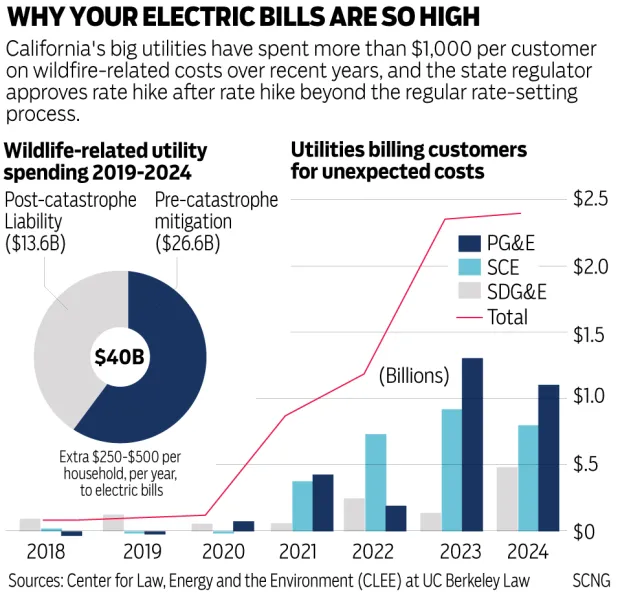
Jaw Drop Detail No. 1: California’s big electric companies spent more than one thousand dollars for every state resident on wildfire-related costs between 2019 and 2024.
Read more Pai family patriarch celebrates generations involved in surf shop business, Surf City community
Which is to say, a cool $40 billion, divvied up between post-catastrophe liabilities ($13.6 billion) and pre-catastrophe infrastructure hardening ($26.6 billion).
Staggering to think of it this way, no? It translates to an extra $250 to $500 more for electricity, per household, per year, scholars say, and it’s the main reason why your electric bills have skyrocketed (and why they’ll likely continue to climb).
But there’s a lot more going on here. Angry fingers jab at the California Public Utilities Commission, perhaps more vigorously than at the utilities themselves.
Once upon a time, not so very long ago, utility companies rarely sought CPUC permission to extract more money from customers between regular rate-setting sessions. But there’s a way to do that, ostensibly to cover surprise costs, and its use recently has exploded.
Jaw Drop Detail No. 2: In 2018, the utilities recouped just $86.6 million this way. In 2024, they recouped a staggering $2.4 billion this way — a roughly 27-fold increase, according to a new study from the UC Berkeley Center for Law, Energy and the Environment.
“What began as a tool for exceptional circumstances has become a routine workaround, driving up costs while making it harder for regulators and the public to track the true impact of rate increases,” wrote the authors of “Powering Down Prices: Policy Solutions to Lower California’s Electricity Rates.”
These between-regular-session fee hike requests “function like a credit card for utilities — with no spending limit and no real accountability. Utilities have exploited this loophole in the ratemaking process to dramatically increase their spending outside the budget constraints of the General Rate Case.”
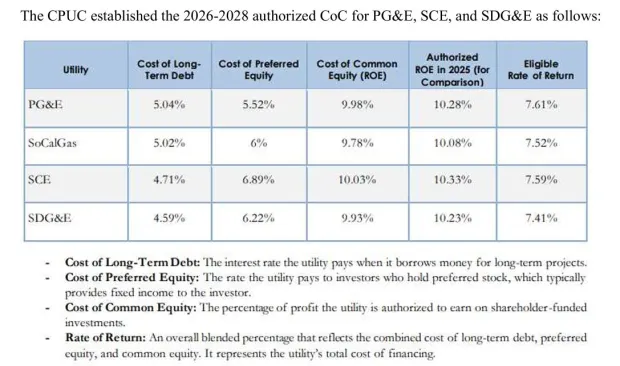
Like many analyses before it, the Berkeley study found that utilities have built-in financial incentives to overspend (because they make their profit not on electricity sales, but as a set return on infrastructure investments, providing a “perverse incentive” to pursue the most extravagant rather than the most thrifty option).
The Berkeley study recommends slicing utility profits on wildfire-related spending, closing the loophole that lets them bypass the usual oversight process to charge customers billions and beefing up the CPUC’s regulatory muscle so it can push back on utility excesses.
The consumer advocates recommend revolt.
“What we have to do is to fix the broken system where there are no limits to rate hikes, no limit to how much they can ask for or how many times a year they can ask, and no limit to how much the CPUC can grant,” said Mark Toney, executive director of The Utility Reform Network, at a cyber town hall last week.
“We’re being crushed,” agreed Ayn Craciun, Orange County policy director for the nonprofit Climate Action Campaign. “The cost of electricity gets baked into everything else and contributes to the larger affordability crisis. We need permanent structural changes that will reduce costs and prevent unnecessary spending.”
The utilities say they’re empathetic.
“Southern California Edison shares the concern about rising electricity costs and agrees affordability is a top priority for California,” said spokesman David Eisenhauer. “We’re committed to keeping rates as low as possible while maintaining safety and reliability. “
His company is reviewing the Berkeley report, Eisenhauer said. But in the meantime, “SCE forecasts its rates will grow at or below local inflation through 2030, as they did for about 20 years prior to 2020.”
Still, several “affordability” bills are moving through the state Legislature, aiming to blunt our pain. But consumer advocates watch with dismay as some of those ideas are gutted or watered down.
Read more Retired Chino Hills firefighter welcomes Father’s Day, 7 months after surviving a stroke
Making sausage
Take Senate Bill 905, one of the most sweeping reform bills out there.
It would direct the CPUC to lower bills and reduce utility spending; link a portion of executive pay raises to keeping electricity rates below the rate of inflation (“If bills keep skyrocketing, executives should feel the pain in their pocketbooks, too,” Toney said); reduce unnecessary grid investments by requiring utilities to make the most of the existing network of poles, wires and substations; and create public financing for expensive infrastructure projects that costs less than corporate financing.
SB 905 also would establish “performance-based metrics,” reduce profits (“returns on equity for certain capital costs”) and improve grid data transparency.
“By lowering the (return on investment), the overall cost of financing long-term infrastructure can decrease, potentially helping to ease cost pressure on ratepayers over time,” says an Assembly analysis of the bill.
“However, a lower (return on investment) does not automatically reduce customer bills. The real impact depends on separate CPUC decisions, including which utility projects are approved, which investments are added to the rate base (the portion that earns a return) and how much infrastructure spending utilities propose in future rate-setting cases.”
Enter the sausage making.
Proposed amendments to SB 905 would significantly weaken it, Craciun said. They’d remove or eliminate the provisions linking executive compensation to ratepayer affordability, preserve pathways for increases in utility profit and leave key transmission financing decisions largely in the hands of utilities and regulators.
“Are we willing to make the structural changes necessary to lower bills and put ratepayers first, finally?” Craciun asked. “We don’t think ‘maybe someday’ is a good enough answer. Our leaders need to be doing a lot more. There’s no question voters want action.”
The Assembly Utilities and Energy Committee — chaired by none other than Orange County’s own Cottie Petrie-Norris, D-Irvine — will hold a hearing on SB 905 at 1:30 p.m. Wednesday, June 24. Craciun urged folks to flood the committee and Petrie-Norris’ office with calls and letters demanding action. The hearing will be streamed at https://autl.assembly.ca.gov/hearings and held live in the Assembly State Capitol, Room 437.
There are several other important reform bills as well, they said. SB 886 would shield consumers from getting saddled with the expense of giant data centers and SB 1098 would take away the utilities’ aforementioned “platinum credit card with no spending limit and guarantee that someone else will pay the balance,” Toney said. It would limit utility overspending by making the utilities state their requirements more precisely in general rate case proceedings, rather than asking for so much between those proceedings.
Southern California Edison has five increase requests pending at CPUC outside its big general rate case, asking to add $5.2 billion to residential and business bills, Toney said.
San Diego Gas & Electric is asking for three additional rate increases, adding $1.8 billion to bills. And last week, it filed a general rate case asking for a $22.50 monthly increase to the typical household bill, costing consumers another $270 or so a year.
California’s already-high electricity rates have increased far faster than inflation, threaten progress on climate change and pose painful affordability burdens on residents and businesses, the Berkeley report said.
Electricity costs less, by and large, when it’s provided by public rather than private companies.”If you’re fed up with skyrocketing monthly bills,” Toney said, “you have to take action.”
So take action! Find out how to contact your state legislators here: https://findyourrep.legislature.ca.gov/?lv=true. Share your thoughts with the CPUC here: https://www.cpuc.ca.gov/about-cpuc/contacting-the-puc. Let the Assembly Committee on Utilities and Energy know what you think about SB 905 by email [email protected].