
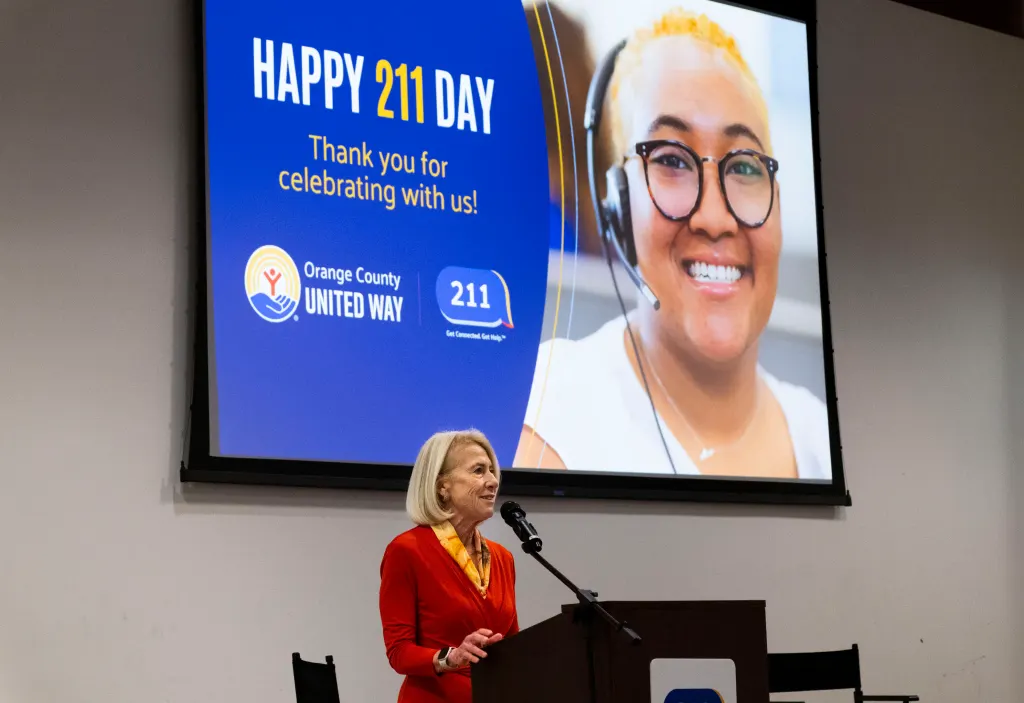
Orange County United Way is raising money to pay for what it hopes will be a fundamental shift in the way local social services are distributed and, critically, who gets them.
Read more A Russian drone strike in Ukraine kills 3 from one family, including a 13-year-old boy
The nonprofit announced Monday, June 22, that it is launching The OC Way Campaign, a push to raise the final $4 million in a longer-running $18 million initiative aimed at paying for an expansion and rebranding of the 211OC information service.
The expected changes to 211OC, which has been run by United Way since mid-2023, will be key to any broad shift in social assistance, according to people connected to the project.
The 211 system has existed in many counties nationally since the early 2000s, serving as a financial version of the 911 call-in hotlines used by people facing medical and physical emergencies. And, as is the case in much of the country, most of the people who reach out to 211 locally are facing an imminent financial crisis, such as sudden unemployment or an eviction notice.
Everybody reaching out to 211OC – which offers information via phone, online (211oc.org) and text – talks with trained counselors who get details about each specific situation before connecting those clients to more than 150 local nonprofits. Those nonprofits, in turn, provide thousands of different services, ranging from rent money or free food to a ride to the local senior center.
When United Way’s fundraising mission is met, and expansion of 211OC is complete, the nonprofit is expected to keep that operational model intact, but pitch itself as a service for a much bigger group of people – the roughly 1 in 3 Orange County residents who have full-time jobs and stable housing, yet still can’t afford to pay for basics like rent and food.
“Three years ago, when United Way acquired 211OC, one of the reasons we felt that was an important step to take was because we wanted to expand the service,” said Steve Churm, a local United Way board member who is chair of the 211OC Leadership Council.
“Historically, people near the financial brink are the people who reach out. But we believe 211OC exists not only for that segment of the population, but for everyone,” he added.
If 211OC successfully reaches a broader world of the nearly poor – offering everything from budget advice and job training to applications for price cuts on utility bills – the shift would reflect what economists and others have long known about how poverty actually plays out in high-income, high-cost communities such as Orange County:
A lot of locals qualify as “poor” in most aspects of their financial lives, except for their paycheck.
From 2020 through 2024, Orange County’s official poverty rate was about 9.5%, according to the U.S. Census Bureau. Those people (about 297,000 individuals) didn’t make enough money to pay for essentials, such as shelter and food. Under federal rules – which are not adjusted for varied costs of living in different parts of the country – their incomes ranged from about $16,000 for an individual to $33,000 for a family of four.
But others describe poverty in Orange County in ways that include people who make a lot more than that.
Read more California Legislature tackles a slate of clean energy transparency and acceleration bills
For example, in late May, the California Department of Housing and Community Development issued its annual update on who qualifies for housing assistance in different parts of the state. In that reckoning, a single person could get help for rent in Orange County and qualify as “very low” income with an annual paycheck of about $65,000 a year, and as “low” income with annual pay of about $104,000. A family of four in Orange County could have a household income of nearly $149,000 and still qualify as “low income” and get help from the state agency.
The state report drew media attention because it was the rare public document to show how a six-figure paycheck in Orange County qualifies as “low-income.” But it might not be the last. Costs for food, medical insurance and gas have spiked over the past 16 months. And the cost of shelter in Orange County continues to be an outsized burden that is reshaping the population, driving younger people inland or out of state and leaving older property owners in place.
Though rents have risen more slowly than other spending categories (about 1.1% in the past year), a studio apartment in Orange County leases for about $2,100 a month, while a two-bedroom apartment runs about $3,166, according to the latest report from the apartment-finding platform RentCafe. And prices for home ownership in Orange County have jumped faster (about 5% in the past year) to about $1.3 million, according to data from the real estate information service Redfin.com.
Other data points show the huge difference between the number of people who qualify as “poor” under federal rules and the world of people who aren’t technically poor but still might need financial help or some other social service.
In all, about 4 in 10 people living in Orange County are “housing burdened,” meaning they pay more than 30% of their income for shelter, while more than half (52%) of all Orange County families with children under the age of 6 don’t have enough money coming in to cover their necessities each month, according to a recent report from the Orange County Community Foundation.
Helping those people, Churm said, will be one of 211OC’s key missions as it expands.
Another element of 211OC’s mission could involve economic temperature-taking.
While federal agencies and others use income data and other measures to sort out the state of the economy at any given time, an expanded 211OC could generate data that could lead to a quicker, on-the-ground take on how locals are faring financially at any given time.
During the three years that Orange County United Way has run 211OC, it has started to create a database, using information collected voluntarily from clients and from service providers. That data (income, household formation, geography) has reflected shifting demand for services such as free food or rent assistance. Because 211OC is getting about 500,000 contacts a year, and hopes to be connected with 200 nonprofit partners by the end of this year, that database could become useful to researchers and others hoping for a true measure of local economic trends.
For example, 211OC would have told researchers just how much demand there was for free food late last year when the federal government was shut down and federal money was pulled out of the Supplemental Nutrition Assistance Program (SNAP). At that time, the 211OC service saw a surge from people reaching out for information about where they could eat. More recently, 211OC saw a spike in demand when parts of Orange County were ordered to evacuate from their homes for several days because a chemical tank at an aerospace plant in Garden Grove seemed ready to explode.
“The data we have, and will have, could help identify trends that will help everybody in the public and private sector look around the corner,” Churm said.
“It will help us respond more quickly to needs in an efficient and economical way. That’s our high objective.”
Read more Judge in Charlie Kirk killing case to decide if prosecutors could be punished for comments in media