
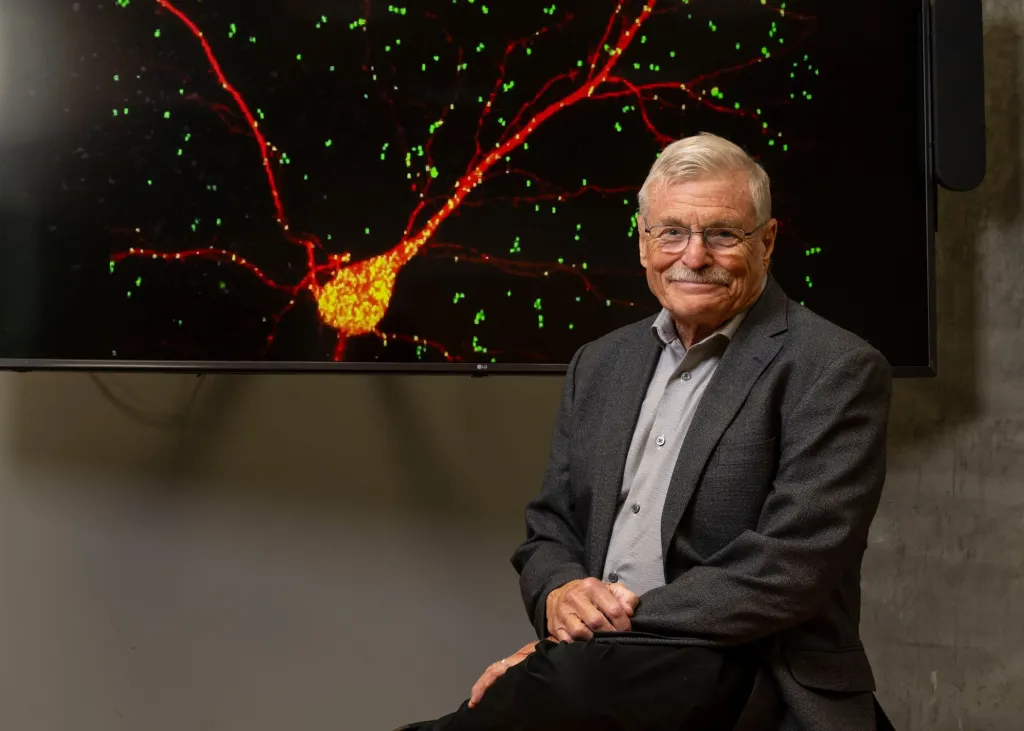
Oswald Steward remembers the exact moment in 1981 when he made a scientific discovery that, now, decades later and with deeper research and help from his peers, has earned him one of his field’s most prestigious honors and, more significantly, could change the way scientists and doctors treat brain injury recovery, learning and memory.
Read more Frank Carone, ally of former NYC Mayor Eric Adams, arrested by feds in bribery scheme
The discovery involves how neurons build, strengthen and modify connections in the brain.
What makes it so significant, Steward said, is that for decades scientists have believed that the proteins neurons need are produced primarily in the cell body. But Steward, an anatomy and neurobiology professor at UC Irvine, and three scientists with whom he’s collaborated have dug deeper and discovered that neurons not only manufacture cells in one spot but also produce those healing proteins in areas where they’re needed.
“It’s like a gigantic tree with every leaf on it being a place where an individual connection forms,” the founder and current director of UCI’s Reeve-Irvine Research Center said. “The trick is, and the thing that nobody understood, is how the protein components of each of those little contacts actually get there, and more importantly, how it is modified during memory.”
Their research and studies now show how the cells move, which Steward said creates a new understanding of brain plasticity, learning, and memory, and should, when paired with medical and pharmaceutical research, make a difference for people with neurodevelopmental disabilities and brain and spinal cord injuries.
When you’re learning something, Steward explained, new connections form, requiring new protein synthesis. And, the cool thing, he said, is that a person can make as much as they need.
“It’s not like shipping out a package, and you get the package, and that’s it,” he said. “You’re basically shipping out a 3D printer that can make as many copies as you want, or if you change its program, it can actually make different copies. That was really the change for the way plasticity was understood.”
This discovery has won Steward, of Laguna Beach, the 2026 Kavli Prize in neuroscience. He shares the prize to be presented in Oslo, Norway, this September with Christine Holt of England’s University of Cambridge, Kelsey Martin of the Simons Foundation, and Erin Schuman of Germany’s Max Planck Institute for Brain Research. Schuman spent part of her childhood in Huntington Beach but could not be reached for an interview.
The prize, administered by the Norwegian Academy of Science and Letters in partnership with The Kavli Foundation and the Norwegian Ministry of Education and Research, is awarded every two years to scientists whose discoveries transform understanding in three areas: astrophysics, nanoscience and neuroscience. As part of the prize week festivities, Steward and the others will have an audience with Harald V, the King of Norway, and present lectures. They are also jointly awarded $1 million.
Since it was founded in 2008, 73 scientists have received the Kavli Prize, 10 of whom went on to receive the Nobel Prize.
Getting here
Though Steward remembers the actual “a-ha” moment when it all first came to him while on the faculty of the University of Virginia, the road to this year’s Kavli nod was not quick or easy.
“I have a pretty clear memory of looking at the photos and realizing what I saw,” Steward said of a stack of micrograph images a technician brought into his office.
But what led him to realize what he had was a combination of years of study, beginning when he landed a spot as a graduate student at UC Irvine in 1970, after finishing his undergraduate degree in psychobiology at the University of Colorado.
“The field had just established at that time that when you form a new memory, you have to make new protein,” he said. “There was something that had to be done, and everybody knew that something had to be at these synaptic connections.”
Synaptic connections are links formed between neurons through which information is transmitted, he explained.
For Steward, that fact to him was “the coolest thing in the world,” he said.
When he applied to UCI for graduate school, he did so to continue his study of protein synthesis. But then there was a new discovery made at the university.
“All of a sudden, we learned that these connections could actually repair themselves,” he said, about the discovery made in the labs of Carl Cotman and Gary Lynch. “Previously, everyone thought that if you injured the brain, it would never get any better. But it was discovered when I was a first-year student that with an injury to the brain, new connections could grow. And, this was a huge discovery at this time.”
So, Steward jumped on that, finished his graduate degree, and moved to the University of Virginia for his first faculty position in 1974. There, he eventually became the founding chair of its department of neuroscience and the Harrison Foundation professor of neuroscience and neurosurgery.
He continued with the line of research, focusing on one particular example.
“I was there for six years working on this repair, this growth of synapses, and back in those days when we wanted to find out about mechanisms and molecules, there weren’t any genetic tools,” he said. The way he looked for levels of protein synthesis at the time, he said. was to take parts of a brain, cut and slice them, and put them on X-ray film.
“What we expected to see was that the protein synthesis would be happening at the cell body, the trunk of the nerve cell,” he said. “Instead, we saw evidence of protein synthesis out in the branches. We were, ‘Wait a minute, how can that be?’”
He asked his technician to take a bunch of images of the areas where these new synapses were forming.
Read more Camp Mystic in Texas files for bankruptcy after catastrophic floods killed 28 people
“She did and brought in the stacks and literally, almost the first one I looked at, what I saw was that,” he said. “I looked at it and said, ‘Those are polyribosomes, and they are making proteins for that synapse.’ That was the ‘a-ha’ moment right there, and it started a 47-year history of working on the problem.”
Driving home the proof
The reason the re-growth of the proteins is so important, Steward explained, is because of the earlier prevailing thought that if there was a brain injury, nothing could be done, the injured area was gone, dead.
“We found there were synapses growing, not completely restoring the brain but enough that actually accounted for some of the recovery you get with a brain injury,” he said. “The reason it’s important was that knowing there’s just a little bit gave us enough that we knew there was more we could do to make that improve.”
An example he pointed to was a later discovery by Cotman, who showed that it’s really important to keep retraining the brain as a preventive measure for Alzheimer’s disease.
“As the disease destroys your synaptic connections, if you can boost your brain’s capacity to get new connections to form or to maintain the ones there a little longer, it’s huge,” Steward said, adding that thinking is the basis of “keep your brain active, learn new things, learn a new language, all the things we think are so important now to slow down the progression of Alzheimer’s disease.”
All of this background is what Steward said he used to build upon his aha moment; though for the first decade, “nobody really believed it, and if they paid any attention at all, it was, ah, that’s interesting,” he recalled.
He began exchanging ideas with Nobel Laureate John Eccles, receiving encouragement, he said.
“He won the Nobel prize because he had made major, surprising discoveries,” Steward said. “And, it took him a while to sell them to the field. It was just so incredibly rewarding to talk to him.”
It would take another decade, though, before others in his field began seriously pursuing the idea, which helped build momentum. As others came on board and they helped prove, “Yes, it really was important,” Steward said, “and they started to fill in the details.”
Building blocks
Steward said his research became a focus at more important meetings of the top minds in the field. And, it was also after more attention was paid to Steward’s work that Martin and Schuhman took an interest. Martin did her Ph.D. research on the very same topic, but in Aplysia californica, a sea slug.
“She showed another dimension of this whole story and really nailed it as being a mechanism of learning and memory in the (sea slug),” he said. “Erin Schuhman began to focus on it heavily, and the two of them have just made major discoveries. Kelsey also did wonderful work on how does a gene know that a synapse is active and needs protein there. She established the molecular mechanism of that.”
Steward said that Holt, who is also sharing the prize, discovered that the other place where the basic phenomena are really important is at the axonal end, explaining, “When the cell is developing, it grows a long axon,” for example, from the brain to the spinal cord, which controls the ability to move.
“Christine’s work showed that this same local protein synthesis was important for the tip of the axon to sense the environment and navigate the correct way to the area where it needs to connect,” Steward said. “This mechanism turns out to be very important for that specific growth.”
“It turns out that this same mechanism is operating during regeneration of connections,” he added, referencing spinal injuries.
The Kavli Prize recognizes the role the four scientists played in the concept of synaptic connections; while Steward “got the story started,” each of the four continued to build pieces of it to demonstrate the critical role that this local protein synthesis plays in every aspect of synapse function.
Now that the functioning of the basic mechanism is established and highlighted through the prize recognition, Steward said it has created a new understanding for the basis of clinical trials.
Moving this forward will become part of the next work where this concept can be applied to improve function, he said. With the information out there, he said, scientists have to figure out how all the pieces fit together and create results.
“All of this information gives people hints about what to do to improve repair after brain injury,” he said. “To basically understand what goes wrong when memory doesn’t work the way it’s supposed to, when we forget things that we’ve known for decades. It’s just this core mechanism at this stage.”
“We’ve got the pieces, and now there’s just so much more than you can do,” he added. “It will be years more work and tons of fun, and I’m so glad I’m still involved in all this.”
Read more AI companies stabilize after rout and oil continues slide as Trump threatens major drillers