
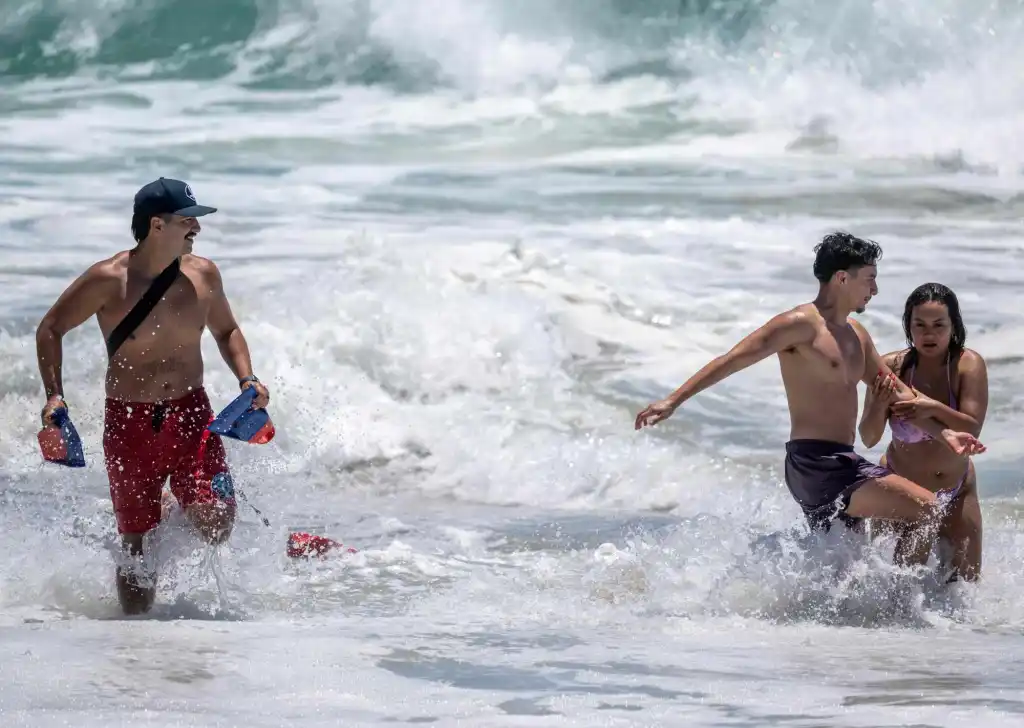
The beach is a go-to place for many to hang out for fun in the sun, an inexpensive way to enjoy one of the region’s most cherished resources.
Read more A few lessons for dads from the U.S. Open
“We’ve had consistent surf, it’s that time of year where school is out, people are excited to go to the beach, the weather has been pretty warm and we’ve just seen more crowds on our beaches,” Laguna Beach Marine Safety Chief Kai Bond said. “It’s the best option for families … It’s just an inexpensive, cost-effective way to come and enjoy our best, biggest resources – which is our beaches.”
But as this summer gets underway, it’s been a busy start for lifeguards with big waves and rip currents that pose dangers to people hoping to enjoy a relaxing day at the beach.
In the past month, dating back to Memorial Day weekend through last week, OC Lifeguards Chief Jason Young said his crew of lifeguards at county-run beaches has had to make 239 rescues and give medical aid to 260 people; they have also made contact with tens of thousands of people to warn them about safety.
Big waves are a big worry, but there’s more to keep in mind so your beach trip stays fun, including an added element that makes this summer different — the warmer waters luring people into the ocean are also bringing creatures beachgoers may not be accustomed to, experts say.
We’ve gathered some need-to-know info as summer gets into full swing and the Fourth of July weekend draws crowds clamoring for sand space so your beach day runs seamlessly.
Tips to stay safe
While lifeguards want people to go out and enjoy the beaches, they should do it responsibly, said Newport Marine Safety Chief Brian O’Rourke.
Even when the swells drop and waves aren’t massive, there can be the risk of rip currents or “sneaker waves,” according to the National Weather Service, that suddenly surge farther up the beach than expected, catching people not paying attention.
“If you come to the beach, you should know your limitations and understand there are days you come to the beach and at times, it’s better just to observe and enjoy it for a different reason than going in the water,” Bond said.
Most agencies up and down the coast post colors that indicate ocean condition hazards: Red means high hazard with extreme conditions; yellow means moderate hazard conditions; and green means low hazard conditions, but still use caution, according to Young.
“It is never safe to enter the ocean if you don’t know how to swim,” he noted. “Always swim near an on-duty lifeguard, always check with the lifeguard on conditions before entering the ocean.”
Lost children are also a regular issue lifeguards face.
Take note of what street or lifeguard tower number is nearby, and if you have a pen, write it on your child’s hand and ask them to find a lifeguard if they need help, O’Rourke said.
Newport Beach is a hot spot for Fourth of July revelers, and this being the 250th anniversary year, they are expecting big crowds at the beaches — a child can easily be lost.
“The best things families can do is be very vigilant of children and what they are doing,” O’Rourke said. “You turn your back and they are following a bird and they wander off and they are lost.”
The lifeguard chiefs offered some more tips for having a safe beach visit, here are some of their warnings, delivered rapid-fire style:
– Balboa Pier, Corona del Mar, Huntington Beach are go-to spots for fire rings: Let them burn out on their own and never make a fire outside of the rings, not only is it illegal, but coals can stay hot in the sand, sometimes a day later, burning the feet of people who unknowingly step in them.
– Don’t dig deep holes in the sand or into the berms; they have collapsed on people.
The general rule is nothing deeper than knee high. And even then, a few years ago, a shallow hole near the shoreline got filled in with water, trapping those playing in something akin to concrete.
– Watch for extreme heat. Always stay hydrated and keep sunscreen lathered on and wear hats to avoid getting severe burns.
– Drinking alcohol is not a good idea at the beach and is prohibited in lots of areas. Swimming while intoxicated is dangerous.
– Never turn your back on the ocean. Watch waves from higher ground for 20 minutes before moving closer to the water.
Read more World Cup: Senegal routs 10-man Iraq to boost odds of advancing
Laguna Beach’s coastline has its own challenges, with caves and coves tucked away along its shoreline — areas that can trap beachgoers when the tides fill in. Lifeguards will shut down these areas temporarily when hazards are present, Bond noted.
“It’s our job to try and predict the future and how those conditions will affect the public,” he said. “Our coastline is incredibly unique, but that’s what drives people here — they love the rocky features and the areas that are incredibly picturesque, but at the same time, they can be hazardous.”
Just don’t pee on it
Experts have already forecast a “sharky summer,” with a marine heatwave keeping waters lukewarm, just how the apex predators like it. Cal State Long Beach’s Shark Lab has been out at area beaches with its “Shark Shacks” to educate the public about what the researchers have learned, including about sharks’ general lack of interest in humans.
The largest “hot spot” the lab is tracking is off Santa Barbara, with about 40 to 50 sharks consistently hanging out, some bigger 12-to-13 footers, the lab’s director, Chris Lowe, said.
There’s also a smaller group hanging out off the Santa Monica Bay between the Malibu Pier and Will Rogers State Beach, and a new group that has shown up off Del Mar, he said.
While the researchers haven’t tracked any large aggregations of sharks off Orange County beaches, Lowe said it’s likely only a matter of time, suspecting Huntington Beach will be the next hot spot.
“I think it’s just getting started,” he said.
Mostly, they are juveniles who are just around to feast on stingrays, he added. “People are not part of the equation.”
But that abundance of stingrays poses a problem for beachgoers, with an uptick in stings in recent weeks, Lowe said.
The Shark Lab recently collaborated with the university’s dance department on an educational piece shared on social media showing people how to do the “stingray shuffle” to avoid getting hit.
“We cover all the beach safety things,” Lowe said.
That includes a new campaign: Stop peeing on people.
There’s a misconception that if you get stung by a stingray, jellyfish or sea urchin, you’re supposed to pee on the wound.
“It doesn’t work. For nothing. Stop peeing on people,” Lowe urged.
What does work for a jellyfish sting is vinegar, which helps stop the stinging cells from firing. Vinegar also helps with sea urchin barbs, typically found on rock reefs, which can leave embedded painful stingers.
For stingrays, the best solution is hot water to break down the venom — think the temperature of a jacuzzi or as hot as you can handle — with most lifeguard headquarters equipped with treatment areas.
It’s easy to know when stingrays will be out in force — when the swell is strong, they typically retreat away from the shoreline. But when waves are small and the tide is low, they linger around the shallows.
Another thing ocean users should be aware of is exotic creatures headed to our area due to the marine heatwave. Already, mahi mahi have been caught off local waters, and typically hammerhead sharks will be right behind them, Lowe said.
“Spearfishermen need to be really careful,” he said. “Those sharks get really excited around fish blood. They will come right in and try and take it from you, and if your hand or foot is in the way, you could get bit.”
There’s a new emergency fishing regulation people should be aware of that was just recently passed by the California Fish and Wildlife Commission: a 90-day ban on the use of heavy fishing gear to catch sharks. Those fishing for big game can still use the gear 1,000 yards away from shore, but not on piers.
“Heavy gear is not designed to break. That fishing gear can be like a cheese grater, if you have people surfing, they can be decapitated,” Lowe said of the long lines that stretch from say a pier into the water. “I don’t think people should be fishing for big things in the same place where people are swimming and surfing.”
The biggest resource to make your beach day go seamlessly is to talk to lifeguards, who can explain rules and best practices, or help if you are in trouble, Bond said. Don’t be afraid to approach them.
“We’re friendly, we want to get you the best information,” he said. “A lot of times, lifeguards are running around making preventative actions and educating people. Those educational contacts are equally important. Our job is to make sure you are safe and enjoy the beach in a responsible manner.”
Read more World Cup: Cape Verde’s dream run continues with spot in knockout round