
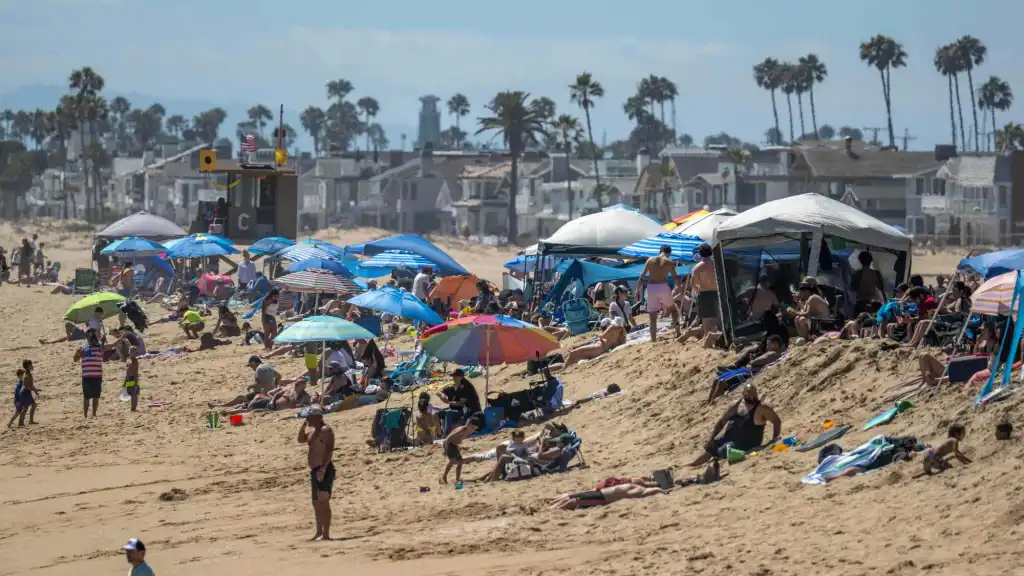
With some good-sized waves close to 4 feet expected this week and over the Fourth of July weekend, Laguna Beach lifeguards will have their work cut out for them as they watch over hundreds of thousands of beachgoers expected to descend upon the small seaside town and its 7 miles of beaches.
Read more It’s summertime, OC beaches are going to get popular. Here are some tips to stay safe
But a new city ban on canopies and easy-ups at almost all of its beaches should make their jobs easier, officials said.
By keeping the large structures off the sand, Laguna Beach Marine Safety Chief Kai Bond said his lifeguards have improved visibility across the sand and into the water. Firefighters and police should also have better access in emergency situations.
“It was very important for our lifeguards to be able to see people who are in the water near shore,” he said. “Some of those larger canopies are obstructive, and it’s very difficult a lot of times to see.”
Bond said his lifeguards would often have to ask people to move to open up the view of the beach and water. In general, he said, people would comply, but the new law makes it much easier to enforce the request.
“Our beaches are so much different than our neighboring cities and more narrow,” he said. “A lot of the larger canopies take up a lot of space and it’s hard to see around, and when we had emergencies, it was very hard for our staff to get to incidents. Having fewer or none on the beach has been an improvement.”
Bond said most people have understood why they can’t have their larger structures up – those found in violation can face as much as a $500 fine – and the number of people still coming with structures is dwindling over time. The city’s Park Rangers approach anyone still putting up a larger cover to educate them on the need to put it away.
Beach umbrellas are allowed.
Bond credits the positive response to the city’s proactive efforts to get word out on social media and with other public messaging, in addition to signs posted throughout the town.
“People are coming prepared,” he said, but added that canopies and easy-up structures are allowed in some zones at Main Beach and Aliso Beach and can still be used in all of the city’s parks.
“If you don’t come to the beach with your umbrella, there are options for you,” he said, adding that Main and Aliso beaches are the two most frequented areas for tourists. “The zones are out of the sightlines of the lifeguards. I felt it was important for at least a while to give people options if they came to the beach and didn’t know what the specific regulations were.”
The new rule in Laguna Beach may be the most visible change, but lifeguards and police departments at other agencies along the Orange County coast are also stepping up their efforts to make beach visitors more aware of existing rules, or in some cases, such as Newport Beach, have stepped up fines attached to existing regulations to drive home the point. That city will have a mobile booking station this summer to help officers making arrests.
Huntington Beach is also “all hands on deck” for the Fourth of July and will have mounted horse patrols along the sand, and help from the SWAT team at the ready, so foot and ATV officers are freed up for more beach and downtown enforcement, said police Lt. Shawn White.
“Most holiday weekends, we’re trying to help people control drinking and the behaviors related to that,” he said.
The stiffened regulations are measures marine safety officials, law enforcement and city officials say are meant to make the beachgoing experience as safe and fun as possible while also helping those tasked with providing public safety do their jobs more effectively.
After arresting more than 500 people over the July 4 holiday a year ago, Newport Beach officials have had a year to plan and gear up.
“Knowing that the Fourth of July is on a Saturday, our police and fire departments, along with lifeguards, public works, and executive management, have been working throughout the year to prepare,” said Councilmember Erik Weigand, pointing to the mayor’s “Not in Newport” campaign.
Read more A few lessons for dads from the U.S. Open
“Visitors and short-term rental operators have been warned that fines will be doubled throughout parts of town,” he said. “With the help from several outside agencies, including the Orange County Sheriff’s Department, egregious behavior will not be tolerated. I’m confident our city will rise to the challenge and ensure residents, businesses and visitors alike will have a fun, but safe experience.”
When Newport Beach braced for an onslaught of Spring Break revelers, the council increased enforcement and fines in some of the most visitor-attracting areas such as the Balboa Peninsula, West Newport and Corona Del Mar.
The city already had designated enhanced safety zones where fines had increased, and this spring the council agreed to expand the number of days around the Fourth of July and extend the safety zone covering West Newport and the peninsula to B Street, instead of 32nd Street, while adding Corona Del Mar. The increased enforcement was in place for Memorial Day.
The new restrictions and stiffened fines are already proving helpful, said Lifeguard Chief Brian O’Rourke.
“It looks really good this year,” he said, reflecting on beach behavior so far. Last year, for example, during the Fourth of July, he said there was a big problem with large, rowdy gangs gathering around 32nd Street.
“It seems to be almost self-policing,” he said. “Officers are on the beach and are making sure things are staying in order.”
While roomier than Laguna Beach, Newport Beach has limited the size of permitted large shade structures on the sand this year. The coverings cannot exceed 6 feet in height and width, and are not allowed to be clustered together. They also can’t stand in the way of public access routes, emergency roads, or lifeguard towers. They must be placed at least 50 feet from a tower and separated by at least 5 feet.
O’Rourke said the smaller shades also improve lifeguard visibility and prevent large groups from gathering under them.
“It gives enforcement opportunity to break those up,” he said.
Lifeguards in San Clemente get help from the city’s Park Rangers, who two years ago took over from a team of private security guards, the Sheriff’s Department and the Coastal Animal Services Authority, Mayor Rick Loeffler said.
“When we had the private security, they had no enforcement ability; these guys can write citations,” he said. “Once the sheriffs get busy during the day, they’re nowhere around, but these guys are out there, and they’re real visible. The bang for the buck is great.”
That model has also worked well in Laguna Beach. Park Rangers were brought into the Laguna Beach Police Department by Chief Jeff Calvert to address the growing quality-of-life issues across the town’s neighborhoods, especially those near the beaches.
Calvert said the program is a step up from the city’s former Beach Patrol, which was run with civilians. The rangers have the authority to cite and arrest people and carry the same equipment as police officers, except a firearm.
In addition, Laguna Beach this year also added a private security team to help out in some of the town’s most popular spots. At Thousand Steps Beach in South Laguna, they are catching people at the top before they have to lug a prohibited item back up the stairs.
“They’re like docents in that they’re providing information,” said Lt. Jason Farris, who oversees the ranger program. “It also lets (people) know we are actively enforcing.”
Read more World Cup: Senegal routs 10-man Iraq to boost odds of advancing