
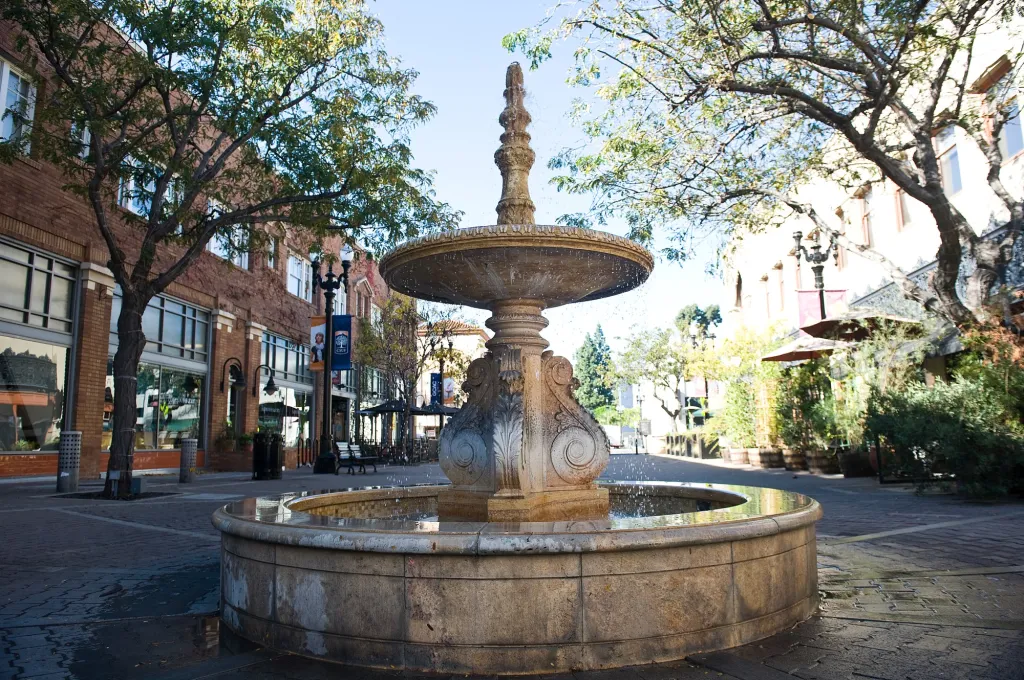
Incorporated in 1886, Santa Ana is the oldest city in Orange County and boasts many historic homes and buildings. Since the 1990s, the nine-member Historic Resources Commission has helped city leaders with preserving the landmarks and architecture that tell the story of Santa Ana’s history.
Read more Supreme Court upholds state laws banning transgender girls and women from school athletic teams
To help close a looming budget gap, the City Council recently agreed to dissolve the commission and four others that are not mandated by law: the seven-member Arts and Culture, the nine-member Environmental and Transportation Advisory, the seven-member Youth and the nine-member Parks, Recreation and Community Services.
The commissions are made up of residents appointed by the councilmembers, with responsibilities that will now be absorbed by other existing bodies and departments, with the city’s Planning Commission assuming the entirety of the Historic Resources Commission’s duties.
To pass the 2026-27 fiscal year budget, which goes into effect July 1, city officials worked to close a $19 million deficit through a mix of spending reductions, revenue adjustments and other balancing measures. Dissolving the commissions was part of budget discussions that started back in the spring; the elimination of the five commissions contributed $38,400 to the savings.
“Nobody wants to make these cuts,” City Manager Alvaro Nunez said at a June 2 budget hearing, framing the package of cuts as a “necessary” shared sacrifice with trims made across all departments.
Tim Rush, a former chair of the Historic Resources Commission and also a founding board member of Preserve Orange County, which advocates for countywide efforts to preserve historic architecture, called the $38,400 in savings “tinkering at the margins.”
He asked, “Why would you do that?” and argued that eliminating five commissions closes forums where residents can help shape policy before it reaches the City Council.
Councilmember Jonathan Hernandez pressed Nunez to confirm that historic preservation programs and arts grants would remain available to residents through other commissions, with Nunez saying that the functions were being realigned rather than removed. Councilmember Thai Viet Phan also followed up, asking whether residents would still be able to attend meetings, call in, email, and make their voices heard on the same matters, to which Nunez affirmed they would.
Councilmembers Jessie Lopez and David Penaloza later opposed the ordinance dissolving the commissions, arguing the move minimizes public input.
“I think this is one of those ways where we could include the public as much as we can,” Penaloza said. “I will not be supporting this, dissolving the various commissions just because it gives an opportunity for our public to participate and be engaged and have that civic engagement.”
City staffers said “nothing precludes the City Council from evaluating the purpose of, or need for, any board or commission in the future and re-introducing them at a later date.”
Rush, who helped found the Historic Resources Commission in the early 1990s, said its advocates fought “tooth and nail” resistance from city planners and he does not consider the two bodies interchangeable.
Rush argued the commission was created precisely because city planners once resisted keeping a historic register.
Commissioners on the Historic Resources board play a practical role in safeguarding the city’s historic character by supporting Santa Ana’s participation in state and federal preservation programs through its Certified Local Government status and reviewing applications for historic designation, exterior alterations, and Mills Act agreements.
They also help ensure that qualified historic buildings are evaluated under the relevant preservation standards.
Read more Miscarriage management remains muddled 4 years after Dobbs
Recently, the commissioners recommended to the City Council a series of amendments to the city’s preservation laws, adding new protections against demolition by neglect and requiring the disclosure of a property’s historic status during real estate transfers. Commissioner Ginelle Hardy previously described the revisions as a “major milestone” for preservation in the city.
The city’s Planning Commission is a seven-member body that meets twice a month and holds final authority over subdivisions, conditional use permits, and variances when properties deviate from current zoning regulations. Under the new proposed ordinance, that same body would now issue approvals for requests to alter, expand, demolish, or relocate any building that falls under a designated local historic district or is considered a registered historic landmark property, among other responsibilities.
“People on a planning commission are presumed to have expertise in municipal planning, not historic preservation,” Rush said. “Now, are they first cousins? They might be second cousins, twice removed.”
Hardy raised with the City Council concerns over the impact the decision would have, including fears that the Planning Commission would try to “wear the hat” of the Historic Resources Commission without proper specialized training. To serve on the HRC, appointed residents must have expertise or experience in fields such as architecture, history, architectural history, or urban planning.
“If that training doesn’t occur, it will be recognizable immediately,” she told the council. “I want the council to know that the HRC is a valuable achievement adopted by City Council, a specialized asset envied by other cities, and a different scope and focus from all the other commissions.”
Hardy asked the council to reinstate the HRC once the budget permits.
“If there’s anybody up here that is absolutely sensitive to the idea of historic resources not continuing as a commission, it’s myself,” said Councilmember Phil Bacerra, who previously served on the commission and the board of Preserve OC.
Bacerra said he has faith that city staff will remain intentional about preserving city history. “I wish we had the commission backing it up. But again, these are some of the tough decisions that all of us up here are facing.”
Ed Murashie, the commission’s current chair, argued the panel’s role extends beyond bureaucratic procedures.
“Every member of this commission has a passion for historical preservation,” he said. “We all, pretty much, across the board, go out and we visit the home, we meet with homeowners, and we listen to their stories.”
Murashie recalled walking through the one-time home of the late Olympic diver Sammy Lee in West Floral Park, who trained folks such as American Olympic diver and gold medalist Greg Louganis in his backyard.
“We’ve gone into homes where somebody says, ‘Do you see the other door in here? In this room?’ And he’ll go over, and he’ll push a panel, and he goes, ‘Yeah, this takes you down to the speakeasy,’” Murashie said. “I mean, there’s these great things about Santa Ana and the historical stuff that we want to make sure gets preserved.”
Moving forward, Murashie said the Planning Commission should include a representative from the former HRC board, so that when a project comes up, “you have somebody that has a little more expertise to look at that and judge that and make sure the right things are being done.”
“And now that’s a little better, a little protected,” he argued, “because you’re going to have a voice sitting in on that commission when it comes to historical preservation.”
Read more Job openings stayed at a surprisingly strong 7.6 million in May; US labor market proves resilient