
A Santa Ana native, Mia Verdin considers herself privileged to be able to call herself a U.S. citizen.
Read more Consumer confidence ticks up as gas prices fall but Americans remain gloomy about the economy
Verdin, along with her two younger brothers, was born in the U.S., which means they are citizens despite their parents’ immigration status. It’s a pivotal part of her family’s story, the 21-year-old said.
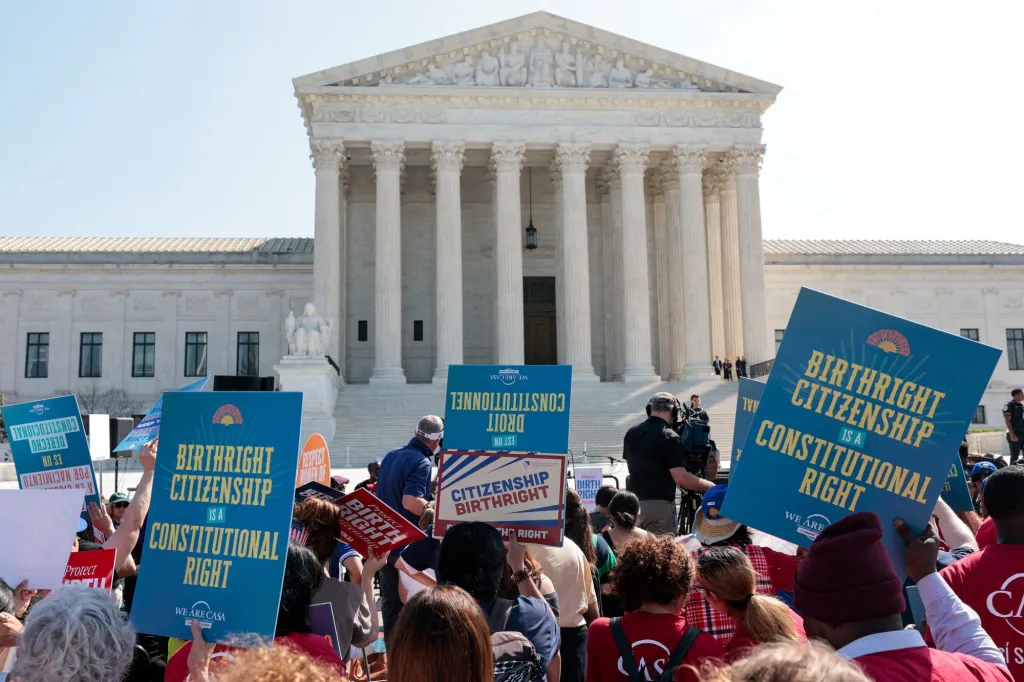
And it’s one on Tuesday, June 30, when it ruled the Fourteenth Amendment to the U.S. Constitution means children born in the U.S. — even to parents unlawfully or temporarily in the country — are citizens at birth.
An estimated 24,500 children are born each year in California who fall under the birthright citizenship category, according to the state attorney general’s office.
Verdin’s parents, Bob and Vanessa, immigrated, without documentation, into the country from Mexico more than two decades ago. They both settled in Santa Ana, where they met as coworkers in a patio furniture business.
“They got together. They worked really hard. They saved up enough money to be able to buy the business from their boss when he retired,” Verdin said, proudly.
They’ve raised three children. Their eldest will soon graduate from one of the top public universities in the country: UC Berkeley.
“They’ve had to move mountains to get to where they are and to give their children the opportunities that they have,” Verdin said. “It’s a common thread I hear from my friends who are also birthright citizens, who are also first-generation students.”
Verdin’s parents “come pretty close” to the American Dream, she said. Birthright citizenship is a pivotal part of that story.
For Rep. Dave Min, D-Irvine, President Donald Trump‘s attempt to end birthright citizenship is personal for him, too.
“Like millions of other Americans, I am the product of birthright citizenship, as I was born to Korean immigrants here in the United States,” Min said last year, following the president’s executive order.
“Almost all of us who claim citizenship of this great country are either birthright citizens or descended from birthright citizens,” Min said.
And Rep. Mike Levin, D-San Juan Capistrano, thinks about his own family as well. While his mother was born in the U.S., making her a citizen, her parents — his grandparents — built their lives in the country after arriving from Mexico. His grandmother, Levin said Tuesday, was a lawful permanent resident for her entire life, while his grandfather became a U.S. citizen at 50 years old.
“Under (Trump’s) theory, a child like my mom, born here to parents who were not yet citizens, could have been told she did not fully belong,” Levin said. “The order he signed would have created exactly what the Constitution forbids, a permanent underclass of people born in this country and denied the country of their birth.”
Read more Supreme Court strikes down limits on party spending in federal elections, backing Republican appeal
“My grandpa waited 50 years to call himself a citizen of the country he already loved. He did everything this nation asked of him,” Levin added. “The idea that his daughter’s place in America could have depended on his immigration status in the year she was born is not just legally wrong. It is fundamentally un-American.”
“The promise is older than any of us, and it does not bend to one man’s politics. If you are born here, you are one of us. That is the country my family believed in,” Levin said.
Just after beginning his second term, Trump issued an executive order attempting to deny U.S. citizenship to children born after Feb. 19, 2025, whose parents are living in the country illegally, as part of his administration’s broad immigration crackdown.
Min called the executive order “deeply un-American, attacking one of the most hallowed and sacred pillars of our country and what it has stood for through its history.”
Multiple lawsuits, led by several states and a number of immigrant rights groups, ensued after the president’s executive order.
The 14th Amendment to the Constitution promises citizenship to those born on U.S. soil, a measure ratified in 1868 to ensure citizenship for former slaves after the Civil War. It was later expanded to immigrants’ children when the Supreme Court ruled that nearly anyone born in the U.S. — no matter their parents’ legal status — has citizenship.
That was a case that stemmed from Wong Kim Ark, who was returning home to San Francisco, where he was born, from a trip to China, where his parents were from. Despite having documentation attesting to his citizenship status, he was denied entry and ordered deported because his parents were not U.S. citizens.
Wong, while detained off the coast of San Francisco, mounted legal challenges, reaching the nation’s highest court — which ruled in his favor.
Outside of the Americas, most countries follow the legal principle of jus sanguinis, or “right of blood,” with a child’s citizenship inherited from their parents, no matter the place of birth.
But American legal practice is descended in many ways from English common law, which had long provided for citizenship based on a child’s place of birth, the legal concept of jus soli, or “right of soil.” That being said, the United Kingdom abandoned that right of soil practice in 1981, and under new rules, people born there only get citizenship if at least one parent is a British citizen or has “settled status” under the law.
The Supreme Court’s decision on Tuesday “affirms a foundational tenet of American democracy: that every child born in this country, no matter their background, is equal under the law and can pursue the ‘American dream,’” said California Attorney General Rob Bonta.
“As President Ronald Reagan, the great Californian, once reminded us, what makes America great is that anyone can become an American,” said Rep. Lou Correa, D-Santa Ana.
“President Trump tried to create a class of people born without citizenship to further divide Americans, failing to recognize that the ability for anyone born in this country to be an American is what makes us exceptional,” Correa said. “The highest court in the land has upheld the most fundamental American truth — that all are created equal.”
Read more Supreme Court upholds birthright citizenship, rejecting Trump’s proposed limits
The Associated Press contributed to this report.
This is a breaking news story. Check back for updates.