
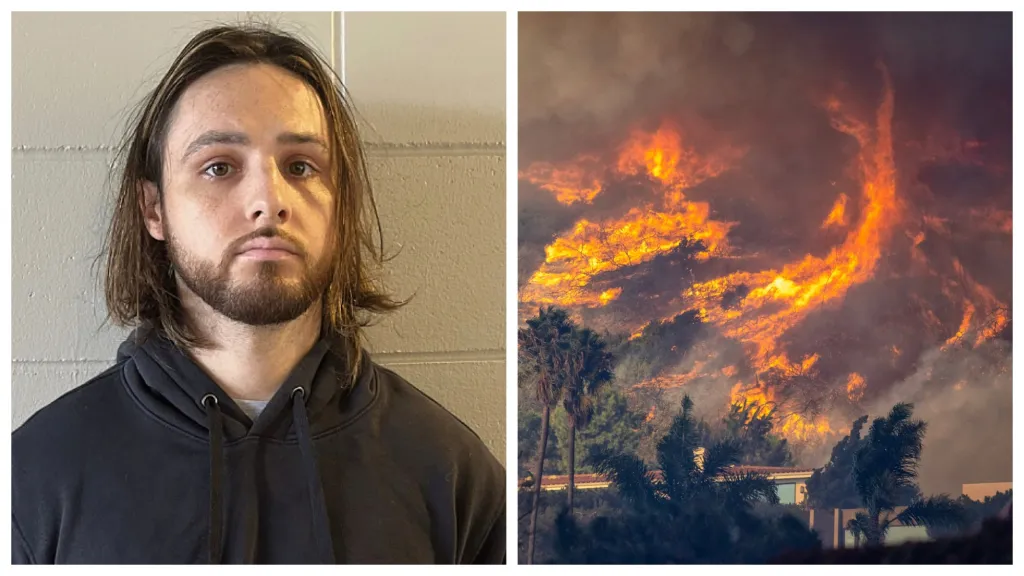
After a jury failed to reach a verdict in the trial of a man accused of igniting what became the massive Palisades fire, prosecutors immediately pledged to try again, but legal experts say the U.S. Attorney’s Office will have to reassess its court strategy if it hopes to win over a new jury.
Given the surprise split of last week’s jury — 10 to 2 in favor of an acquittal — some also questioned the wisdom of moving forward with a second trial, while others noted that prosecutors now have the chance to potentially refocus their case based on feedback from jurors who weren’t convinced during the first trial.
“It was a high-profile prosecution; you (the U.S. Attorney’s Office) held a big press conference,” said Neama Rahmani, a former federal prosecutor, in an interview following the mistrial. “You told the entire country he was responsible. And you couldn’t even get the majority of the jurors, when you need a unanimous vote to convict.”
Jonathan Rinderknecht, accused of starting a blaze that eventually became the disastrous Palisades fire, remains in custody as he awaits an October retrial.
Shortly after the mistrial was declared on Friday, First Assistant U.S. Attorney Bill Essayli announced on X that his office intended to retry the case, adding that “the evidence is strong.”
A ‘total loss’
Rahmani, however, called last week’s result a “total loss” for the government and said he believes the U.S, Attorney’s Office should step away from the case.
While there was evidence to suggest Rinderknecht started the Lachman fire, Rahmani said, making the leap from Jan. 1 to the Jan. 7 start of the Palisades fire was a “bridge too far and I don’t think the jurors bought it.
“The true biggest challenge in this case,” he said, “I’ve never covered a case ever where the ignition happened on one day and the real effects weren’t felt for a week later.”
During the nine months between the fire and Rinderknecht’s arrest, “people developed some very strong feelings about who was responsible,” he added, whether it was Mayor Karen Bass, the Los Angeles Fire Department or the Los Angeles Department of Water and Power who were seen as dropping the ball.
An uphill battle
Laurie Levenson, a former prosecutor and Loyola Law School professor, said Essayli “didn’t do himself any favors” by immediately announcing the move to a retrial on social media, which some people, she added, viewed as “knee jerk.”
But, Levenson noted, Essayli may have done so in order to show confidence in his prosecutors.
Levenson said the reaction by the first jury shows prosecutors have an uphill battle and that there are “serious issues” with the case. But she added that the case was not necessarily a lost cause.
“The first thing they need to do is listen to the jurors who have spoken,” Levenson said. “When you have ten that are ‘not guilty,’ to the extent you can find out why, that is crucial.”
After a year in which criticism about the response to the fire by the Los Angeles Fire Department and city leaders has been publicly aired at length, residents want answers, Levenson said. But Rinderknecht’s trial is meant to focus solely on his alleged role in igniting the fire. Levenson said that makes jury selection — and finding out whether prospective jurors have an agenda based on their potential knowledge of the fire or the first trial — a key concern for prosecutors.
Read more Kids’ game: What it’s like to walk with players onto a World Cup field
“I’m not sure they knew enough about the jurors and their attitudes regarding the case,” Levenson said. “Now you have to worry if you have jurors who have an agenda one way or another.”
Levenson noted that a major focus of the first trial was on Rinderknecht’s social media and alleged motive. But, based on comments made by at least one juror afterward, the jury appeared to want to see more forensic evidence so that they could play “junior sleuth,” she added.
Rolling the dice
John Day, a New Mexico-based defense attorney with experience in arson cases, said should prosecutors retry the Rinderknecht case, the question would be whether they would run into the same issues in terms of lack of proof with 12 new jurors.
“The government can’t ignore the 10-2 split (in favor of acquittal) and the government has to rethink the science, the causation and the motivation of the defendant,” Day said. “But again, the things that were uncertain in the first trial will certainly be uncertain in a subsequent trial.
“You roll the dice with a new jury and a new trial, but the defense knows what works for them,” he added.
Day acknowledged the work of the defense team in presenting possible alternative causes, like fireworks, to raise reasonable doubt with the jury.
Without direct evidence, the government had to “plug that hole” with circumstantial evidence, including the defendant’s digital trail and ChatGPT use.
“The jurors are going to want something that says, ‘Here’s the guy, here’s how he started it,’ ” Day said.
A new trial would require a lot of resources and money spent, the defense attorney added.
“Is that the best use (of those resources)?” he asked.
By their nature, arson investigations into large-scale wildfires provide defense attorneys with a lot of room for potential reasonable doubt when it comes to how the flames were actually ignited.
The last high-profile arson suspect to go on trial related to a major wildfire, Forrest Clark, was fully acquitted of igniting the Holy Fire, which burned through Orange and Riverside counties in 2018. Orange County prosecutors had accused Clark of being a “monster” at the time of his arrest. But an Orange County Superior Court jury arrived at a not guilty verdict in 2023 after Clark’s defense attorney accused fire officials of carrying out a sloppy and inadequate investigation that failed to prove he actually ignited the blaze.
If the prosecutors in the Rinderknecht case want to avoid the same fate, it appears they will have to deal in particular with the skepticism the first jury apparently had regarding the delay between when Rinderknecht is alleged to have first sparked a fire in the area and when the blaze that became the Palisades fire ignited out of control.
“The public just wants answers to how this could happen,” Levenson said. “And it is a little hard for them to believe a guy who lit a match a week earlier is responsible for all this horror.”
Read more Can Team USA snap its World Cup knockout phase curse?