
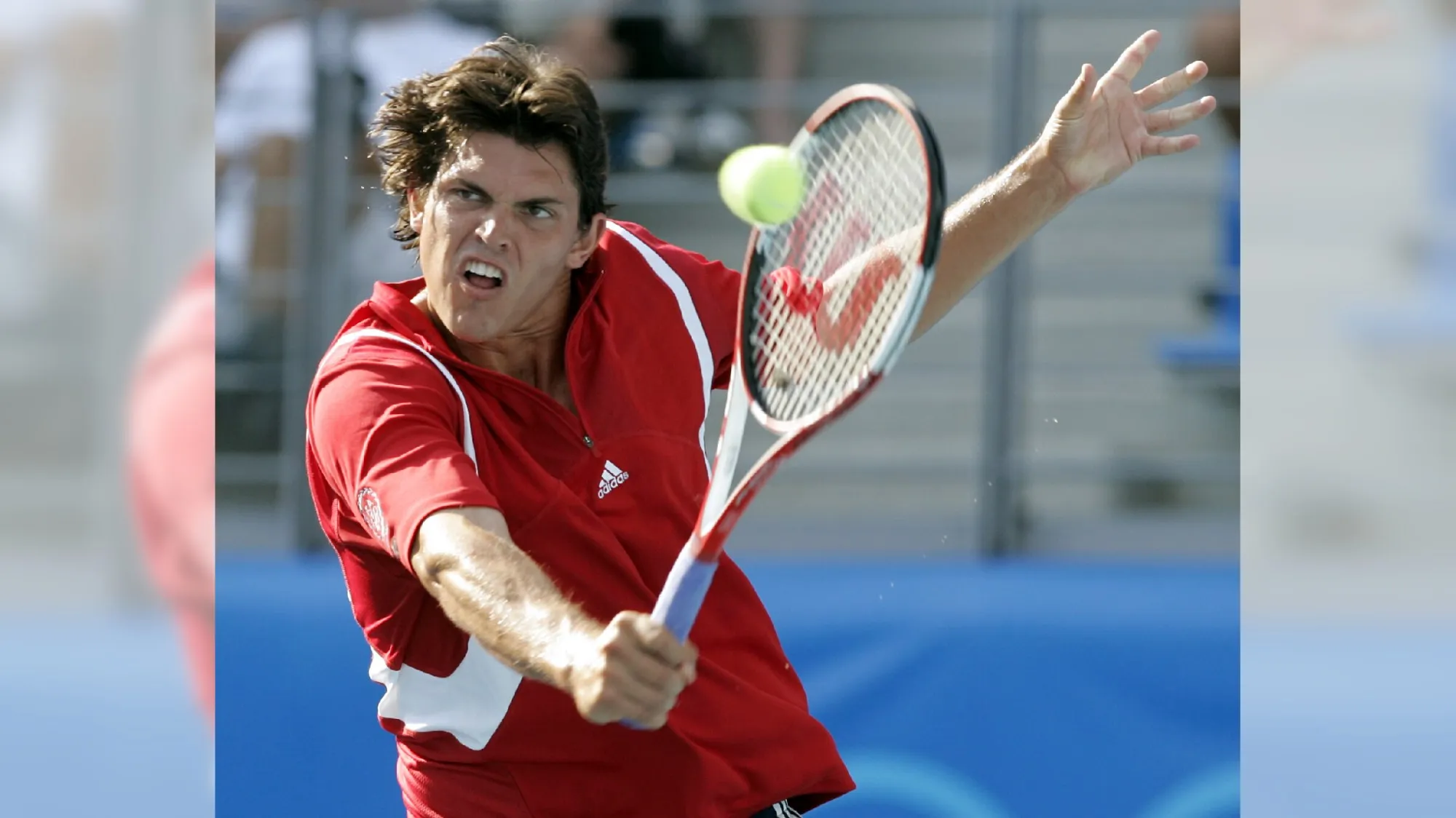
Corona del Mar High product Taylor Dent said he considers each of his four titles on the Association of Tennis Professionals Tour “special in their own way.”
Read more Struggling US home buyers, and market, face new hurdles as mortgage rates near 7%
There was Newport, R.I., in 2002, when he beat fellow American James Blake on grass to capture his initial ATP title. Just winning one was an incredible feeling, Dent said, especially on the heels of becoming a professional and realizing a childhood dream.
It was especially meaningful because it made Dent and his father, Phil Dent, the first father-son pair in the open era to win ATP Tour singles titles. Phil Dent won three titles and finished as runner-up at the 1974 Australian Open, along with capturing a dozen ATP doubles championships.
Then came Memphis for Taylor Dent in 2003, perhaps the most impressive championship of them all. Dent defeated American star Andy Roddick, then ranked No. 5 in the world, 6-1, 6-4 in the final, without dropping a set during the tournament.
And then there was the remarkable one-two punch later that year: Bangkok and Moscow, winning in consecutive weeks.
In Bangkok in September 2003, Dent defeated one of the world’s top players, Juan Carlos Ferrero, 6-3, 7-6, for the Thailand Open title, before traveling to Moscow and winning again the following week. In the final, Dent beat Sargis Sargian, 7-6, 6-4, to claim the Kremlin Cup.
But perhaps the most eye-opening victory in Dent’s playing career came against one of the greatest players of all time – Novak Djokovic.
Dent was an established player, at the peak of his game and ranked No. 29 in the world, facing an 18-year-old Djokovic at the Hopman Cup in Perth, Australia, on Jan. 1, 2006. It was a non-ATP Tour event with Dent winning, 6-1, 6-4.
“I was playing my best tennis at the time,” Dent said. “I get asked about that match a lot. What’s funny, when my agent asked me what I thought of Novak Djokovic after (the match), I said ‘I don’t know. I don’t think he’s very good.’ It blows me away when I think about Djokovic and his courage to keep improving.”
Djokovic’s trajectory was about to change dramatically. Later that same year, at age 19, he reached the French Open quarterfinals, the fourth round at Wimbledon, and then won his first ATP Tour title in Amersfoort that July.
Read more A global AI safety strategy depends on US-China cooperation. They each see the other as the problem
Djokovic has won 24 Grand Slam singles titles, tied for the all-time record with Margaret Court and first among men, ahead of Rafael Nadal (22) and Roger Federer (20).
In 2010, when Dent lost to Djokovic at Wimbledon, he set an All England Club record with the fastest serve ever recorded at 148 mph. Dent’s serve topped his previous Wimbledon record of 144 mph in 2001.
While Dent’s service weapon and solid play led to a successful pro playing career, back injuries ultimately forced him off of the ATP Tour.
Dent, whose world singles ranking reached as high as No. 21, won the CIF Southern Section singles championship in 1996 under CdM Coach Tim Mang, becoming only the third freshman in section history to accomplish the feat, joining Jon Leach (Laguna Beach) and Pete Sampras (Palos Verdes). Dent turned pro two years later.
Dent, who placed fourth at the 2004 Athens Olympic Games, started playing tennis at an early age. At 10 years old, he began taking it seriously after watching Grand Slam winner Michael Chang practice at his home in Newport Beach when Chang came to train with then-coach Phil Dent.
These days, Dent owns and operates a tennis academy at The Birch Racquet & Lawn Club in Keller, Texas.
“(The club) pretty much runs well because of Jenny,” Dent said of his wife, who he met at Indian Wells when they were playing junior tennis. They moved to Texas from Newport Beach in 2016 and have four children, two boys and two girls.
Richard Dunn, a longtime sportswriter, writes the Dunn Deal column regularly for The Orange County Register’s weekly, The Coastal Current North.
Read more Former US Sen. Jon Kyl of Arizona, a ‘workhorse’ who shaped water policy, dies at 84