
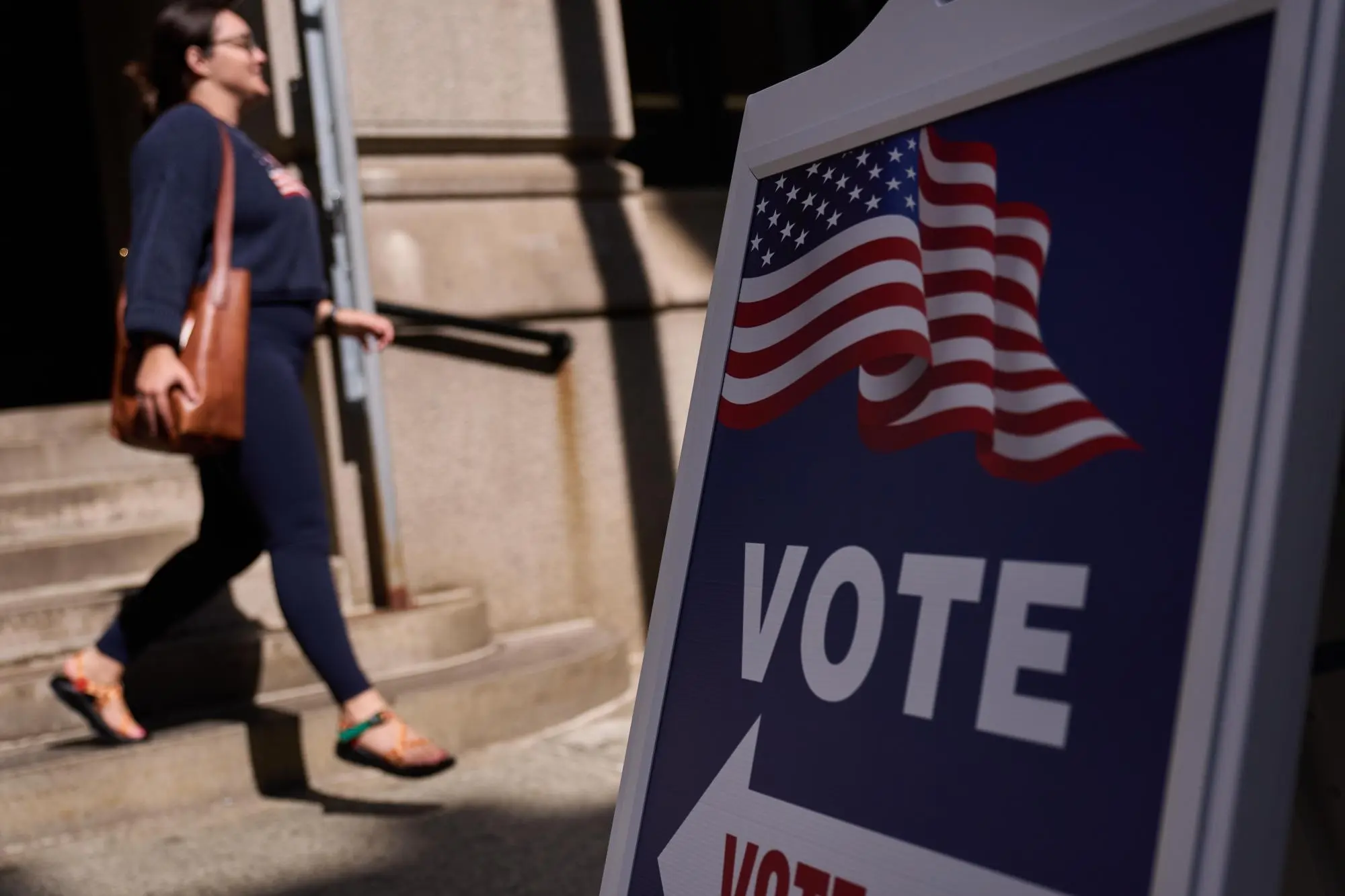
On Sept. 19, 1893, New Zealand enfranchised its female citizens, making it the first nation or territory to formally allow women to vote in national elections.
Read more UFC 331: Van brings confidence and title into Pantoja rematch
Fighting for suffrage
With the signing of the Electoral Bill by Governor Lord Glasgow, New Zealand becomes the first country in the world to grant national voting rights to women. The bill was the outcome of years of suffragette meetings in towns and cities across the country, with women often traveling considerable distances to hear lectures and speeches, pass resolutions and sign petitions. New Zealand women first went to the polls in the national election in November 1893.
Movement in the U.S.
The United States legally guaranteed American women the right to vote in 1920, and Great Britain granted full voting rights for women in 1928.The fight for women’s suffrage in the U.S. spanned generations. The organized movement began 72 years earlier in 1848, when activists Elizabeth Cady Stanton and Susan B. Anthony issued the Declaration of Sentiments at the Seneca Falls Convention in New York, demanding equal political rights for women.
Women had the right to vote in 16 states prior to the passage (Hawaii and Alaska where not states yet) of the 19th Amendment to the Constitution. While many assume 1920 was the first time women appeared on voter rolls, early voting rights existed on local and state levels. Here are those 16 states:
- Wyoming 1869
- Utah 1870
- Colorado 1893
- Idaho 1896
- Washington 1910
- California 1911
- Oregon 1912
- Arizona 1912
- Kansas 1912
- Montana 1914
- N. Dakota 1917
- New York 1917
- Louisiana 1918
- Oklahoma 1918
- Michigan 1918
- S. Dakota 1918
Modern voter
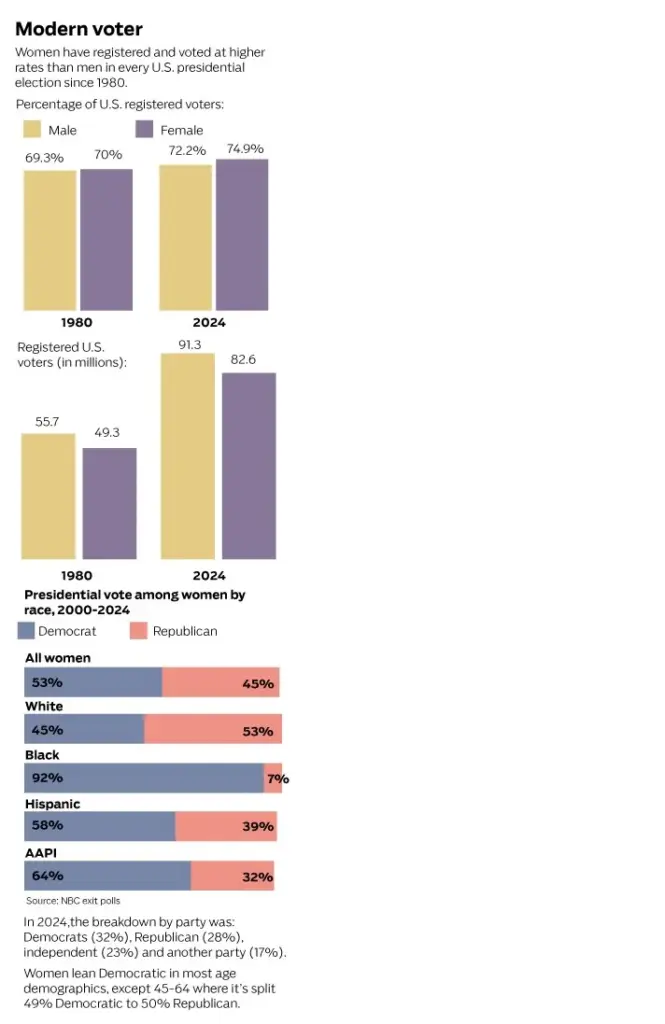
Women have registered and voted at higher rates than men in every U.S. presidential election since 1980.
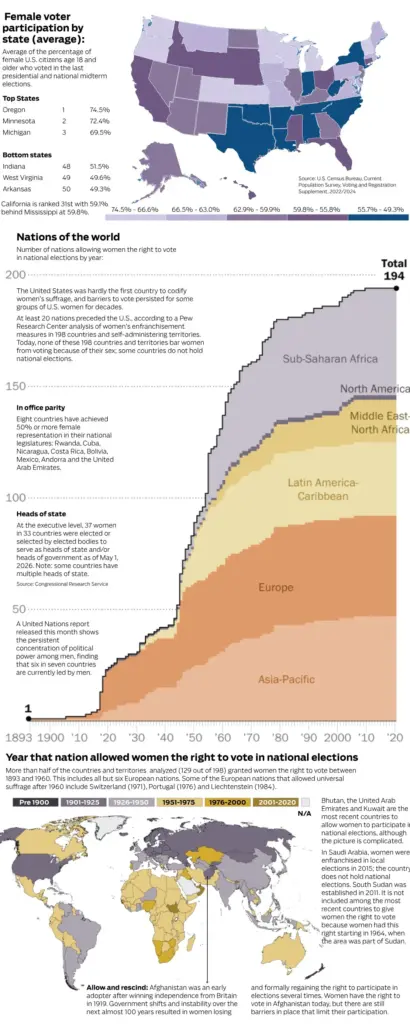
Female voter participation by state
Average of the percentage of female U.S. citizens age 18 and older who voted in the last presidential and national midterm elections.
Top States (rank, percentage)
- Oregon 1, 74.5%
- Minnesota 2, 72.4%
- Michigan 3, 69.5%
Bottom states
- Indiana 48, 51.5%
- West Virginia 49, 49.6%
- Arkansas 50, 49.3%
California is ranked 31st with 59.1% behind Mississippi at 30th at 59.8%.
Nations of the world
The United States was hardly the first country to codify women’s suffrage, and barriers to vote persisted for some groups of U.S. women for decades.At least 20 nations preceded the U.S., according to a Pew Research Center analysis of women’s enfranchisement measures in 198 countries and self-administering territories. Today, none of these 198 countries and territories bar women from voting because of their sex; some countries do not hold national elections.
Read more OC Pride’s Big Homecoming: Festival Returns to Downtown Santa Ana in October
You can read a Pew Research Center report from 2020 about women’s enfranchisement here.
In office parity
Eight countries have achieved 50% or more female representation in their national legislatures: Rwanda, Cuba, Nicaragua, Costa Rica, Bolivia, Mexico, Andorra and the United Arab Emirates.
Heads of state
At the executive level, 37 women in 33 countries were elected or selected by elected bodies to serve as heads of state and/or heads of government as of May 1, 2026. Note: some countries have multiple heads of state.
A United Nations report released this month shows the persistent concentration of political power among men, finding that six of every seven countries, on average, are currently led by men.
Sources: The Pew Research Center, Center for American Women and Politics at Rutgers University, Congressional Research Service, Public Religion Research Institute, U.S. Census, NBC News, State of Wyoming
Read more Pasadena mid-century home by Harold Bissner Jr. seeks $3.8M