
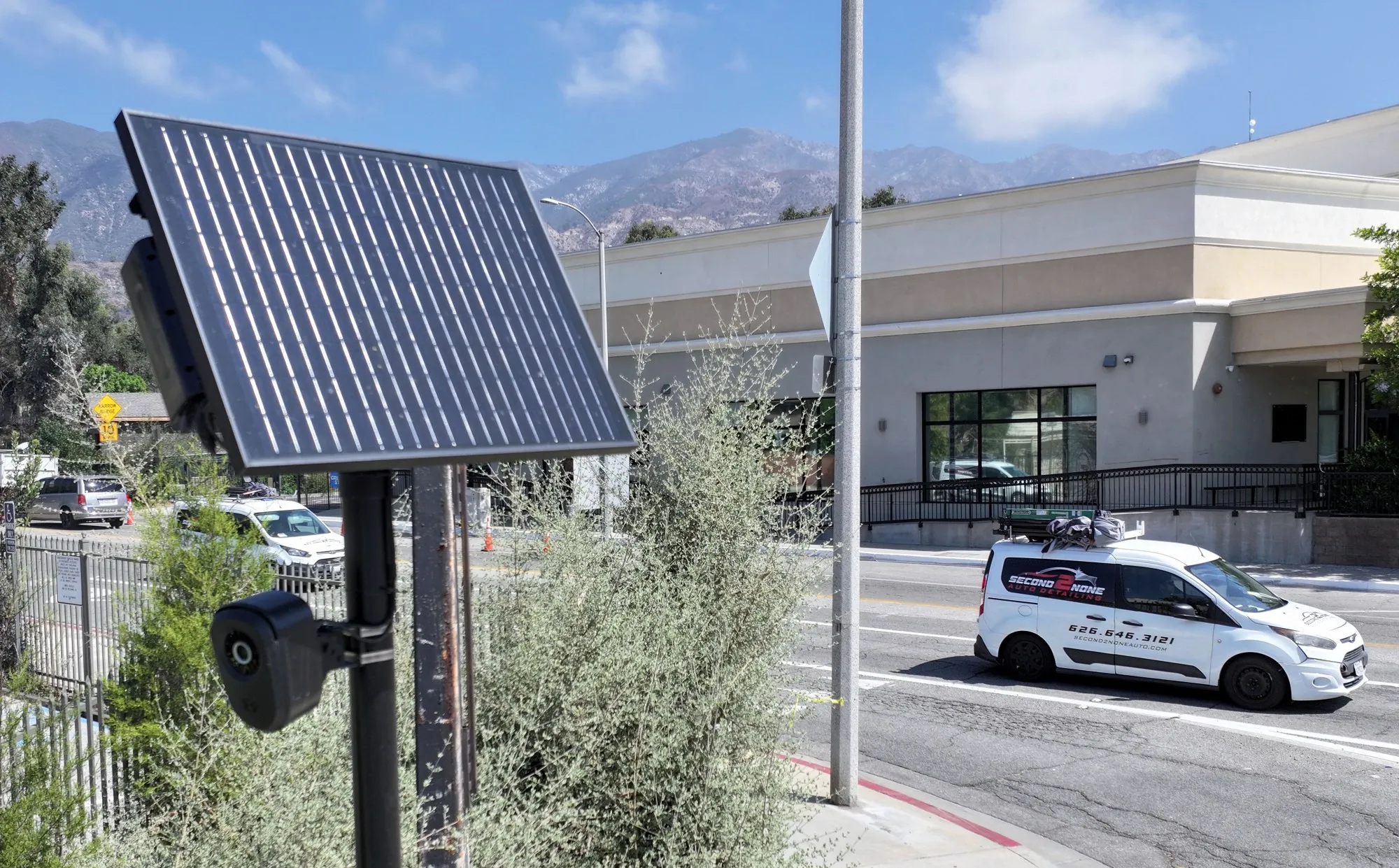
Months after the deadly Eaton fire decimated the town she has called home for more than a decade, Shawna Dawson was struck by something new, and disturbing, that suddenly was popping up in her neighborhood.
Read more Long Beach mid-century duplex photographed by Julius Shulman seeks $1.5M
Flock cameras, the sleek, black solar-powered automated license plate readers, had seemingly blanketed her community. She couldn’t drive to her property, where her home once stood, without passing at least one of them.
Other wary residents also took note, and questions and concerns soon flooded into online forums and groups that Dawson was part of: Where did these cameras come from? What were they being used for? Why didn’t community members and fire survivors have a say?
It felt, Dawson said in a recent interview, like the community was being hit with another troubling issue while many were already dealing with devastating loss and looming litigation.
“It does feel particularly egregious to thrust this upon us when the community isn’t here to defend itself,” she said.
‘The only witnesses’
In a for community members and presented to the public in September, 170 of the 230 respondents said they strongly oppose ALPR cameras in Altadena. Nineteen respondents said they strongly support the cameras as a crime deterrent. About two-thirds of respondents said there shouldn’t be any ALPR cameras in the town, and 114 respondents said there should be some form of public input or notice before cameras are placed anywhere.
At the September Altadena Town Council meeting, residents expressed concern and anger about the new Flock cameras. A few residents, including Town Councilmember Connor Cipolla, saw the cameras more positively, saying that, since the January 2025 Eaton fire — which killed at least 19 people and destroyed more than 9,000 structures — some blocks or streets only have one occupied home.
“These are the only witnesses to know who violated their security, who violated and stole their stuff, the last things that they had left,” Cipolla said, speaking as a resident during public comment. “I’m a huge fan. I’ve been a long-time advocate of this technology used here in Altadena in the unique situation and threats that we face despite the national headlines.”
But after the fire destroyed their homes, Dawson said she and many other residents installed trail cameras on their properties to monitor illegal dumping, theft and other crimes. The solar-powered trail cams were the best option for many residents still hoping to rebuild because they don’t need power or wifi and can have night vision and 360 degree capabilities.
Trail cameras also make residents more comfortable, Dawson said, because each property owner decides how many cameras they have and who sees the footage.
‘Sunshine is a good disinfectant’
There are 70 automated license plate reader cameras around Altadena, including 40 from Flock and 30 from Motorola as well as an additional seven cameras bordering Altadena in Pasadena, according to a presentation Anderson gave at a September Town Council meeting. More than half of those cameras are west of Lake Avenue, where historically more of the town’s Black residents have lived, Anderson said, citing deflock.org, a website where people across the country have mapped ALPR cameras.
The Los Angeles County Sheriff’s Department wouldn’t disclose where its ALPR cameras are but told Anderson that the 70 cameras don’t cover 70 unique locations and emphasized that law enforcement needs multiple cameras to capture every angle of an intersection. ALPR cameras were first deployed post-Eaton fire on a trial basis, but sheriff’s officials told Anderson the department hopes to continue using them.
Camera systems like Flock take images of passing vehicles and collect information like vehicle make, model and color and license plate numbers into a searchable database. Flock has said its cameras don’t use facial-recognition technology or log information about people, and individual agencies decide how their data is shared and how long it is retained in the system.
Flock cameras have come under fire across the country as more cases come to light involving law enforcement officers who used data from the cameras to stalk ex-romantic partners and agencies that have shared Flock data with federal immigration authorities. In Costa Mesa, a former police officer was sentenced to three years probation after he pleaded guilty to using the data to stalk his wife, an ex and her new boyfriend. Despite this case and pushback from residents, the city council voted almost unanimously to renew its Flock contract with some changes to address residents’ concerns.
With growing public scrutiny, Los Angeles police ended their agreement for Flock license-plate readers, and other California cities, including South Pasadena, El Cerrito and Mountain View, have done the same. But despite pushback against all license plate readers, the Los Angeles Board of Police Commissioners agreed to a 10-year deal with Axon that would supply more than 1,600 patrol cars with ALPR cameras as well as a three-month pilot program for street-light-mounted ALPR cameras just months after the Flock agreement ended.
Anderson is working to schedule a town hall meeting this month that would bring together community members, law enforcement, county and town leaders and representatives from Flock and Motorola to get community members more information on the cameras in Altadena. He hopes to get concrete data showing crimes that were solved because of the cameras and to see the department’s current policies, including how long they hold onto data from Flock and Motorola.
“I want everyone to have the data,” Anderson said, “and I believe strongly that sunshine is a good disinfectant.”
‘Connect to correct’
Personally, Anderson said he hopes the community will push to remove all the cameras. As a technology consultant, Anderson advises clients to review security settings on their phones and social media accounts each year and understand how their data is being used. But with ALPR cameras out in the community, there’s no way for drivers or passersby to decide how their information is collected or used.
Read more Austin Beutner is the latest to sue Chubb over smoke-damaged Pacific Palisades home
Flock gifted cameras to Altadena at first, but as the Sheriff’s Department and county navigate a new contract, Anderson said taxpayers in the community deserve a say in whether or not the cameras stay and how they’re used.
“I think we should have a say in how we’re surveilled,” Anderson said. “And if we don’t, I want to know why.”
Community members have told Heavenly Hughes, co-founder of My Tribe Rise, that the cameras feel invasive and counter to Altadena’s culture as a community that prides itself on being close-knit. Her organization has co-led protests against the cameras, calling instead for law enforcement and county leaders to meet with groups across Altadena to determine how residents want to move forward with surveillance and public safety measures.
“We must connect to correct,” Hughes said. “We must connect to be able to correct what has caused a heaviness or some may say a damage in our community.”
When it came to looting concerns, for instance, Hughes said community members formed canvassing groups with around 15 to 20 people in each shift patrolling the town to deter possible criminal activity. With little data available on the effectiveness of the cameras in Altadena, Hughes said she would rather local leaders put money that could go to Flock and Motorola towards social welfare programs.
Capt. Ethan Marquez with the Altadena Sheriff’s Station said the cameras have pointed to leads in investigations, but said he couldn’t share further details on ongoing investigations.
“We have been extra vigilant and have ensured that no data sharing has occurred outside California or with any Federal law enforcement agencies,” Marquez said in a statement. “We monitor this closely and on a continual basis. We do not blanket-share with any law enforcement agency. Data is only shared with agencies that have a signed Memorandum of Understanding (MOU) and have agreed to comply with our policies and strict requirements.”
The community wants more details, Dawson said. She wants to see records of how ALPR data has been searched and used in Altadena and cases where the cameras can be tied to arrests. If the cameras have helped catch people suspected of illegal dumping and work site and property theft — some of the crimes Dawson said residents are most concerned about — the community might be more willing to support them. Many community members, she said, have also advocated for more patrols in fire-affected areas to cut down on crime.
Instead, she said they’ve been met with little information.
Dawson and other community members also feel wary that Flock would donate 50 cameras to a community of about 43,000, based on 2020 U.S. Census data, when nearby Pasadena has 61 cameras despite having more than triple the population of Altadena. Some of this, she worries, is because of Altadena having a larger Black and Latino community.
“If it’s free, you’re the product,” said Rin Alajaji, associate director of state affairs for the Electronic Frontier Foundation. “That’s the bottom line of what Flock is doing here.”
No matter what Flock, Motorola or proponents of the cameras say their benefits are, Alajaji said she and other privacy advocates believe there isn’t an ethical use of the technology. While there have been cases where law enforcement in various cities have said the cameras helped them generate a lead or find a suspect, Alajaji said that’s not worth it if cameras can track every vehicle’s movement throughout a region.
In a statement, LA County Supervisor Kathryn Barger, who represents Altadena, said she supported the Sheriff’s Department’s use of cameras donated by Flock post-fire because of residents’ concerns of burglaries, looting and other crime in the community.
“I’m aware of the privacy concerns being raised by some residents, and I take them seriously,” Barger said. “Public safety and privacy should not be treated as mutually exclusive.
“As Altadena rebuilds, my priority is ensuring residents are protected from theft, burglary and potential vandalism of construction sites, illegal dumping and other criminal activity,” she continued, “while also making sure the community’s concerns about how technology is used are addressed.”
Despite their concerns, Dawson said she doesn’t think she and other Altadena residents have the time that they’d need to push back against Flock and other ALPR cameras. Dawson already spends her time advocating for state laws benefitting fellow fire survivors, helping neighbors with their rebuilds and eventually working towards her own and hosting weekly office hours to address community concerns. Other residents have told Dawson they’re overwhelmed dealing with unlicensed contractors, poorly done rebuilds, insurance claims and ongoing lawsuits.
Altadena’s residents, she said, can only fight so many battles at once.
“I would love to tell you we’re going to storm the castle and protest,” Dawson said, “but the odds of that are slim because we have to do that on about a dozen other issues that are more pressing.”
Read more Anaheim hits 100 degrees on Tuesday, marking 4th straight day of record-breaking heat