
A cruise ship floats around with infected passengers, is denied permission to dock, finally unloads people in hazmat suits into quarantine….
Read more Laguna Niguel man sentenced to 25 years in prison for fentanyl deaths
Do visions of the Diamond Princess, circa 2020, dance in your head? Does a vague sense of dread curdle your belly?
There has been much chatter this week about whether we’re seeing the tip of the next pandemic, courtesy of the Andes hantavirus that killed three and sickened many more on a different cruis ship, the MV Hondius. There’s been so much chatter, in fact, that we checked in with public health expert-types to get their take.
Yes, the World Health Organization has categorized “the risk to the global population posed by this event as ‘low.’”
Yes, the U.S. Centers for Disease Control said, “The risk of a pandemic caused by this outbreak and the overall risk to the American public and travelers remains extremely low.”
But we remember hearing much the same in January 2020. Back then, some public health officials said SARS-CoV-2 was nothing to worry about and the threat to the U.S. was “just miniscule.”
So we turn first to UC Irvine epidemiologist/demographer Andrew Noymer, who studies infectious diseases, and who directly contradicted the official line, even way back then.
“Duck tape your underpants,” Noymer posted on what was then called Twitter on Jan. 31 of that fateful year. “2020 is going to be a wild ride.”
Infuriating many public health types, Noymer asserted that “2019-novel-coronavirus *is* more frightening than SARS +certainly more than MERS b/c spreading more countries more quickly +appears to have an appreciable case fatality rate.” That kicked off 240-character brawls with other scientists who insisted that flu posed a greater risk than COVID.
Noymer was right back then. So, should we be worried now?
“I am an alarmist,” Noymer said.
“And I am not alarmed.”
Whew!
But… really? Even though hantavirus — which spreads via the droppings of infected rodents — is all over the Southwest, and last year it killed Betsy Arakawa, Gene Hackman’s wife, in Santa Fe, N.M.?
I mean, I practically live in the woods. I’ve seen a mouse or two skittering across the floor. The cats offer them as presents.
“The entire desert Southwest is an enzootic region for hantavirus, so people who come into contact with rodent droppings do have to keep that in mind,” Noymer said.
“But I’m referring to this recent outbreak becoming something a la COVID-19, and I’m here to tell you that that’s not a worry. It’s on people’s radar because of the Diamond Princess. But the fact is, that’s where the similarities end.”
So, what’s different?
The South American strain of hantavirus isn’t new or novel the way COVID was, Noymer said. We’ve known it can transmit from person to person — unlike the strains we find here in the Southwest — for some time. And it’s not as super highly crazy contagious as COVID was.
“It just doesn’t have pandemic potential.”
Dr. Boghuma K. Titanji, an infectious diseases physician and researcher at Emory University, would agree.
The Andes strain is a single-strand RNA virus, which is less enduring than a DNA virus, she said on a MedPage webinar.
Yes, influenza and COVID are also single-strand RNA viruses. But the Andes virus doesn’t have the same opportunity, or pressure, to mutate as they do.
People forget that there were some 2 billion COVID infections, giving the virus a tremendous opportunity to replicate and mutate. That disease also faced the pressure of vaccines, forcing it to adapt in order to survive, she said.
The Andes virus, in contrast, doesn’t make its rodent hosts sick. So it doesn’t face much pressure to change to become more infectious.
This outbreak has caused three deaths and about a dozen infections in a world of eight billion people, she said. Plus, all of those cases can be traced directly back to the source. There’s no evidence of secondary or tertiary infections thus far. Hopefully, people will remain healthy in quarantine and isolation and we’ll have containment six weeks from now.
There’s much we don’t know, but we will learn — with humility, she said.
Good luck
Of course, not everyone agrees.
“We’re still leaving a lot to chance, crossing our fingers and hoping for the best,” wrote Princeton University professor Zeynep Tufekci in a recent opinion piece bemoaning our complacency about the potential threat posed by hantavirus.
While the World Health Organization assures everyone the Andes strain can be transmitted only through “close and prolonged contact” and is thus unlikely to spread widely, a 2018 study of a “super-spreader” event in Patagonia, Argentina, raises many questions.
“We know fairly little about the Andes strain of the Hantavirus, with an estimated 3,000 human cases over three decades. How could that assertion about it not being easy to spread be true given what we know about the 2018 superspreading event?” she wrote.
The senior author of that study seemed as baffled by official reassurances as she, Tufekci added. While the 2018 paper surmised that the virus spreads by “prolonged or close contact,” that doesn’t mean strictly physical or bodily contact. The authors believe it spread via respiratory secretions.
Noymer, of UC Irvine, would agree there. It appears that someone picked up the virus while bird watching and was already infected when they boarded the ship, he said. That person passed it on to others.
Read more Ducks’ Jackson LaCombe playing key roles in playoff run
“The chain will die out,” Noymer said. “It’s not the tip of the iceberg the way COVID was in late 2019.”
The close quarters of a cruise ship almost certainly helped the spread, but details aren’t completely clear. “They say ‘close contact,’ but ‘close contact’ is not a mode of spread. Is it droplets? Aerosol? Skin to skin? Sharing dining utensils? It’s probably some sort of droplet or aerosol, but there’s a gray boundary between those things. We just don’t know yet.”
The World Health Organization has clarified its definition of the type of contact that could spread hantavirus to include “close proximity exposure” and “exposure in enclosed or shared spaces.” But people may develop symptoms as long as 40 days (!) after exposure, and no one is recommending extended quarantines or extensive contact tracing to account for that.
“Public health officials, from the W.H.O. to U.S. officials, would be more helpful if they stopped constantly reassuring people about the likelihood of future events they can’t accurately calculate — like the odds of a pandemic occurring or how long this outbreak could last — and just told us more details about the things that matter: mode of transmission, lengthy period of incubation and the inevitable uncertainty of something for which there is little actual knowledge,” Tufekci wrote.
“If we’re lucky, this hantavirus outbreak will peter out, or resemble the 2002 SARS outbreak: It dies out with the help of safety measures and because the virus doesn’t adapt fast enough. If we are unlucky? It should be unthinkable, but here we are. And this time Health Secretary Robert F. Kennedy Jr. will be in charge of the U.S. response.”
Growing sour
Noymer agrees that we are unprepared, but for different reasons.
People are distrustful of public health. The uptake for preventive vaccines — “even for the ones we used to know and love, like measles” — has cratered since the pandemic, he said.
Data bears that out. While California boasts some of the nation’s highest vaccination rates, that varies significantly among kindergartners across the state, according to recent research by the Public Policy Institute of California.
In 2024–25, a dozen of California’s 58 counties reported overall immunization rates below 90%, and 15 counties reported measles-mumps-rubella vaccination rates below 95%.
The threshold for “herd immunity” is considered to be 95%. Below that, outbreaks are more likely.
ProPublica recently reported that babies are bleeding to death as parents reject a vitamin shot given to newborns that can promote clotting.
And even though the breakthrough mRNA platform that gave us the COVID vaccines can be quickly adapted to new pathogens, people are skeptical about taking them. Only a measly 10.6% of Californians have gotten the latest COVID vaccine, according to data from the California Department of Public Health.
This skepticism leaves us more poorly prepared to face a pandemic than we were in 2019, Noymer said.
Dr. Jeanne Marrazzo, CEO of the Infectious Disease Society of America, would agree.
“We can see this as a sentinel event,” she said in a recent media briefing about the current health event. “It’s not limited to hantavirus. It’s really how well the country is prepared for a disease threat. And right now, I’m very sorry to say that we are not prepared.”
The mortality rate for hantavirus is some 30% to 40%, yet there are no treatments or vaccines for the virus, said Dr. Carlos del Rio, past president of the IDSA and professor of global health and epidemiology at Emory University.
“Treatment” here means respiratory support with a ventilator et al in the ICU until the person beats the virus — or doesn’t.
Yet public health and scientific research have been on the official chopping block.
“I think this is a good example of why ongoing infectious disease research needs to continue and cannot stop,” he said on the briefing.
Homegrown hantavirus
So the most expert experts aren’t alarmed, and hopefully we’ll skirt the Andes hantavirus mostly unscathed.
But we always face our own Southwest hantavirus. So let’s review how the CDC suggests we protect ourselves:
If you encounter rodent droppings, do not vacuum or sweep them up! That scatters ick into the air.
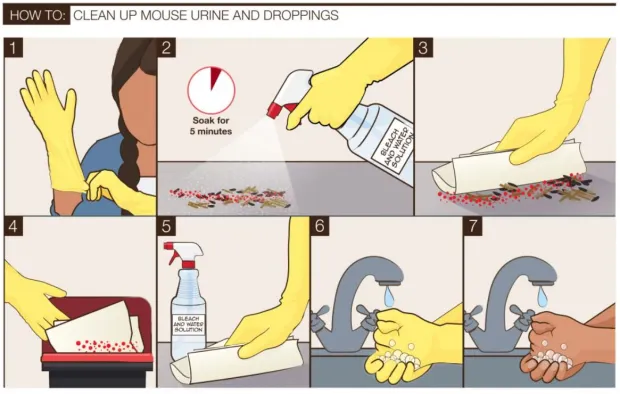
Instead, the CDC advises us to don rubber or plastic gloves and a protective N95-type face mask; soak the droppings with a bleach solution or an EPA-registered disinfectant until very wet; and wait five minutes.
Then, wipe the mess up with paper towels; dispose of the paper towels in a covered garbage can that’s regularly emptied; mop or sponge the area with a disinfectant; clean all hard surfaces (including floors, countertops, cabinets and drawers); wash your gloved hands with soap and water or a disinfectant; then remove the gloves and wash your hands yet again.
And, for good measure, I’d use some alcohol-based hand sanitizer left over from the pandemic.
Read more Longtime Ducks fans enjoying rewards for being patient