
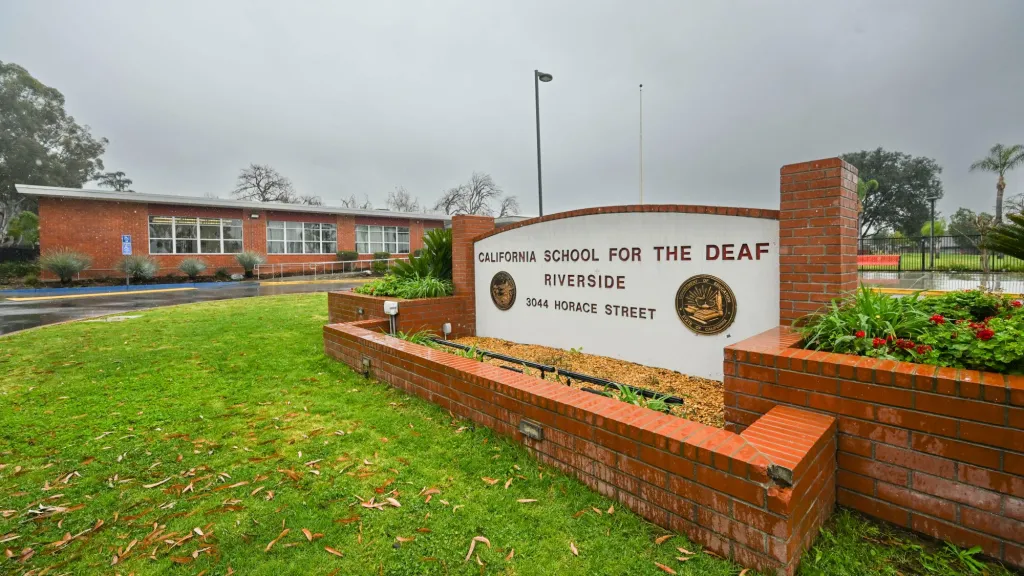
Attorneys for the state of California have been accused of violating two court orders by withholding thousands of pages of evidence in a sexual abuse lawsuit involving a former student at California School for the Deaf-Riverside.
Read more Art, wine and Ferraris: Inside the luxury garage condos for South Florida’s richest collectors
Weeks after a judge declared a mistrial in the case over their evidence-handling failures, attorneys for the school and state Department of Education, which operates the school, have produced only about 7,746 pages of roughly 17,520 records that were allegedly withheld from the plaintiff’s attorneys, according to a motion filed May 4 in Riverside Superior Court.
Attorneys Deborah Chang and Candice Klein are representing a former female student in the lawsuit alleging the school failed to protect her from repeated sexual assaults by five male classmates in 2022 and 2023, when she was 16 and 17 years old.
The filing also alleges the state continues to withhold about 9,300 text messages between the plaintiff and another student central to the allegations in the case, despite allegedly providing those same messages to defense experts preparing for retrial.
The motion asks the court, at a hearing scheduled for July, to order the defendants to produce all requested documents, text messages and other records and to remove “nonsensical and overbroad redactions” from previously produced records, then reproduce them to plaintiff’s attorneys in either unredacted or properly redacted form.
The lawsuit alleges administrators ignored warnings, failed to follow mandatory reporting requirements and failed to adequately address longstanding problems involving inappropriate sexual conduct on campus.
Judge Eric A. Keen ordered the mistrial on March 24 at the request of Chang and Klein, who accused the defense of failing to produce the documents in timely fashion, saying they did not learn about them until weeks into the trial. In their mistrial motion, they argued the delays prevented them from conducting key depositions, completing expert analysis and adequately preparing for trial, “severely prejudicing the plaintiff’s case and undermining a fair trial.”
Although defense attorneys had amassed the compendium of evidence months earlier, the defendants’ counsel disclosed only a small, selective portion to the plaintiff’s attorneys on March 18, while the trial was already weeks in progress, the motion for mistrial states. It accused the defense of “cherry-picking” documents for their own use.
Keen ordered the defendants to produce all requested documents within 30 days and directed the parties to meet and confer by March 27. When plaintiffs said the defendants were not complying, Chang and Klein asked the court to intervene, and on April 7 Keen issued a second order requiring production by April 24.
By that deadline, the defendants had not fully produced the requested records and told the plaintiffs the materials were en route, according to the May 4 motion by Chang and Klein.
In their motion, Chang and Klein said they are still awaiting internal communications from the school that they contend are directly related to their claims. “These internal CSDR communications go directly to supervision, notice, Defendants’ knowledge, and their response to the events at issue, the very facts that will be decided at trial,” the motion states.
Read more Big data, big goals: Information gathered in calls to 211OC track hardship in Orange County
A spokesman for the Department of Education said the state could not comment on pending litigation.
Founded in 1953, CSDR serves about 400 deaf and hard-of-hearing boys and girls in kindergarten through 12th grade from Bakersfield to the Mexican border. It is one of two such schools in the state, with its other campus in Fremont. Some of the students live in cottages on campus.
During the short-lived trial, Chang alleged the plaintiff was “passed around for sex” for two years by five male students, most of them members of the school’s renowned football team, fueling rumors that led to years of persistent bullying. Chang said some of the boys told the girl they wanted to rape her because it was “national rape day.”
According to Chang, the plaintiff — now living at a residential care facility because of major depression and suicidal thoughts — was sexually assaulted at least 21 times in 2022 and 2023, mostly in restrooms at the school gymnasium and Career and Technical Education building.
Chang and Klein said the former student suffered from multiple neurological and developmental disorders, including congenital encephalopathy, autism spectrum disorder and oppositional defiant disorder, which they said impaired her emotional regulation, judgment and understanding of consequences, and required constant on-campus supervision.
But the state disputes that portrayal, arguing the plaintiff was not a vulnerable victim but an intelligent, socially assertive student who understood her actions. During trial, Deputy Attorney General David Klehm said many of the sexual encounters were consensual and involved boys she was dating. He also alleged she was the aggressor in one relationship involving a boy three years younger and described her during that period as a “normal teenage girl.”
Klehm said the school first learned of the alleged assaults in September 2022, when the girl’s father reported them. The school investigated and contacted the California Highway Patrol, which handles criminal matters on state school campuses. Three boys admitted having sexual relations with the girl, one denied it, and it was unclear whether a fifth admitted or denied it.
None faced criminal charges, though some were required to undergo counseling and one was barred from football practice.
The retrial is scheduled for July 31 before Judge Keen at the Riverside Historic Courthouse.
Read more Health advice is all over social media. Here’s how to vet claims