
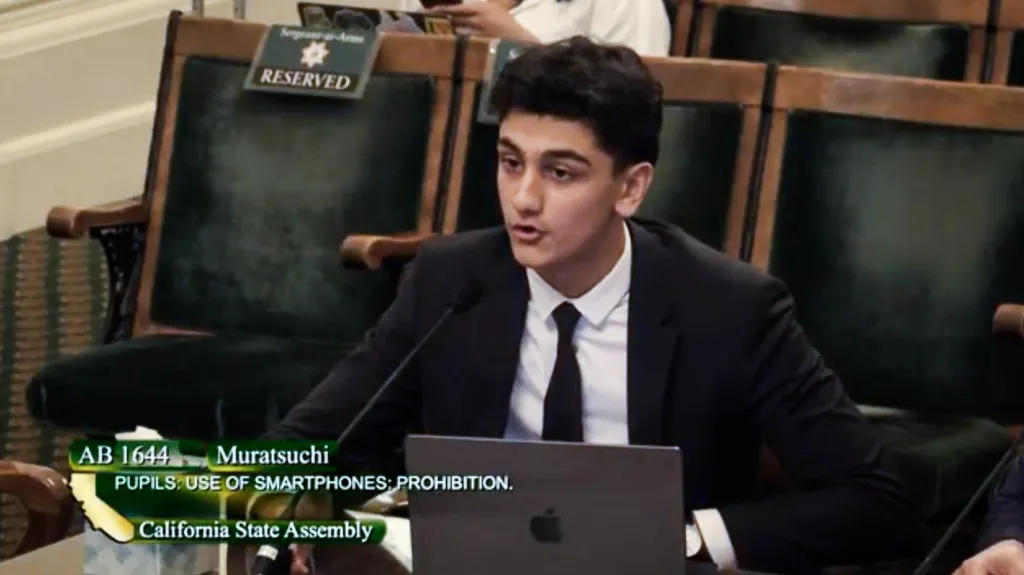
Sage Hill freshman Rishaan Marwaha watches his peers scrolling, constantly, on their smartphones. The 15-year-old admits that he, too, was once a little addicted to his own phone before setting up a screen time block to limit his Instagram usage.
Read more Trump moves to dismiss $10B suit over leak of tax returns after reports of a resolution
And that’s how he found himself in Sacramento recently, wearing a suit and tie and sitting in a wooden chair at a small desk, facing nearly a dozen legislators and staff, asking them to support a bill that would prohibit students’ use of cellphones for the entire school day for kindergarten through eighth grade.
“Right now, learning is not just being interrupted; it’s being completely eroded,” Marwaha, a Newport Beach resident, testified before the Assembly Education Committee.
“Half of the room is trying to learn, while the other half is trapped, chasing notifications, videos and fake dopamine hits,” Marwaha said. “Even the students who want to focus cannot.”
From Assemblymembers Al Muratsuchi, D–Torrance, Josh Hoover, R-Folsom, Josh Lowenthal, D-Long Beach, and Buffy Wicks, D-Oakland, Assembly Bill 1644 survived a key legislative hurdle last week, passing out of what’s called the “suspense file,” a process of quickly advancing or killing bills with large fiscal impacts.
Originally, the bipartisan bill was set to require “bell-to-bell” smartphone policies through 12th grade, but it has been amended down to only eighth grade. The bill also requires schools to ensure that classroom instruction for kindergarten through eighth grade does not require students to use a smartphone.
“I think it’s a great idea to ban schools in school because the addiction doesn’t automatically stop in the classroom,” Marwaha said in a recent interview.
Kids, he said, ask to go to the bathroom or contact their parents — excuses to check their phones throughout the day.
He is, though, disappointed that the bill has been scaled back.
Still, it was “gratifying,” Marwaha said, to shake hands with Assembly members in Sacramento, letting them know the cause he’s fighting for is personal.
Gov. Gavin Newsom, just two years ago, urged school districts to restrict the use of smartphones in schools. He later signed a law instructing school districts, charter schools and county education offices to adopt policies to limit or outright prohibit the use of smartphones by July 1.
There’s more, though, that needs to be done, Marwaha said.
He was pushing for another bill — although it’s already died this year, he said — that would require the state Department of Education to study the effects of nonconsensual artificial intelligence-generated images (known as deepfakes) on school-aged kids. He wants to see, perhaps, a hotline established eventually for students who are victims of bullying through deepfakes.
Read more Why you should be worried about job security
This was Marwaha’s first time testifying before a legislative committee in Sacramento, but he’s been involved in other advocacy work, including sitting on the statewide board for the California Association of Student Councils under the Department of Education.
Marwaha is interested in politics and political science, he said, but he’d like to go into the economics field one day to “make the world better for other people, make moral decisions for helping others in the economic world.”
In other news:
• Another bill that survived last week’s suspense file culling is an administrative one meant to help those adopted from other countries. From Sen. Steven Choi, R-Irvine, the bill provides a process for people who were adopted as children from a foreign country to petition, as adults, for their readoption, the legal process of finalizing an adoption back in California.
parents or adoption agencies to submit readoption paperwork by the time they are 16 years old. However, that 2019 bill doesn’t address those who were adopted long before, a fact sheet for Choi’s bill said.
“Each time an adoptive parent in California fails to finalize their child’s intercountry adoption, the adoptee is never issued a delayed registration of birth from the State Registrar to prove they are a legal U.S. resident,” Choi said in an analysis of the bill.
“After decades of adoptive parents failing to finalize foreign adoptions, tens of thousands of former adoptees are adults living in the United States without necessary identification or documentation, vulnerable to possible deportations,” he said.
The bipartisan bill from Choi, which counts fellow Orange County Sens. Kelly Seyarto and Tom Umberg as co-authors, would allow anyone of any age to file a readoption petition on their own behalf if their parent or adoption agency failed to do so.
• An effort to establish a new crime that penalizes an adult who coerces a minor to exploit, groom, harass or harm another minor also cleared the appropriations hurdle last week. Someone found guilty of this could be punished as a misdemeanor or felony, according to the bill text.
From Sen. Tony Strickland, R-Huntington Beach, the bill is backed by the Orange County Department of Education and the Orange County Sheriff’s Department.
It’s opposed by the ACLU California Action and other civil liberties and criminal justice reform groups.
Read more Wall Street edges lower, oil prices volatile after Trump warns the Iran ‘clock is ticking’